
Mallikarjun Kharge: RSS BJP Poisonous Snake kill them

Poonam Sharma
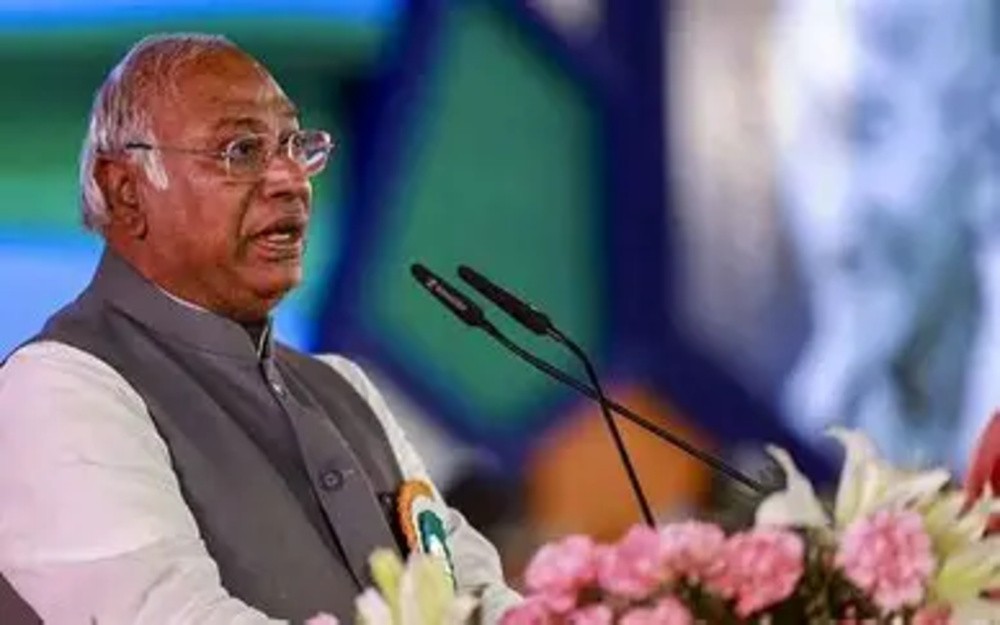
Congress president Mallikarjun Kharge has made a controversial call to action during an election meeting in Sribhumi, urging his Muslim supporters to attack the BJP and RSS. In his speech, he likened the BJP and RSS to “poisonous snakes,” advising the crowd to “kill the poisonous snake in front of you even if you pray incomplete,” stating that such a directive is rooted in Islamic teachings. This inflammatory rhetoric has drawn parallels to historical events, particularly referencing the 1946 calls by Muhammad Jinnah and Hussain Chorabardi for violence against Hindus, which resulted in widespread communal violence and atrocities. The severe implications of Kharge’s statements raise concerns about the potential for inciting violence and communal tensions in the lead-up to the elections. The Election Commission’s response to these remarks is eagerly anticipated, as they navigate the fine line between political speech and incitement to violence within a highly charged electoral atmosphere. Kharge’s declarations have ignited significant controversy and discussions regarding the responsibilities of political leaders in upholding communal harmony during sensitive electoral periods.Controversy Surrounds Mallikarjun
Kharge’s Alleged Remarks: Communal Rhetoric and the Responsibility of Political Leaders
In the high-stakes environment of Indian electoral politics, words matter. The recent uproar over Congress president Mallikarjun Kharge’s alleged remarks at an election meeting in Sribhumi has reignited debates around the use of communal rhetoric for political gain and the pressing need for responsible leadership.
The Incident
Mallikarjun Kharge, while addressing a gathering that included a significant number of Muslim supporters, referred to the Bharatiya Janata Party (BJP) and the Rashtriya Swayamsevak Sangh (RSS) as “poisonous snakes.” It is further alleged that Kharge went on to exhort his listeners to “kill the poisonous snake in front of you even if you pray incomplete,” and claimed such an action is sanctioned by the Quran. The purported quote, “Let BJP go – RSS Markogoi,” has been interpreted as a direct call to attack members of these organizations.
Such language, if accurately reported, raises grave concerns. Not only does it invoke violent imagery, but it also risks inflaming communal passions at a time when political tensions are already running high.
It draws historical parallels to the violence of 1946, when, leaders like Muhammad Ali Jinnah and Hussain Shaheed Suhrawardy allegedly incited violence against Hindus in pre-Partition Bengal. The aftermath was tragic, with reports of widespread attacks, killings, and atrocities, especially during the infamous Direct Action Day, which left a deep scar on the subcontinent’s history.
The invocation of such comparisons is not merely political rhetoric. India’s history is marred by recurring episodes of communal violence, often triggered or aggravated by inflammatory speeches from political or religious leaders. The memory of these events lingers in the national consciousness, making any suggestion of violence along communal lines particularly sensitive.
Implications for Democracy and Social Harmony
The role of political leaders in upholding the values of democracy and social harmony cannot be overstated. This congress is the same party responsible for the Partition of Bharat .When influential leaders resort to language that demonizes communities or incites violence, it not only violates the spirit of the Constitution but also threatens the fragile fabric of Indian society.
The consequences of communal rhetoric are not limited to election cycles. They can have a far-reaching impact, leading to polarization, mistrust, and sometimes, actual violence. In a country as diverse as India, such divisions can be catastrophic, both socially and economically. The Election Commission of India (ECI), as the apex body overseeing the conduct of free and fair elections, must take such matters seriously to ensure that political competition does not devolve into communal confrontation.
The Election Commission’s Role
The ECI has, in the past, taken action against candidates and parties accused of using hate speech or violating the Model Code of Conduct. The Commission’s guidelines explicitly prohibit the use of language that may aggravate differences or create mutual hatred or cause tension between different castes and communities. In this context, the response of the ECI to Kharge’s alleged remarks is being closely watched.
Swift and decisive action by the ECI would send a clear message that incitement to violence and communal polarization have no place in the democratic process. It would also reaffirm the Commission’s commitment to maintaining the integrity of elections and the safety of all citizens.
The Larger Political Context
It is worth noting that the use of provocative language must never be accepted and must have a serious system to deal with. Indian politics has, unfortunately, seen Congress leaders across the spectrum resorting to divisive rhetoric for short-term electoral gains. The responsibility, therefore, lies with this political party to hold their members accountable and to foster a political culture rooted in mutual respect, debate, and democratic values.
At the end
The controversy surrounding Mallikarjun Kharge’s alleged remarks is a stark reminder of the perils of communal rhetoric in Indian politics. As the world’s largest democracy, India’s strength lies in its diversity and commitment to peaceful coexistence. Political leaders, regardless of their party or ideology, must recognize the immense power—and responsibility—that their words carry.
At this critical juncture, it is imperative for institutions like the Election Commission to act decisively, for political parties to uphold democratic norms, and for citizens to reject divisive narratives. Only then can India continue on its path of unity, progress, and justice for all.
