
Yoga a Bridge Between India and Germany, says Sukadev Bretz at Bundestag
Yoga Vidya founder highlights India’s centuries-old spiritual influence on German thought, health culture and understanding of consciousness

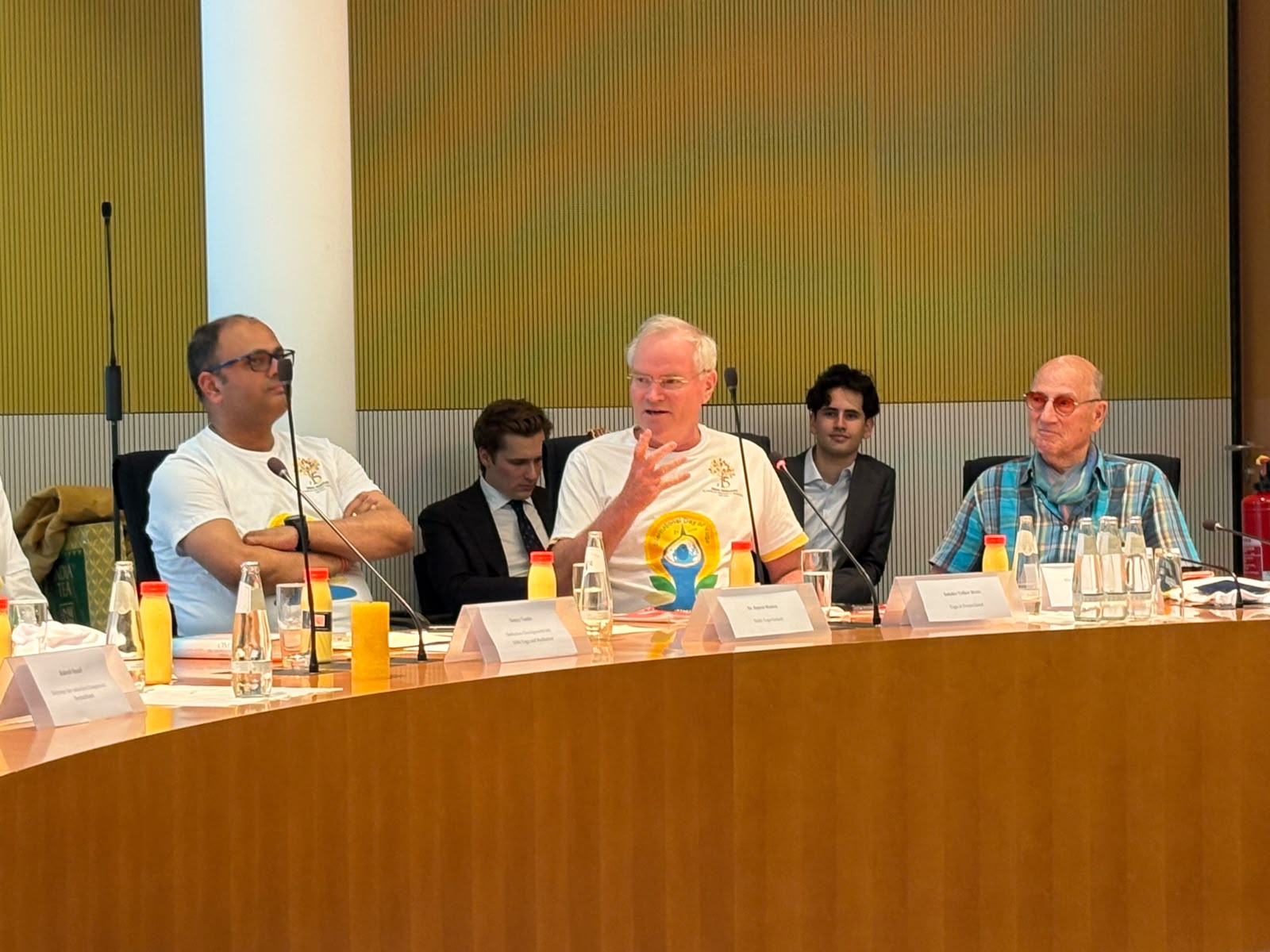
GG News Bureau
Berlin, 8th July: Marking the International Day of Yoga at the German Bundestag, Sukadev Bretz, founder of Yoga Vidya e.V., highlighted the profound influence of Yoga and Indian philosophical thought on Germany and Europe, arguing that their impact extends far beyond modern fitness and wellness culture.
Addressing diplomats, members of the German Bundestag, representatives of the Indian Embassy and the Indian community, Bretz described Yoga as a centuries-old bridge between India and Germany that has influenced German philosophy, psychology, health practices and ideas of spirituality and self-mastery.
He said Yoga’s significance lies not merely in physical practice but in its ability to cultivate consciousness, inner freedom, self-discipline and peace. Tracing the influence of Indian thought from German Romanticism and the study of the Upanishads and Bhagavad Gita to modern psychology, naturopathy and contemporary Yoga culture, Bretz stressed that Yoga remains deeply rooted in India’s Hindu spiritual tradition while carrying a universal message for humanity.
At a time of growing global unrest and social anxiety, he also underlined Yoga’s relevance to public life, arguing that peace, dialogue and responsible leadership must begin with mastery of one’s own mind.
Following is the full text of Sukadev Bretz’s speech: Your Excellency, Ambassador Ajit Gupte,
Honourable Members of the German Bundestag,
representatives of the Embassy of India, of the Indian community,
ladies and gentlemen,
Namaste.
We are gathered here today on the occasion of the International Day of Yoga – a day established by the United Nations on the initiative of India, to make visible the significance of Yoga for health, harmony and peace.
The fact that we are marking this occasion here in the German Bundestag is more than symbolic. For this is the place where the outer order of our country is shaped. Yoga, however, begins with the inner order of the human being.
And my thesis today is this:
Yoga did not arrive in Germany only when yoga mats appeared in fitness studios. Yoga did not arrive only when health insurance providers began subsidising prevention courses. Nor is Yoga simply a friendly import from India for stressed people in the West.
Yoga and Indian thought have shaped Europe – and Germany in particular – much earlier and much more deeply than we usually realise.
Sometimes directly: through encounters, translations, teachers, books and practice.
Sometimes indirectly: through philosophy, Romanticism, psychology, naturopathy, life reform movements and modern health culture.
And sometimes so deeply that today we no longer recognise where some of our assumptions come from.
That the human being can train the mind.
That body, breath and consciousness belong together.
That inner freedom is more important than outer circumstances.
That religion is not only belief, but can become experience.
That peace is not first of all a political treaty, but a capacity of consciousness.
All these are ideas that have been alive in India for thousands of years. And they have changed Europe.
Yoga comes from Hindu Dharma. Yoga has its roots in the great spiritual culture of India. But deep roots do not make a tree narrow. They make it strong enough to give shade to many people.
I would like to show four lines through which Yoga has helped shape Germany.
First: Yoga has shaped our thinking about self-mastery.
Already in antiquity, Greeks encountered Indian sages, ascetics and yogis. They called them Gymnosophists – naked wise men. At the time of Alexander the Great, there were encounters between Greek thinkers and Indian spiritual practitioners.
The Stoics spoke of inner freedom, equanimity, self-mastery and ethical action. In the Bhagavad Gita it says: “samatvam yoga ucyate” – Yoga means equanimity. And: “yogah karmasu kausalam” – Yoga is skillful action in service of the good.
This is not ancient wisdom for museums. It is a question for our time.
We live in a culture of constant agitation. Outrage is fast. Fear is fast. Anger is fast. Social media rewards reaction, not wisdom. Politics, media and society are often shaped by the logic of the immediate impulse.
Yoga says: The first place where civilisation begins is one’s own mind.
Those who cannot lead themselves cannot lead others well.
Those who cannot observe their emotions are ruled by them.
Those who have no inner distance confuse loudness with truth.
Yoga is the training of the human being, so that he or she can act more clearly in the world.
Second: Yoga has shaped the German search for inwardness.
Around 1800 something decisive happened in Germany. The Enlightenment had achieved great things. It had strengthened reason, criticism and freedom. But many felt: The human being is more than reason. A world that only calculates becomes cold. A religion that only administers becomes empty.
The Romantics searched for depth. They searched for mysticism. They searched for the infinite within.
And in this search, they looked toward India.
Friedrich Schlegel, Schelling, Novalis, and later Goethe in his openness to world literature – they all lived in an atmosphere in which India was not a marginal topic, but a source of spiritual awakening. The Upanishads, the Bhagavad Gita, Sanskrit, Indian myths and Indian thought entered deeply into German intellectual history.
Of course, this enthusiasm for India was sometimes idealising. But it was influential. It expanded the German understanding of the human being.
The human being is not only a citizen.
Not only a worker.
Not only a consumer.
Not only a voter.
Not only a psychological problem.
The human being is consciousness. Depth. Longing. Soul. A being that asks for the Infinite.
From there, a line leads into modern psychology. C. G. Jung engaged deeply with Yoga, meditation, symbols and inner transformation. Later, thinkers such as Erich Fromm and Abraham Maslow asked: What is the highest potential of the human being? Is it only about functioning normally – or is it about self-realisation, meaning and transcendence?
Today, this question has arrived in everyday life. Many people do not come to Yoga because they are looking for a hobby. They come because they have lost contact with themselves. Because they function, but do not truly live. Because they are constantly reachable, but inwardly no longer connected to themselves.
Yoga says: Return. Feel. Breathe. Listen within. You are more than your stress. More than your role. More than your history. More than your thoughts.
This is not soft. It is revolutionary.
Third: Yoga has shaped our health culture.
In India, health was never merely the repair of the body. Yoga and Ayurveda see the human being holistically: body, breath, mind, nutrition, rhythm of life, ethics and spirituality. Health does not only mean that no disease can be measured. Health means harmony.
This view has deeply influenced Germany – especially through the life reform movement of the nineteenth and early twentieth centuries: naturopathy, reform nutrition, vegetarianism, spa culture, light, air, movement, Wandervogel, body culture. Not all of this was Yoga. But much of it was fertilised by Indian, yogic and holistic ideas.
Hatha Yoga was already being practised in Germany more than a hundred years ago. Between the two World Wars, there was a growing lively Yoga movement with books, magazines, articles, courses and many practitioners. After the Second World War, new waves followed: Indian masters, adult education centres, books, associations, television programmes, and later yoga centres, studios, health insurance courses, business yoga, children’s yoga, yoga for seniors, yoga in clinics, schools, universities and rehabilitation centres.
Today, around ten million people in Germany practise Yoga. Many more have tried it. Yoga has arrived in the heart of society.
But the truly decisive point is not the number of yoga mats.
The decisive point is this: Yoga has changed how people think about their bodies.
In the past, movement often meant performance, endurance, gritting one’s teeth. Yoga brought another sentence into our culture:
Feel into your body.
This sentence sounds simple. But it changes everything. It means: The body is not my enemy. Not merely my tool. Not my machine. It is a place of intelligence. A place of perception. A place where consciousness awakens.
Fourth: Yoga has shaped our understanding of religion.
In Hindu Dharma, religion is not only confession, not only belief.
In Hindu Dharma, there is the powerful conviction: The Divine can be experienced.
God is not only an idea.
The Self is not only a theory.
Peace, love, unity, divine presence – all this can become living experience.
Yoga leads from assertion to experience.
And this is precisely what has touched Germany. Some practise Yoga explicitly in a Hindu-spiritual way – in ashrams, temples, centres and communities. Movements of Indian masters and gurus have had a great impact, including Yoga Vidya in the tradition of Swami Sivananda and Swami Vishnudevananda.
Others practise Yoga in a secular way. Others again are Christians and practise Yoga in order to deepen silence, prayer and the experience of God. Yoga is also practised in Christian monasteries.
This shows: Yoga is rooted – and precisely for that reason, it connects.
One can practise Yoga religiously or secularly, physically or spiritually, therapeutically or philosophically. But whoever practises Yoga touches – consciously or unconsciously – a great current of Indian wisdom.
The greatness of Yoga lies in the fact that it does not make things narrow. Yoga does not demand that everyone become the same. Yoga invites us to become deeper.
That is why Yoga is so necessary today.
We live in a time of outer crises and inner unrest. Many people are constantly informed, but not calm. Constantly networked, but not truly connected. Constantly active, but not present within themselves.
Yoga asks an uncomfortable question:
How do we want to bring order to the world if our own mind is in disorder?
Before we demand peace, we must practise peace.
Before we demand dialogue, we must learn to listen.
Before we lead others, we must learn to lead ourselves.
When Yoga is practised and spoken about today in the German Bundestag, it is a powerful sign: The wisdom of India can contribute to health, education, dialogue, democracy and peace.
I thank India for this great gift to humanity. I thank the Indian teachers, masters and traditions that have preserved Yoga over thousands of years. And I thank all those who pass on Yoga in Germany with respect, seriousness and depth.
May Yoga in Germany not only remain popular, but remain deep.
Not only movement, but consciousness.
Not only relaxation, but transformation.
Not only method, but bridge.
Namaste. Thank you very much.
