
498 Sewer Cleaning Deaths Since 2019
Government tells Lok Sabha fatalities occurred during hazardous sewer and septic-tank cleaning; compensation unclear in 78 cases

GG News Bureau
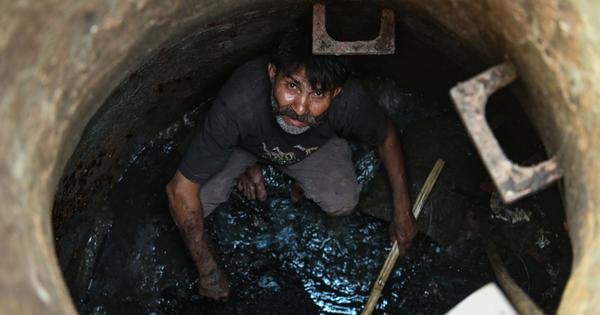
New Delhi, 5th Aug: Nearly 500 sanitation workers have died while cleaning sewers and septic tanks across India since 2019, but none of these fatalities has officially been classified as a death due to manual scavenging, according to government data placed before the Lok Sabha.
Minister of State for Social Justice and Empowerment Ramdas Athawale, responding in writing to a question from Congress MP Rahul Gandhi, said 498 workers died during sewer and septic-tank cleaning between January 1, 2019 and June 30, 2026.
The highest number of fatalities was recorded in 2019, when 132 workers died. This was followed by 34 deaths in 2020, 62 in 2021, 88 in 2022, 65 in 2023, 54 in 2024 and 47 in 2025. Another 16 deaths were recorded during the first six months of 2026.
Despite the cumulative toll, the government told Parliament that “no death has been reported due to manual scavenging.”
Why Are the Deaths Classified Differently?
The apparent discrepancy stems from the official distinction between manual scavenging and hazardous cleaning of sewers and septic tanks.
Under the definition cited by the government, manual scavenging refers to manually handling human excreta from insanitary toilets, open drains, pits, railway tracks or other notified locations before it fully decomposes.
Hazardous cleaning, meanwhile, refers to manually cleaning sewers or septic tanks without prescribed protective equipment, cleaning devices and safety precautions.
The 498 fatalities were therefore recorded as deaths during hazardous sewer and septic-tank cleaning rather than deaths caused by manual scavenging.
The government also said a nationwide survey conducted across all districts during 2024-25 did not identify any manual scavengers, following which all districts declared themselves free of the practice.
The finding contrasts with surveys conducted in 2013 and 2018, which had identified 58,098 manual scavengers across 17 states. Uttar Pradesh accounted for 32,473 of them, followed by Maharashtra with 6,325, Uttarakhand with 4,988 and Assam with 3,921.
Compensation Partial or Unconfirmed in 78 Cases
The Lok Sabha reply also detailed compensation provided in the 498 fatality cases.
Following a Supreme Court judgment in October 2023, compensation for deaths during sewer cleaning was increased from Rs 10 lakh to Rs 30 lakh.
Government data showed full compensation of Rs 10 lakh in 345 cases and Rs 30 lakh in another 75 cases. Partial compensation was reported in 22 cases, while payment could not be confirmed in 56 cases.
This leaves 78 cases in which compensation was either only partially paid or its payment could not be confirmed from the available data.
Of the 47 deaths reported in 2025, compensation could not be confirmed in 20 cases. For the first six months of 2026, full compensation of Rs 30 lakh was confirmed in six of the 16 cases, while the status of the remaining 10 could not be confirmed.
The Centre further said 89,915 sewer and septic-tank workers have been profiled under the National Action for Mechanised Sanitation Ecosystem (NAMASTE) Scheme, which provides safety equipment, training, health insurance and financial assistance for mechanised sanitation machinery.
However, the government did not provide a deadline for complete mechanisation of sewer and septic-tank cleaning or a time-bound plan for fresh identification and rehabilitation of affected workers and their dependants.
