

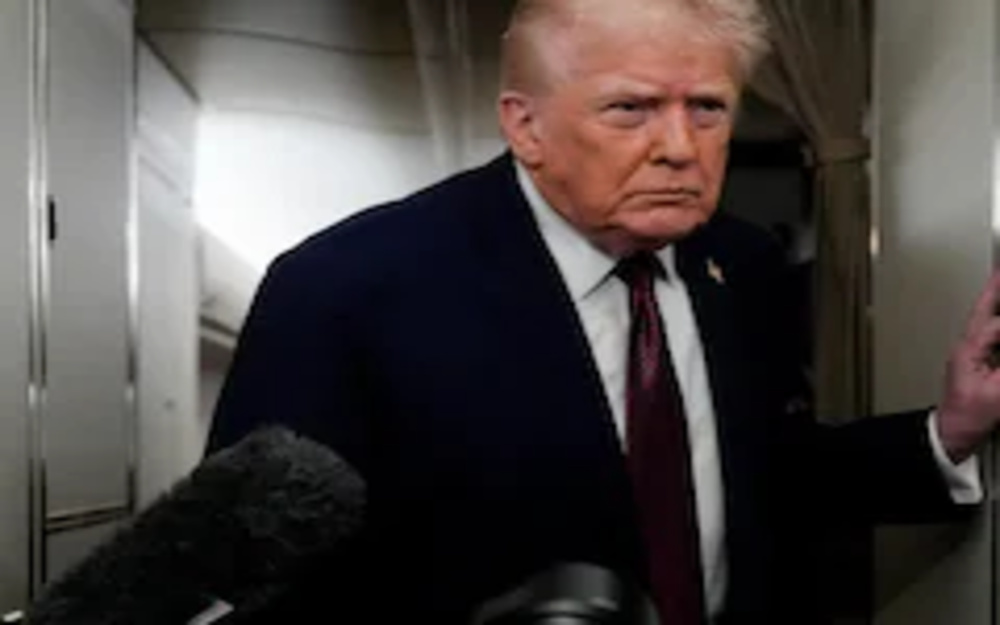
- Trump returned to Washington earlier than planned from Camp David.
- US officials reportedly considered military options in Yemen.
- Saudi Arabia said it intercepted a Houthi ballistic missile targeting Riyadh.
- Iran said Qatar had conveyed its conditions for ending the war to Washington.
By Anjali Sharma
WASHINGTON –US President Donald Trump on Sunday returned to the White House earlier than expected from Camp David as his administration reportedly considered possible strikes in Yemen after a Houthi ballistic missile attack targeted Riyadh, media reported.
US diplomatic missions have issued fresh security warnings across the Middle East while Tehran said Qatar has conveyed its conditions fto end the war to Washington.
The reported deliberations raise the prospect of another flashpoint in an already volatile West Asia.
US diplomatic missions in the region have issued security warnings amid concerns over possible retaliation and a wider military escalation.
CNN National Security Analyst Alex Plitsas said he had been told that Trump’s meeting at Camp David was convened to consider possible military action in Yemen.
“As I said last night, was told that the POTUS meeting at Camp David was to deliberate and review Yemen strike options. Today, U.S. embassies in Middle Eastern countries that are likely to be targets of retaliatory strikes issued warnings. Now POTUS head to the White House early,” Plitsas wrote on X.
Media reports stated that the developments in Washington followed a Houthi attempt to strike Riyadh with a ballistic missile.
Saudi Arabia said its forces intercepted the missile. The Houthis said they had targeted “sensitive sites”, without identifying the locations.
The attack has added Yemen to an increasingly complicated regional security picture involving Iran, the Houthis, Saudi Arabia and US interests.
Saudi Crown Prince Mohammed bin Salman has previously issued a stark warning over the Houthis.
“If it weren’t for our fear for the innocent people of Yemen, we would have conquered it in one week and eliminated the Houthis,” he said.
Media reported on US military preparations and discussions over strikes. Any potential operation remains subject to changes in scope and timing.
Trump’s return to Washington also coincided with heightened security messaging from American diplomatic missions in the region.
US citizens in the Middle East have been advised to monitor alerts issued by embassies and consulates as the security situation could change rapidly.
The concerns are acute in Saudi Arabia, where US guidance warned of the threat of Iranian drone and missile attacks as well as attacks by Iran-backed Houthi forces in Yemen.
The officials said that Washington considers its military options, diplomatic contacts with Tehran remain open.
Mohsen Rezaei, secretary of Iran’s Supreme National Security Council, said that Tehran had sent its conditions for ending the war to Washington through Qatar and was waiting for Trump’s response.
“We remain in contact with the mediator Qatar, which has conveyed our conditions to Washington with the aim of ending the war. We are awaiting President Trump’s response,” Rezaei said.
“Our conditions are an end to the war on all fronts, the release of our frozen funds, and an end to the naval blockade. It is in Washington’s interest to accept these conditions. Trump’s threats will not achieve any results. We are prepared for a decisive war,” he said.
Iran has said it is prepared for a prolonged confrontation if its demands are rejected.
The reports of fresh military activity have emerged from elsewhere in the region.
Media reported that a US bomber had left an air base in the UK for West Asia, while Iran’s Press TV reported air-defence activity near the Kharab al-Jir base in northeastern Syria.
The escalation came as world leaders prepare to gather in New York for the UNGA with the conflict in West Asia set to remain a major focus.
The diplomacy and the possibility of military action are unfolding in parallel.
Washington’s response to the attack targeted Riyadh could determine whether Yemen becomes a bigger front in the regional conflict.
