
India’s Quantum Ecosystem Gains Momentum
National Quantum Mission expands startup support, infrastructure and industry partnerships

- Quantum-secure communication reaches 1,000 km.
- Quantum startup support rises to 26 ventures.
- Four hubs connect 152 researchers across 43 institutions.
- PRAGATI Q-FOUNDRY showcases new quantum technologies.
GG News Bureau
New Delhi, 1st Oct: India’s quantum technology ecosystem is expanding through the National Quantum Mission, with increased support for startups, research infrastructure, industry partnerships and indigenous technology development, Union Minister of State (Independent Charge) for Science & Technology and Earth Sciences Dr Jitendra Singh said on Wednesday.
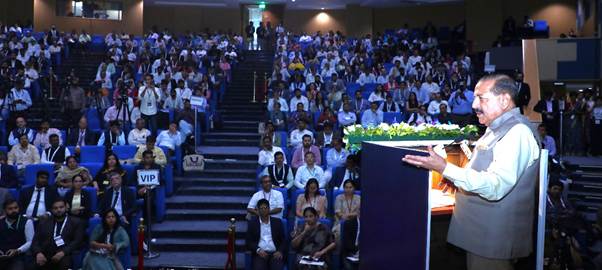
Addressing PRAGATI Q-FOUNDRY 2026 – NQM Co-development and Venture Partnership Meet at the Dr Ambedkar International Centre in New Delhi, Dr Jitendra Singh said the policy environment created by the government was enabling greater participation by industry and the private sector in frontier technologies.
He said the National Quantum Mission brings together government, scientific institutions, startups, industry, investors, States and strategic users to develop indigenous capabilities in quantum technology.
Highlighting the pace of progress, the minister said India has achieved 1,000-km quantum-secure communication in about three years, against the 2,000-km target set for the mission’s eight-year period.
The mission operates through four thematic hubs at IISc Bengaluru, IIT Madras, IIT Bombay and IIT Delhi, bringing together 152 researchers from 43 institutions across 17 States and two Union Territories. The hubs focus on quantum computing, quantum communication, quantum sensing and metrology, and quantum materials and devices.
Dr Jitendra Singh said India has the potential to become globally competitive in quantum communication and sensing while developing self-reliance in quantum computing.
He said government support for quantum startups extends beyond funding to infrastructure, mentorship, technology validation, industry partnerships and access to customers. He also called for greater participation by investors and industry in co-development, procurement and market access.
The National Quantum Mission has already supported 17 startups, while nine additional startups were announced at the event, taking the total number supported to 26.
The minister said PRAGATI Q-FOUNDRY was designed to facilitate technology validation, procurement, co-development, investment and partnerships rather than merely showcase technologies.
Among the technologies demonstrated was a hybrid PQC-QKD link developed by a technical group under the Quantum Communication Hub at IIT Madras. It was demonstrated across 17 secure nodes between Chennai and Bengaluru using existing BSNL fibre. A 50-picosecond daisy-chain timing synchronisation solution was also released as an open-source resource.
The event also featured the launch of quantum technologies and products, exchange of MoUs and strategic partnerships involving startups, industry, investors and research institutions.
NITI Aayog Member Prof Abhay Karandikar said the progress under the National Quantum Mission highlighted the importance of bringing government, academia, startups and industry together to build the quantum ecosystem.
Principal Scientific Adviser Prof Ajay Kumar Sood said around 52 technologies at various Technology Readiness Levels had emerged from the four thematic hubs, along with financially supported startups. He emphasised that deployment and procurement would be important for making startups sustainable and developing internationally competitive products.
Dr Jitendra Singh said the success of PRAGATI Q-FOUNDRY should ultimately be measured through technologies advanced, partnerships created, investments mobilised, startups strengthened and indigenous solutions deployed.
