
When Courage Matters: Lessons From Flydubai Incident on National Resilience

Poonam Sharma
Sometimes, a country’s strength is not in the size of its military arsenal but in the courage of ordinary people in the face of extraordinary peril.
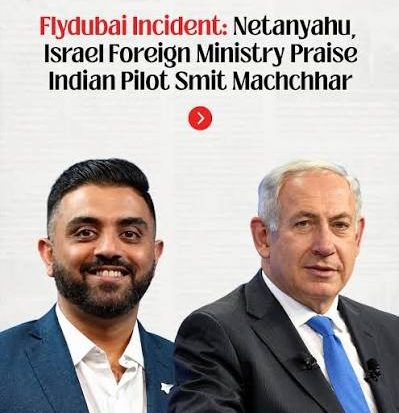
One such moment came from the dramatic incident aboard Flydubai flight FZ1073, flying from Dubai to Tel Aviv.The plane with 174 passengers on board had a violent struggle in the cockpit on 30 September 2026. Multiple sources and Israeli officials have reported the alleged attack by the Omani co-pilot with a knife on Captain Smit Machchhar, an Indian national, and the apparent attempt to take control of the aircraft. The plane pitched down in a steep dive until passengers and crew intervened.
What followed was nothing short of incredible.
Captain Machchhar was badly hurt but managed to open the cockpit door. Israeli passengers rushed forward and helped subdue the attacker. Two off-duty pilots who were on board as passengers helped steady the plane, which eventually made an emergency landing in Tabuk, Saudi Arabia. All passengers would be reported safe later.
But the incident raises a larger question: What does it mean for residents to feel a sense of responsibility for the security of their fellow residents?
Israel is frequently pointed to as an example of a society that incorporates military readiness into social life. But to assume that any Israeli over the age of 18 is automatically military-trained is to overgeneralize. Israel has compulsory military service for eligible citizens, but there are a lot of exemptions and different arrangements for different communities. The Israeli government says that regular service is for eligible men and women within specified age groups.
So the larger lesson isn’t just about mandatory military service. It is about preparedness, responsibility, discipline and the instinct to protect others when danger comes.
This brings India’s Agnipath scheme into the mix.
India in 2022 launched the Agnipath recruitment scheme under which Agniveers will be hired for four years and given military training, discipline, physical conditioning and other skills. The government says the program is a way of creating a younger, more technologically-minded armed forces, while giving trained young people experience that can be useful after their military service too. After that, up to 25% of each batch can be considered for regular enrollment, subject to applicable criteria and organizational requirements.
But on its introduction the scheme became the subject of intense public and political debate, including protests. But that debate should not blind us to a more basic question: Is it possible for a society to create an environment where citizens are calm, disciplined and courageous in the face of a crisis?
The Flydubai incident is a striking illustration.
One Indian captain, severely wounded, kept acting. Israeli passengers did not just sit back and wait for somebody else to solve the problem. They went into the danger. Other trained pilots on board helped bring the plane to safety. It was not one person’s achievement. It was a series of personal bravery. And this is exactly where comparisons between societies have to be made with caution.
It makes us think that whether a person’s nationality, religion or community is a guaranty that they will be courageous or violent. His motive is still being investigated.
This is why the Indian captain’s courage matters so much; it reveals something universal, that character is ultimately to be found in action.
Israel’s response was interesting too. Prime Minister Benjamin Netanyahu publicly lauded Captain Machchhar for what he termed extraordinary actions that helped save 174 lives. The Indian Embassy in Saudi Arabia confirmed that Machchhar was receiving medical treatment and was said to be stable. The passengers eventually arrived in Israel, where they were filmed celebrating their survival.
The most important lesson for India is not that one country is superior to another. The point is that national resilience cannot be built by government decree alone.
It needs citizens who are willing to take responsibility.
Discipline can be learned in military training. Emergency training can teach response. Civic education can teach accountability. But in the end courage has to become a social value. India has crores of young people. The question is can we turn youthful energy into discipline, competence and a willingness to stand between danger and another human being?
That is a far bigger conversation than Agniveer.
And maybe that is the real message from the skies over the Middle East – that when catastrophe strikes with no warning, it is people who refuse to give in to fear who ultimately protect nations, not weapons, uniforms or institutions.
