

By Anjali Sharma
WASHINGTON – Serbian President Aleksandar Vucic on Monday admitted his defeat in the elections.
Vucic said a sample of votes showed his list had lost.
“It is clear that we have lost these elections,” he said. He added that final results were not yet in.
He said the Student List was projected to win between 135 and 140 seats in the 250-seat parliament.
His own list was projected to get 105. A government needs 126 seats. The students are on course to clear that bar with room to spare.
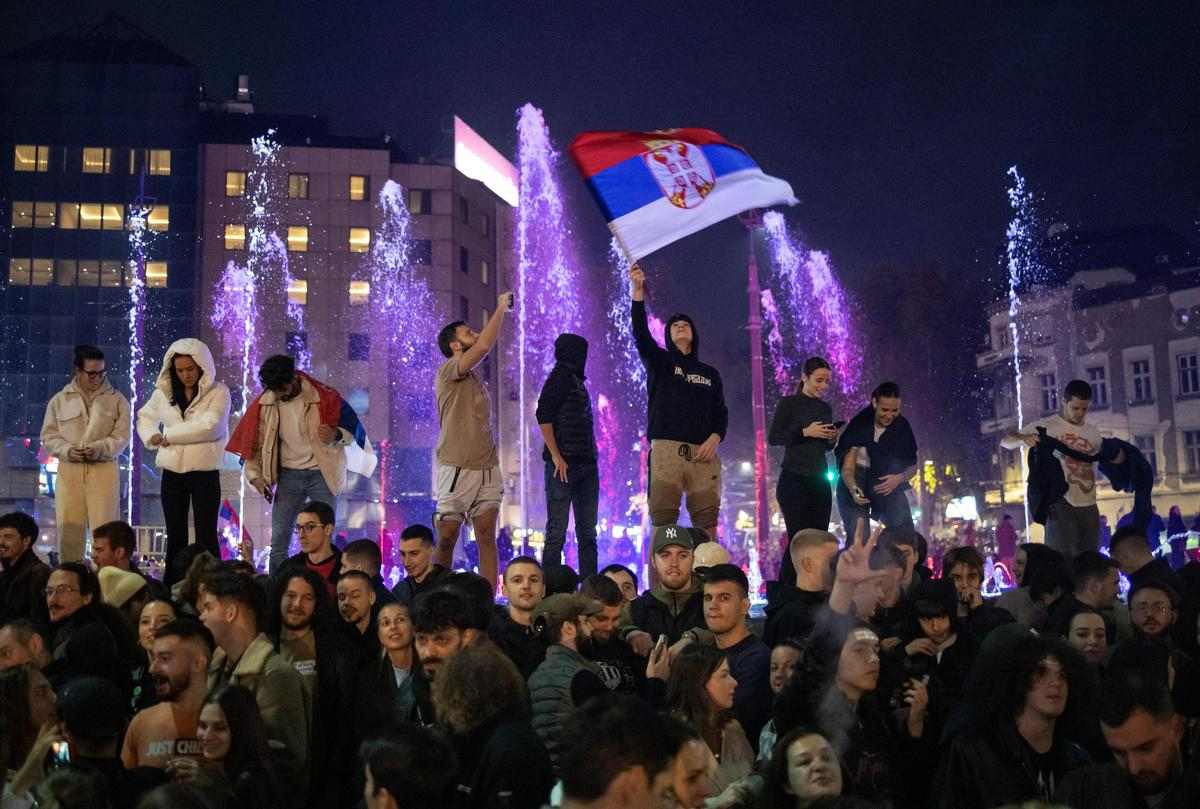
People cheered and cried. FoNet, a Belgrade news agency, described scenes of euphoria. Outside, the whole country seemed to join in.
The fireworks lit the sky within minutes of the concession.
Thousands of people poured onto Belgrade’s main roads. Supporters drove in convoys and held down their horns. Crowds sang the movement’s songs. Many chanted “Aleksandar is gone.”
In central Belgrade, people took down tents in a park.
Vucic loyalists had camped there for more than a year. The sight said a lot about how fast the mood had changed.
The celebrations also spread to other cities. In Novi Sad, people filled the streets as the student movement declared victory. The city matters. It is where this story began.
Belgrade resident Dragana Kovecevic spoke to media said everyone was greeting each other with smiles. Serbia, she said, was finally becoming a normal and free country.
Radomir Saicic, a Student List candidate, spoke to supporters that night. He said the students had won, and that hope had won with them. He called it the start of a new chapter.
The movement did not start in a party office. It started with a funeral.
On November 1, 2024, a concrete canopy collapsed at the railway station in Novi Sad. Sixteen people died.
The station had been renovated only recently. Many Serbians asked a simple question. How does a newly renovated building fall on people?
Students demanded answers. They wanted to know who signed off on the work. They wanted to know who profited. And, they wanted accountability.
It began as grief became a nationwide push against corruption and abuse of power. Vucic and his party deny the accusations. But the protests did not fade.
The protests ran for two years.
Demonstrations were almost daily at times. Some drew hundreds of thousands of people. By most accounts, they shook Vucic more than anything since his Serbian Progressive Party (SNS) took power in 2012.
Vucic has been prime minister and president since 2014.
He held dominant power for over a decade. Few leaders in Europe have been so hard to challenge.
The students stayed peaceful and stayed organised. They kept pressing for an early election.
They said it for more than a year. In the end, the pressure worked. As Belgrade columnist Dejan Ilic told Al Jazeera, the people forced the election.
The Student List is unlike most political groups. It formally entered the race on September 14. Supporters marched through central Belgrade to hand in their papers.
The list has 250 candidates. They include professors, teachers, doctors, experts and former athletes. Many have never held office or worked in politics. The movement is also leaderless by design. It has refused to become a conventional party.
The slogan was “Students Win.” The Pobednik statue in Belgrade, whose name means “The Victor,” became one of its symbols.
The movement ran on a clear message. It called for stronger institutions. It called for an end to corruption. Also, it promised a country where justice is not the privilege of a few. Student Milica Popovic put it that way to the crowd on the day the list was filed.
Some established opposition parties chose to back the students instead of running their own candidates. The Democratic Party, once led by former President Boris Tadic, was among them. That choice helped keep the anti-government vote together.
Serbians showed up in huge numbers. By 6pm, turnout had reached 64.9 percent, according to the State Election Commission. That is the highest since the breakup of Yugoslavia in 1992.
Over 6.5 million people could vote. They chose among 18 electoral lists. The fight was for 250 seats.
Researcher Jelena Vasiljevic of the University of Belgrade had explained the challenge before the vote. The SNS had a reliable voter base. The students needed to bring in people who normally stay home.
The turnout suggests they did exactly that.
The vote was not smooth. Independent monitors reported serious problems.
The watchdog CRTA said its observers saw pressure on voters or election workers at almost a third of the 500 polling stations it covered. It also reported failures to protect ballot secrecy.
CeSID, received about 260 reports of possible irregularities by 5pm. These included ballot photography, group voting and trouble with identification checks.
Serbian elections have a history of such problems.
Past votes have seen irregularities and violence. That makes the students’ result even more striking. They won in spite of the pressure, not because the field was fair.
In Belgrade, police in riot helmets with shields stood near the election commission building. Roads were closed and barricades were up. City prosecutors urged everyone to avoid violence. Voters stayed calm.
Vucic resigned as president. The constitution barred him from a third term. So he chose to run for prime minister instead.
The prime minister’s post is formally stronger than the presidency.
Critics saw the move as a plan to keep power. Vucic promised higher pensions, higher public-sector wages and more investment.
Ana Brnabic, a close ally, became acting president. An early presidential election must be held within 90 days. The first round is due by the end of this year.
Vucic also spent the campaign attacking the students.
He called their list a “nameless list” with no program. Pro-government tabloids pushed the same line. He warned that foreign powers planned to stir unrest on election night.
None of it worked. Voters did not buy it.
Supporters credit Vucic with modernising Serbia’s economy. That view is real and widely held among his base. But many Serbians decided that economic progress did not excuse corruption and fear.
There is one more point worth making. Hours before he resigned, Vucic told CNN something important. If the opposition won, he said, he would accept the result and congratulate them that same evening.
He kept to that. In a region where leaders have often refused to leave, that matters. A peaceful handover is a gain for every Serbian, whichever way they voted.
Still, caution is wise. Final results have not been published. The formal count could shift the numbers. Analysts also warned before the vote that a crisis could begin after it. A clear margin makes obstruction harder. The bigger the student win, the less room there is for games.
Reaction came fast. European Commission President Ursula von der Leyen congratulated the Student List on X. She said the EU stands ready to support reforms. She named the rule of law, media freedom, the fight against corruption and strong democratic institutions.
The message carries weight. Serbia’s bid to join the European Union has stalled under Vucic. Brussels has pointed to democratic backsliding. Serbia also refused to join sanctions on Russia over the war in Ukraine, and Vucic kept close ties with both Moscow and Beijing.
A new government could reset that path. The students campaigned on rebuilding institutions. Those are the very things the EU says Serbia must fix.
The hard part starts now. Winning an election is one task. Running a country is another.
The students must form a government. They must choose a prime minister. They must turn a protest movement into a working administration. Many of their candidates have never held office. They will face a state apparatus built over 14 years by their opponents.
There are also urgent questions to answer. Who is responsible for the Novi Sad collapse? How will the new government handle the media, the courts and the police? How will it keep a broad coalition of voters together?
These are real tests. But the movement has already shown it can plan, organise and endure. It outlasted nearly two years of pressure. It turned grief into a vote. And, it earned a record turnout.
Look at what happened. Sixteen people died under a concrete roof. Students asked why. A country listened.
They marched for nearly two years. And, they did not give up when the powerful called them hooligans. They filed a list of teachers, doctors and professors. Then they won.
For Serbia, this is more than a change of government. It is proof that peaceful, persistent pressure can still move a strong leader. For young people across the region, it is a powerful example.
Serbia has a chance to build what the students asked for. It is a country of justice, freedom and dignity. The road is long. But on Sunday night, in the streets of Belgrade and Novi Sad, it finally looked open.
