

Poonam Sharma
As the conflict involving Iran, the United States and Israel deepens, another strategic chokepoint has suddenly come into focus — the Bab al-Mandeb Strait. While the Strait of Hormuz has already been under severe disruption, Iran-backed groups are now threatening to target Bab al-Mandeb as well, raising fears of a much larger global trade crisis.
For India, this is not just a distant geopolitical issue. A closure of Bab al-Mandeb would directly affect fuel prices, shipping costs, exports and imports, and even the price of everyday goods.
Red Sea , Gulf of Aden and the Indian Ocean
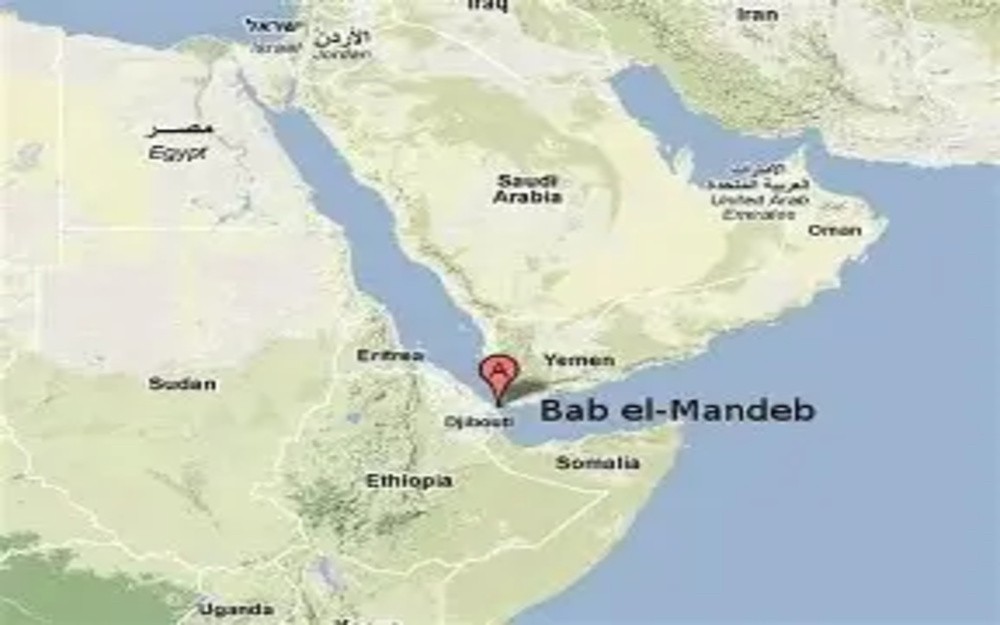
The Bab al-Mandeb Strait lies between Yemen and the Horn of Africa, connecting the Red Sea to the Gulf of Aden and the Indian Ocean. It is one of the most important maritime routes in the world because ships moving between Asia and Europe pass through this narrow stretch before reaching the Suez Canal.
Nearly 10 percent of global trade moves through Bab al-Mandeb. It is also a major route for crude oil and gas exports from the Gulf to Europe and other parts of the world. In 2024 alone, around 4.1 billion barrels of crude oil and petroleum products passed through this route, accounting for nearly 5 percent of the global total.
The danger becomes even bigger because the Strait of Hormuz is already under pressure. Hormuz normally handles around 20 percent of the world’s oil and gas shipments. If both Hormuz and Bab al-Mandeb are disrupted at the same time, nearly a quarter of the world’s oil and gas supply could be blocked.
For India disruption could push crude oil pricesHigher
For India, which imports more than 80 percent of its crude oil needs, this would be a major blow. A prolonged disruption could push crude oil prices far above current levels, making petrol, diesel, LPG cylinders and even electricity more expensive.
Higher oil prices would also mean inflation across sectors. Transportation costs would rise, affecting food prices, consumer goods and industrial production. Airlines would face higher fuel bills, which could translate into more expensive tickets. Shipping companies would be forced to reroute vessels around the Cape of Good Hope in southern Africa, adding thousands of kilometres to journeys and increasing freight costs.
This is particularly worrying for India because a large share of its exports to Europe — including textiles, engineering goods, pharmaceuticals and auto components — travel through the Red Sea route. If ships are forced to avoid Bab al-Mandeb, delivery times could increase by two to three weeks, making Indian exports costlier and less competitive.
China, South Korea, Japan and other Asian economies would also be badly affected, which could further hurt global supply chains. This may remind many of the disruptions seen during the COVID-19 pandemic, when shipping bottlenecks led to shortages and rising prices across the world.
Saudi Arabia’s backup may weaken
Saudi Arabia has tried to reduce its dependence on Hormuz by shifting more oil exports to the Red Sea port of Yanbu through its East-West pipeline. That pipeline has now reached its full capacity of 7 million barrels per day, with around 5 million barrels being exported through Yanbu. However, even this alternative route depends on Bab al-Mandeb remaining open. If that strait is also blocked, Saudi Arabia’s backup plan would be severely weakened.
The biggest concern is that the Iran-backed Houthis in Yemen have already shown they can disrupt shipping in the region. During the Gaza conflict, they repeatedly targeted ships linked to Israel and the United States, causing insurance premiums to soar and forcing many companies to avoid the Red Sea altogether.
Houthis factor
If the Houthis begin attacking commercial ships again, even a few missile strikes could be enough to stop most shipping traffic through Bab al-Mandeb. Shipping companies are unlikely to risk expensive cargo and crew lives in a conflict zone.
That is why this a “nightmare scenario” for the global economy. Europe would face severe supply shortages, energy prices would rise sharply, and countries dependent on imported oil — like India — would face serious economic stress.
For New Delhi, the coming weeks will be crucial. India may need to increase strategic oil reserves, diversify supply routes and work more closely with Gulf countries to ensure uninterrupted energy imports.
The Bab al-Mandeb Strait may be just a narrow stretch of water near Yemen, but what happens there could decide fuel prices, inflation and trade flows for much of the world — including India
