

Poonam Sharma
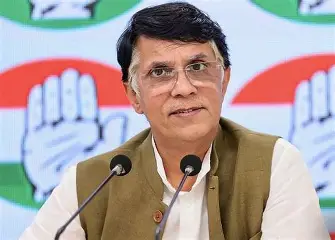
Pawan Khera has long been one of Congress’s most visible television faces. Once a political advisor to former Delhi Chief Minister Sheila Dikshit, he has built a reputation as an aggressive spokesperson willing to take on political opponents in debates and press conferences.For years, the Congress party has attempted to position itself as the principal challenger to the BJP by raising questions about corruption, governance, and the conduct of political opponents. But when allegations are made without hard evidence, the strategy can quickly turn into a liability. That appears to be exactly what has happened in the latest controversy involving Congress spokesperson Pawan Khera, Assam Chief Minister Himanta Biswa Sarma, and his wife Riniki Bhuyan Sharma
Yet this visibility also makes him vulnerable. When Congress launches an attack that later collapses under scrutiny, it is often Khera who is left answering difficult questions.
Citizenship of another country
In a TV debate in 2015, Gardiner Harris, a former New York Times correspondent in South Asia, once said : “The Congress Party is going to die if Congress continues to promote Rahul as the man who is going to lead it because he is going to lead it to its death. I have heard he is a good man, a dog lover but he is not a politician.”
BJP leader Subramanian Swamy has publicly alleged in the past that Rahul Gandhi has held British citizenship or had links to companies in the United Kingdom. One such company often mentioned is Backops Limited, a UK-based firm in which Rahul Gandhi was reportedly listed as a director and shareholder in the early 2000s.documents linked to Backops Limited described Rahul Gandhi as a British national. However, Rahul Gandhi has consistently maintained that he is an Indian citizen. Indian courts and government agencies have not produced any conclusive evidence proving that he holds citizenship of another country. Publicly available records continue to identify him as an Indian citizen.After the cross-checked documents related to Backops Limited it was found that Rahul Gandhi declared himself a British national. Another company with the same name, registered on May 3, 2019 (Company number 11977380), with an office at 166 Ashby Road, Loughborough, England, LE11 3AG. This company is also involved in “Management consultancy activities”, similar to its predecessor. Two individuals, Markose Sibi and Sony Sebastian, both Indian nationals, are involved in this company. A secret cable from March 3, 2005, reveals that US authorities view him as a ‘lackluster leader’, raising serious questions about his ability to guide the future of India. The untold secrets surrounding his personal and professional life The Politics of Allegation:
How Congress’s Latest Offensive May Have Backfired
For years, the Congress party has attempted to position itself as the principal challenger to the BJP by raising questions about corruption, governance, and the conduct of political opponents. But when allegations are made without hard evidence, the strategy can quickly turn into a liability. That appears to be exactly what has happened in the latest controversy involving Congress spokesperson Pawan Khera, Assam Chief Minister Himanta Biswa Sarma, and his wife Riniki Bhuyan Sharma.
At the center of the controversy are claims made by Congress regarding alleged foreign-linked assets, business interests, and passport-related issues involving the Chief Minister’s family. However, what was expected to become a major political attack has instead opened up difficult questions for Congress itself: Were the allegations properly verified? Were the documents authentic? And why was the matter taken to a press conference instead of a courtroom?
A Familiar Pattern of Political Accusation
Political accusations are not new in India. Every major party has, at one time or another, accused rivals of corruption, foreign links, hidden wealth, or misuse of office. But the public increasingly expects evidence, not just rhetoric.
In this case, critics argue that Congress relied heavily on printouts, screenshots, and loosely connected claims rather than presenting legally verifiable documents. Social media users quickly began pointing out inconsistencies in formatting, missing official seals, and other irregularities in the material shown by Pawan Khera. Some BJP supporters even alleged that parts of the material looked digitally edited or manipulated.
Whether those accusations are true or not, the larger issue remains the same: serious allegations require serious proof.
The Pawan Khera Problem
Observers noted that during the recent press conference, Khera appeared heavily dependent on printed notes and supporting material. Critics say he looked uncomfortable while presenting the allegations, especially as questions emerged about the authenticity of the documents.
If Congress leadership pushed him into the spotlight without first ensuring that the claims were legally and factually sound, then Khera may once again find himself carrying the political cost for decisions made elsewhere.
Congress and the Credibility Gap
The latest controversy also revives a long-standing problem for Congress: credibility.
For years, Congress leaders have targeted Rahul Gandhi’s opponents with dramatic accusations. At the same time, Rahul Gandhi himself has faced repeated allegations regarding his citizenship status, his links to UK-based company Backops Limited, and claims that old company records described him as a British national.
Rahul Gandhi has consistently denied holding foreign citizenship and maintains that he is an Indian citizen. No Indian court or government agency has conclusively proven otherwise. Public records continue to identify him as an Indian citizen.
However, the fact that these questions continue to resurface weakens Congress’s ability to attack others on issues of nationality, documentation, or foreign connections. When a party has unresolved controversies surrounding its own senior leadership, its attacks on opponents often appear politically selective rather than principled.
Why Not Go to Court?
Perhaps the most important question in this entire episode is simple: if Congress truly has evidence of wrongdoing, why not take the matter to court?
Congress has some of the country’s most experienced lawyers and legal strategists. If there is genuine evidence involving undisclosed foreign assets, forged passports, shell companies, or financial misconduct, then the party could file a petition, request an investigation, or submit evidence before a judge.
Instead, Congress chose to hold a press conference.
That decision has led critics to conclude that the exercise may have been more about generating headlines than proving wrongdoing. A press conference can create noise, but it cannot replace evidence.
Himanta Strikes Back
Chief Minister Himanta Biswa Sarma responded aggressively, saying that “doodh ka doodh, paani ka paani” would become clear soon. He suggested that if false documents were used or misleading allegations spread, there could be legal consequences.
That response immediately shifted pressure back onto Congress. Instead of forcing the Assam government onto the defensive, the controversy has now raised uncomfortable questions about who prepared the documents, who verified them, and whether Congress did enough homework before going public.
In politics, a failed attack can often hurt the attacker more than the target. Congress may have hoped to create a damaging scandal around Himanta Biswa Sarma and his family. Instead, it now risks being accused of exaggeration, poor preparation, and political theatrics.
For now, Pawan Khera stands at the center of the storm, while the larger Congress leadership remains notably silent.
