
PM Modi Calls for Stronger BRICS Business Partnerships, Positions India as Growth Anchor

By Anjali Sharma
WASHINGTON – Prime Minister Narendra Modi on Friday called for stronger business partnerships among BRICS countries, stated deeper commercial engagement could unlock new avenues for growth, innovation and shared prosperity as the global economy confronts rising uncertainties, trade barriers and disruptions to supply chains.
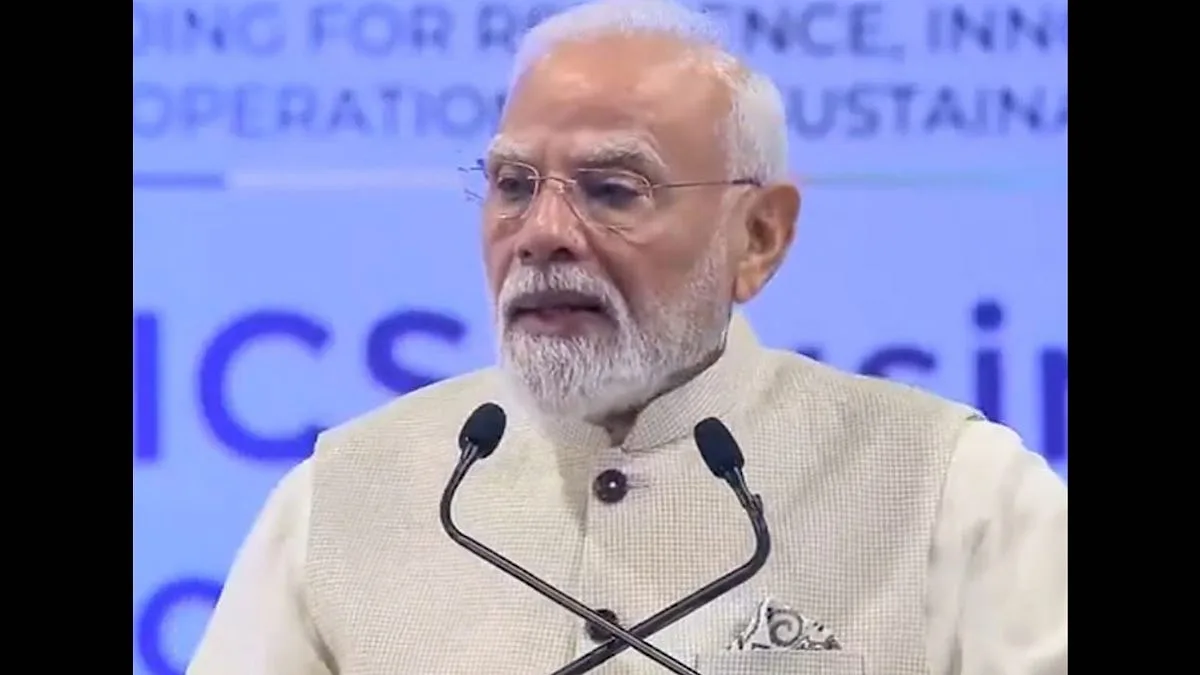
Modi addressed thhe BRICS Business Forum in New Delhi ahead of the 18th BRICS Leaders’ Summit said the expanded grouping was increasingly emerging as an important platform for innovation and practical solutions to global challenges.
He urged businesses across BRICS economies to translate the bloc’s growing economic weight into concrete partnerships and outcomes.
“Strong business partnerships can open new avenues for growth, innovation and shared prosperity,” Modi said, stressing the need to move beyond the traditional framework of government-to-government engagement and build deeper links among businesses, entrepreneurs, investors and innovators.
He said BRICS nations were “emerging as important centres of global innovation and solutions,” giving the grouping an increasingly significant role in shaping the global economic landscape.
PM Modi positioned India as a source of confidence at a time when geopolitical tensions, economic fragmentation, protectionist measures and uncertainty over global trade are weighing on businesses and investment decisions.
“Amid global uncertainties, India today offers a source of confidence for growth and stability,” Modi said.
He highlighted the country’s economic trajectory and its expanding role in global supply chains.
Modi used the occasion to pitch India as both a manufacturing and innovation destination, encapsulated the message in a three-part formulation: “Make in India. Innovate with India. Scale for the world.”
The formulation reflects New Delhi’s effort to position India not merely as a large consumer market but as a global manufacturing, technology and innovation hub capable of serving international markets.
Modi said India was pursuing a different approach by strengthening economic connectivity and partnerships with trade barriers rising in several parts of the world.
“At a time when trade barriers are rising across the world, India is building economic bridges,” he said.
His remarks assume significance as India hosts the 18th BRICS Summit in New Delhi on September 12 and 13, bring together leaders of the expanded grouping at a time when the international economic order is undergoing profound changes.
India assumed the BRICS chairship on January 1, 2026, for the fourth time, after previously leading the grouping in 2012, 2016 and 2021.
The 2026 summit marks two decades since the emergence of BRICS as a major grouping of emerging economies and comes after the bloc’s expansion, which has widened its economic and geopolitical footprint.
The grouping comprises 11 member countries, alongside partner nations, giving BRICS a substantially broader representation across the Global South and strengthening its potential as a platform for economic cooperation.
The business dimension of the summit is particularly important as India seeks to attract investment, diversify supply chains, expand manufacturing and promote Indian enterprises in international markets.
The government has increasingly projected India as a reliable destination for companies seeking alternatives and greater resilience in global production networks.
Modi called on the BRICS business community to seize the opportunities created by the grouping’s growing economic significance and convert its collective ambitions into tangible outcomes.
“Let us turn BRICS’ ambition into action and our collective strength into solutions for the world,” he said.
His message also extended beyond trade and investment to the security of the global trading system, with particular emphasis on maritime routes.
He said international commerce could not function effectively unless the physical routes connecting producers, markets and consumers remained secure.
“Global trade can move forward only when sea lanes are secure, supply routes remain open and seafarers are safe,” Modi said.
He reaffirmed India’s position as a strong proponent of freedom of navigation and maritime safety, declaring that India was a “steadfast advocate of freedom of navigation and the safety of seafarers”.
Modi emphasized on secure sea lanes comes against the backdrop of growing disruptions and vulnerabilities affecting global maritime commerce, including geopolitical tensions in key waterways.
He said for India, whose trade and energy supplies are heavily dependent on maritime connectivity, the uninterrupted movement of ships and goods remains central to economic security.
PM Modi’s address sought to link BRICS economic cooperation with the broader stability of the global trading system argued that stronger business ties, resilient supply chains, open trade routes and secure maritime corridors were essential to sustaining growth.
He placed economic cooperation and business-led growth at the heart of the summit’s wider agenda.
His call for the grouping to convert its collective strength into “solutions for the world” also reflects India’s effort to use its BRICS chairship to project the bloc not simply as a counterweight in global geopolitics, but as a constructive platform for growth, innovation, connectivity and greater economic resilience.
