
WHO says airstrike casualties ‘under rubble’ as ambulances, hospitals face new threats in Lebanon

By Anjali Sharma
UNITED NATIONS – WHO representative in Lebanon Dr. Abdinasir Abubakar on Friday said that humanitarians reported new fears of attacks on ambulances and looming food shortages in the southern Lebanon as the country still facing Israel’s devastating airstrikes since 8 April.
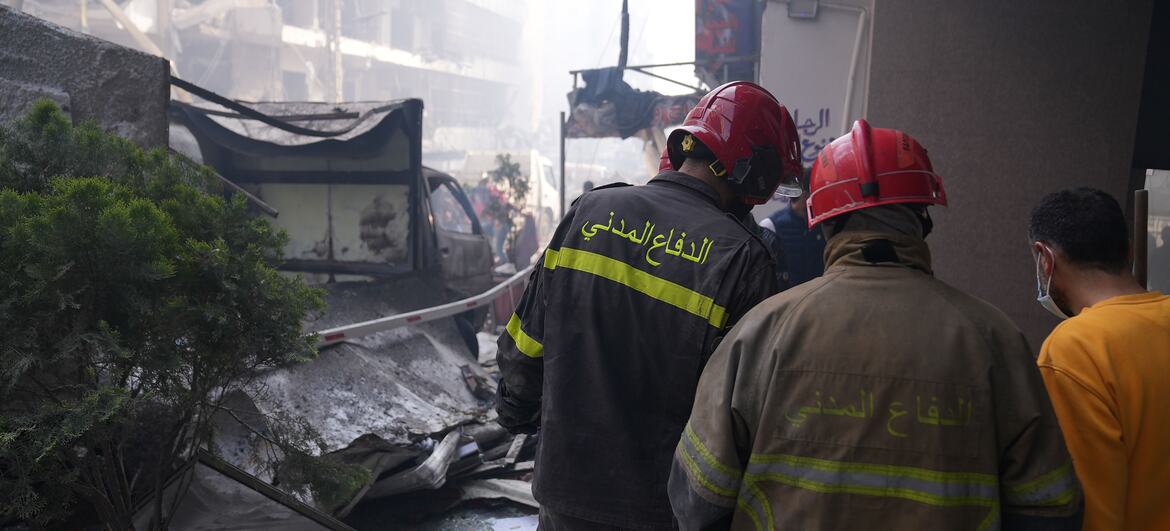
Dr. Abdinasir Abubakar was speaking from Beirut, where he witnessed Wednesday’s attacks first-hand, said that according to the latest figures from Lebanon’s Ministry of Health some 300 people were killed in the strikes one of the highest single-day death tolls since the renewal of full-scale hostilities between Israeli forces and Hezbollah militants on 2 March and 1,150 were injured.
“Many more people actually are still missing,” Dr Abubakar told reporters in Geneva. “They’re believed to be under the rubble.”
Many body parts are also waiting to be identified, he said.
He also spoke of a warning received from Israel on Friday morning that “ambulances will be attacked as well.”
Dr Abubakar said that Israel had been warning about “the use of ambulances by Hezbollah”.
WHO has insisted that while healthcare should not be militarized, misuse of health facilities or ambulances does not justify attacking them.
“The healthcare workers, the facilities, the ambulances are all protected under international humanitarian law,” he said.
“Unless we have these services available, we will not be able to save lives.”
WHO also received a warning that Israeli evacuation orders have been expanded in the Jneh area of Beirut which includes “two major hospitals that are managing the mass casualty [event], Rafik Hariri and Al Zahara hospital.”
Dr. Abubakar stressed the impossibility of potentially having to move the 450 patients, including some 50 in intensive care after having sustained injuries in Wednesday’s bombing, out of the health facilities and the facilities are operating at full capacity, he added.
“We have decided not to evacuate because we don’t have any other place to evacuate them [to], actually,” he said.
He added that overnight “we received some feedback saying that these hospitals will not be attacked…whether that will materialize or not we will see.”
Dr. Abubakar noted that even before Wednesday’s mass casualty the country did not have enough medical supplies to last even one month and the surge in emergency cases.
The 8 April airstrikes took place just hours after a ceasefire was announced between the United States and Iran.
According to media reports Iran said on Friday that it would not take part in peace talks planned for Saturday in Pakistan if the ceasefire was not extended to Lebanon and the hostilities between Israel and Hezbollah have continued.
UNHCR spokesperson Eujin Byun said that families who had fled hostilities in Beirut, the Bekaa Valley and southern Lebanon some of whom had begun contemplating returns after mixed signals about a ceasefire were now once again uprooted.
She said areas considered safe were struck on Wednesday, “triggering panic and forcing people to flee for the second or third time.”
Ms. Byun added that the destruction of the Qasmiyeh Bridge, a major artery connecting the southern cities of Sidon and Tyre, has made “moving between northern and southern Lebanon much more difficult.”
“For many families from southern villages, return is no longer possible as the entire communities have been partially or completely destroyed,” she said.
She stressed that some 150,000 people are estimated to still be in the South and that humanitarian access to them is essential.
“They need a safe route to flee if they are forced to again,” she insisted.
WFP director in Lebanon Allison Oman was on a convoy to a border village in the south this week, gave reporters an eyewitness account of the situation there.
“What I saw really stayed with me,” she recounted, describing a local bakery which “had the glass front destroyed just an hour before we’d been there, and they were already sweeping up the glass and had already fired up the ovens because they were waiting for the wheat flour that we were bringing in on the convoy.”
“Their food stocks were very low, and it was clear that this convoy was much awaited…it was essential to help them keep going,” she said.
Ms. Oman warned that the situation is “rapidly becoming a food security crisis,” with food prices rising across the country.
“In just one month, the price of vegetables has surged by more than 20 per cent, bread prices have increased by 17 per cent…for families who are already struggling, this is deeply concerning,” she said.
She highlighted a “very worrying combination” where prices are rising, incomes are disrupted and demand is increasing.
Ms. Oman also stressed that in the conflict-affected areas in southern parts of Lebanon, over 80% of markets are no longer functioning.
