

Poonam Sharma
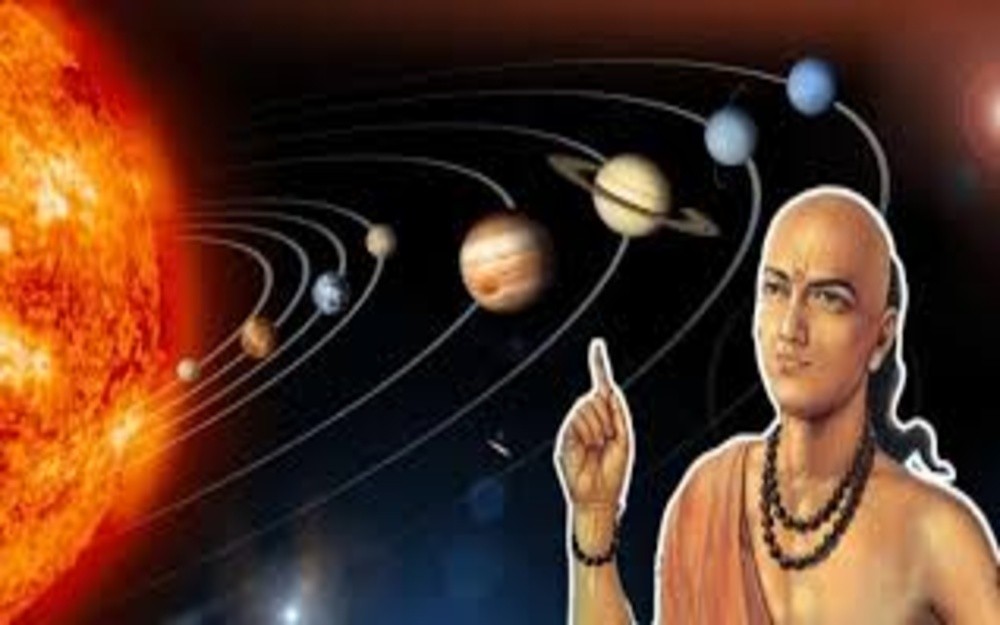
Aryabhata (476–550 CE) was a visionary Indian mathematician and astronomer who elevated Indian science to the international stage. Often regarded as a precursor to Nicolaus Copernicus, Aryabhata lived during the golden age of Gupta Empire, a period marked by great intellectual progress.
At just 23 years old, he composed the seminal work ‘Aryabhatiya’ in Sanskrit. This text laid the foundation for modern astronomy and mathematics. His ideas traveled through Arabic translations to Europe, sparking scientific advancements that shaped the Renaissance.
While the world believed that Earth was stationary and the heavens revolved around it, Aryabhata confidently proposed that the Earth rotates on its axis. He illustrated this with a simple analogy: a person sitting in a moving boat sees the stationary trees seeming to move backward, just as stars appear to move because of Earth’s rotation.
Aryabhata also provided a scientific explanation of solar and lunar eclipses, countering mythological beliefs. He stated lunar eclipses occur when Earth’s shadow falls on the moon, and solar eclipses happen when the moon’s shadow falls on Earth. He further clarified that planets and the moon do not emit their own light but reflect sunlight, explaining their brightness.
His calculation of the sidereal year as approximately 365.258 days closely matches modern values. Aryabhata also estimated Earth’s circumference as about 39,968 kilometers, astonishingly close to the current accepted figure of 40,075 kilometers. He determined the value of π (pi) to be roughly 3.1416, demonstrating remarkable mathematical precision.
However, Aryabhata’s revolutionary ideas met strong opposition from traditional scholars like Brahmagupta and Bhaskara, who favored religious doctrines over scientific observations. They contested his ideas, yet unknowingly used Aryabhata’s mathematical frameworks in their own works.
Ultimately, Aryabhata’s theories were validated and integrated into global science through Arab scholars, influencing European scientific progress. He stands as one of the greatest scientific revolutionaries in world history, not just Indian.
This tribute honors the groundbreaking legacy of Aryabhata.
