
Experts Back 18 as Age of Consent, Call for Stronger Family Values
National seminar in Delhi recommends retaining existing age of consent while expanding counselling, value-based education and adolescent mental health support

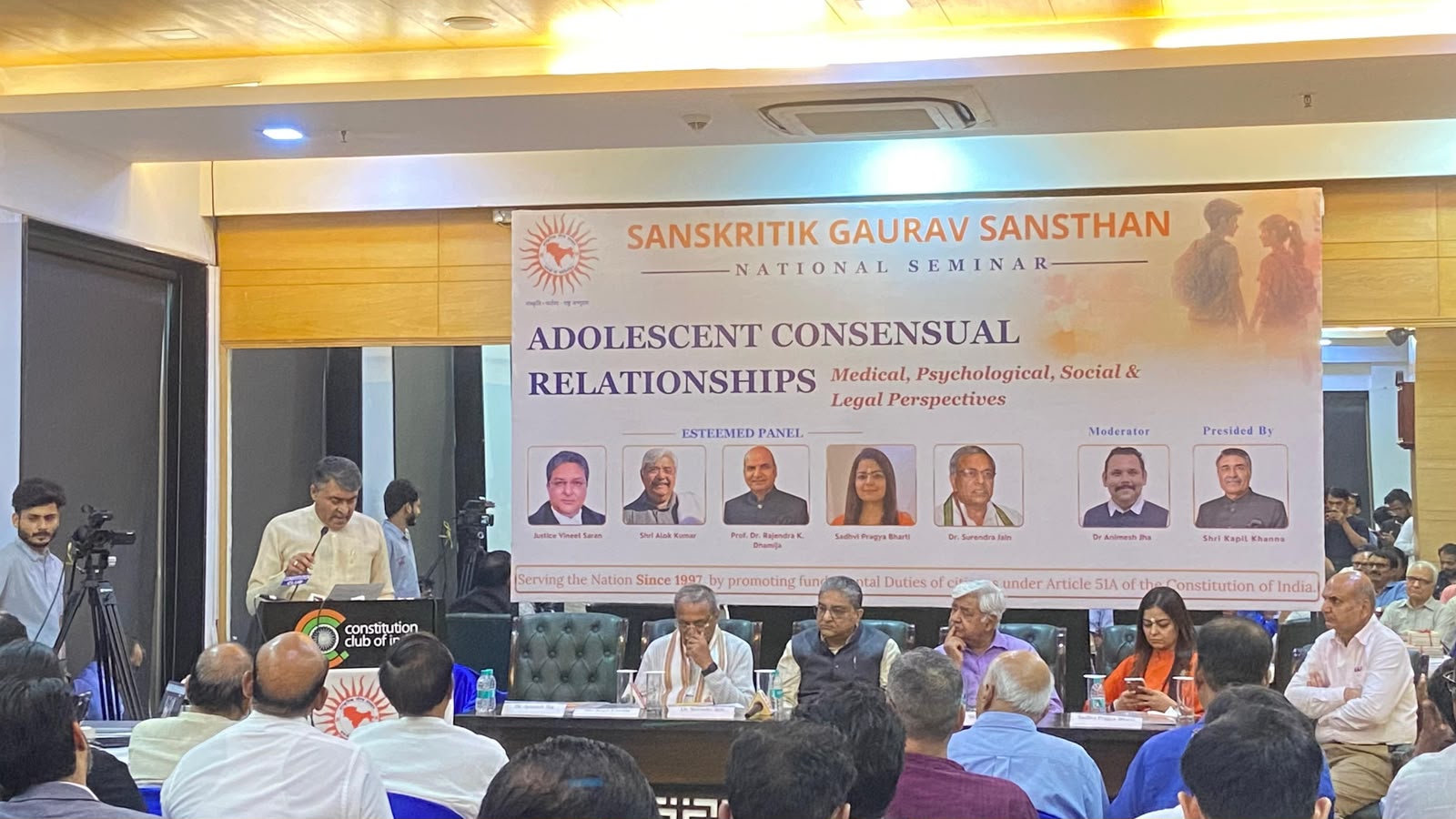
- Experts at a national seminar strongly recommend retaining the age of consent at 18 years.
- Panel calls for stronger families, counselling, mental health support and value-based education.
- Experts stress sensitive implementation of child protection laws rather than lowering the consent age.
- Seminar recommendations will be submitted to ministries, MPs, Law Commission and child rights institutions.
GG News Bureau
New Delhi, 31st July: A panel of experts from the judiciary, law, medicine, psychology and education has strongly recommended that India’s age of consent should continue to remain at 18 years, arguing that lowering the threshold could weaken legal safeguards available to adolescents against exploitation, coercion and abuse.
The recommendation emerged from a National Seminar on “Adolescent Consensual Relationships: Medical, Psychological, Social & Legal Perspectives”, organised by Sanskritik Gaurav Sansthan at the Deputy Chairman Hall of the Constitution Club of India in New Delhi on Thursday.
The seminar brought together former Supreme Court judge Justice Vineet Saran, senior Supreme Court advocate Alok Kumar, Institute of Human Behaviour and Allied Sciences (IHBAS) Director Prof. Dr. Rajendra K. Dhamija, spiritual leader Sadhvi Pragya Bharti, and educationist Dr. Surendra Jain.
The proceedings were presided over by Kapil Khanna, President of Sanskritik Gaurav Sansthan, and moderated by Dr. Animesh Jha, Professor at Dharmashastra National Law University, Jabalpur.
Following deliberations on the medical, psychological, social and legal dimensions of adolescent relationships, the panel reached a broad consensus that the statutory age of consent should remain unchanged at 18 years.
Experts argued that adolescence represents a crucial period of emotional and psychological development and that the existing legal framework provides an important layer of protection to minors.
Rather than reducing the age of consent, the panel called for strengthening family institutions, value-based education, counselling, mental health support and implementation of existing child protection laws.
The participants also stressed the need for sensitivity while dealing with individual cases involving adolescents, saying the protection of vulnerable minors should remain central to the legal framework.
Former Supreme Court judge Justice Vineet Saran said the law should continue to prioritise the protection of minors while maintaining consistency with the legal age of majority.
According to the organisers, Saran maintained that courts could consider the particular circumstances of individual cases with appropriate sensitivity, but the statutory age of consent at 18 should not be altered in the larger public interest.
His remarks highlighted the distinction between maintaining a clear statutory safeguard and ensuring that the justice system responds sensitively to the facts of individual cases.
Senior advocate Alok Kumar cautioned that diluting the existing age of consent could weaken legal protections available to children.
He advocated balanced and sensitive enforcement of child protection laws while ensuring that vulnerable adolescents remain fully protected.
The discussion emphasised that difficulties arising from particular cases should be addressed through appropriate implementation of the law rather than by weakening the overall statutory protection available to minors.
Providing the medical and psychological perspective, Prof. Dr. Rajendra K. Dhamija said adolescents continue to undergo significant emotional, neurological and psychological development until adulthood.
He argued that mental health support, structured counselling and family guidance would provide a more effective response to challenges surrounding adolescent relationships than lowering the legal age of consent.
The seminar consequently recommended wider availability of counselling and mental health services for young people, alongside greater awareness among parents and educational institutions.
Sadhvi Pragya Bharti stressed the role of India’s cultural ethos in promoting character, self-restraint and family values.
She called for moral education, spiritual awareness and respect for relationships to become integral elements in the upbringing of children and adolescents.
The seminar broadly argued that legislation alone could not resolve the social and psychological challenges facing young people. Participants called for strengthening the traditional family system and promoting values centred on responsibility, respect, discipline and mutual trust.
Greater parental involvement and open communication between parents and adolescents were identified as important measures to help young people navigate relationships and emotional challenges.
Educationist Dr. Surendra Jain highlighted the role of educational institutions in preparing adolescents for responsible adulthood.
He recommended integrating value-based education, life skills, emotional intelligence and ethical conduct into mainstream education.
The seminar also called for educational institutions to play a larger role in adolescent counselling and awareness, particularly as young people increasingly encounter relationship issues and social pressures through digital platforms.
The panel identified the digital environment as another area requiring greater intervention.
Participants recommended enhanced digital literacy and online safety awareness, along with greater policy attention to the responsible use of social media by adolescents.
Public awareness programmes should promote responsible behaviour, respect in relationships and ethical decision-making among young people, the seminar recommended.
The participants argued that adolescents require not only legal protection but also the knowledge and emotional skills necessary to navigate rapidly changing social and digital environments.
In his presidential address, Sanskritik Gaurav Sansthan President Kapil Khanna said India’s civilisational wisdom emphasises a balance between rights and responsibilities.
He said protecting adolescents was a collective responsibility involving families, educational institutions, policymakers and society.
Khanna maintained that retaining the age of consent at 18, alongside stronger family guidance and cultural values, was important for the safety and holistic development of young people.
Among its major recommendations, the seminar called for retaining the age of consent at 18, implementing existing child protection legislation fairly and sensitively, strengthening family institutions, incorporating value-based education into school and college curricula and expanding counselling and mental health services.
It also recommended encouraging parents to maintain open communication with adolescents and giving greater policy attention to digital safety and responsible social media use.
The organisers said the recommendations emerging from the deliberations would now be compiled into a policy document.
The document will be submitted to the concerned Union Ministries, Members of Parliament, the Law Commission, child rights institutions and other relevant stakeholders for consideration, with the organisers seeking to contribute to the wider policy debate on adolescent protection, relationships and the legal age of consent.
