
Can Vote Chori Explain Every Election Defeat? Karnataka Says Otherwise

Poonam Sharma
The results of the Karnataka Legislative Council elections have raised a big question in Indian politics: Should trust in an election system depend on whether a political party wins or loses.
The BJP-JD(S) combine had swept all the four seats in the October 23 elections to four Teachers’ and Graduates’ constituencies in Karnataka. BJP won three seats and JD(S) captured Bengaluru Teachers’ constituency from Congress. Congress failed to win any seats. In the Bengaluru Teachers’ constituency held through ballot papers and preferential voting, JD(S) candidate A.P. Ranganath beat Congress candidate Puttanna by 908 votes.
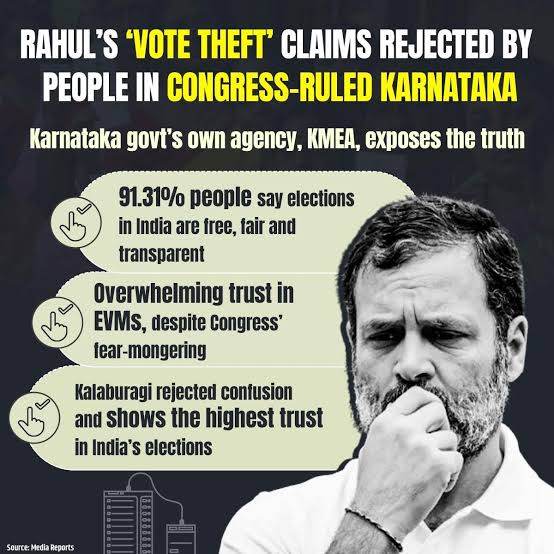
The outcome is politically significant as Congress has been increasingly raising allegations of vote theft and manipulation involving EVMs and electoral rolls. Rahul Gandhi had made similar allegations at a meeting of the Congress Working Committee in September 2026.
So the Karnataka result poses a fair question: if ballot papers can deliver a decisive defeat, can the voting machine alone explain electoral reverses elsewhere?
EVMs did not come under BJP’s watch
History is worth remembering. The Electronic Voting Machines were first used experimentally in India in 1982 in Kerala’s Parur Assembly constituency where 50 polling stations used EVMs. This was decades before the BJP rose to become the dominant national political force.
Then the system evolved through legal, legislative and technological development. An amendment that came into force in 1989 gave Parliament the legal framework to use EVMs, and these gradually spread throughout India. They were used in all 543 Lok Sabha constituencies across the country in 2004.
This history is important because the EVMs are not the invention of one present day government or one political party. These same machines have been the mothers of very different governments There is also a problem in sustaining simplistic arguments on the basis of India’s electoral record.
States like Kerala, Karnataka, Tamil Nadu, Telangana, Punjab, Rajasthan, West Bengal and others have gone through several election cycles of EVM-based elections, according to the Election Commission’s records. The same system has seen different national and regional parties win and lose power.
Congress and its allies have won important elections held through EVMs. In some of the states, opposition parties have been forming governments by the same voting mechanism they sometimes question after defeats.
That doesn’t mean concerns about the administration of elections should be ignored. All democratic institutions must be subject to scrutiny. But scrutiny must rest on evidence and consistent standards, not on whether a particular outcome is convenient politically.
Why India surrendered the normal ballot papers
Paper ballots might appear simple but India’s electoral history also had counting disputes, invalid votes, ballot stuffing and booth capture. EVMs were introduced, in part, to address these problems. Today, the voting system also has the Voter Verifiable Paper Audit Trail or VVPAT through which a voter can see to which candidate the vote has been cast.
The Election Commission said the EVMs being used currently are stand-alone devices and do not have Wi-Fi or Bluetooth connectivity. Candidates and their representatives are involved at various stages and machines are put through mock polls and randomization. Polled machines are kept in strong rooms with armed security guards, double locks and 24 hour CCTV surveillance.
The Commission said more than 67,750 randomly selected VVPATs involving more than 4.5 crore votes had been checked and not a single case of a vote meant for one candidate being transferred to another was found.
The Supreme Court also rejected demands in April 2024 for a complete return to paper ballots and the mandatory counting of all VVPAT slips, issuing additional safeguards to improve voter confidence.
That’s not to say the system shouldn’t be improved. No democratic process should be held above scrutiny. But there’s a difference between asking for better audits and asserting, without evidence, that an entire election system is fraudulent.
Karnataka offers a useful democratic lesson
The Karnataka MLC election offers an interesting counterpoint. These elections are structurally different from the assembly and Lok Sabha elections. There are special electorates for teachers and graduates . Voting is by preferential ballots . But Congress lost all four of its seats.
That result proves nothing about the truth of every charge of EVMs. But it also shows that a ballot paper is no guaranty of victory for any party.
The rule of democracy is simple: sometimes the voter says no to you. The parties must hence resist the temptation of explaining every loss by the voting mechanism. The more difficult questions are usually political: Was the organization robust enough? Was the candidate all right? Did the alliance manage to transfer votes? Did the campaign’s work win over the voters?
In Bengaluru Teachers’ constituency, the NDA candidate defeated a five-time winner. That’s something that deserves political analysis, not technological conspiracy theories.
Winning elections means winning voters
In a constitutional democracy, there is only one legitimate way to political power, and that is to win elections. The loser has to pull its act together, get its message together, choose better candidates and get the trust of the voters back. If every loss is evidence of cheating by the machine or the electoral system or the referee, democracy can’t work. Same should be the case with all parties, BJP, Congress or any regional party.
Similarly, suspicions of foreign interference or outside money should be taken seriously . Foreign interference in democratic systems is a legitimate security concern globally, nameless foreign-funded actors are trying to establish a “puppet government” in India . A defense of democracy, therefore, can itself be an argument against democratic debate.
Trust should be founded on evidence, not political expediency
India votes today under a glare of public scrutiny unlike anything seen before. The use of polling agents, observers, VVPATs, videography, CCTV surveillance, strong-room security, judicial monitoring and instant media monitoring provide layers of accountability that were not there in the old ballot-paper era.
That system should continue to get better. Elections authorities should respond to genuine questions openly, opposition parties should be free to contest irregularities, and courts should be available where evidence exists.
But demanding paper ballots because EVM results are politically disappointing is not a persuasive democratic principle. The Karnataka MLC results are a reminder that the ballot paper can defeat you and the EVM can elect you. The technology should not determine who rules India.
The voter is.
