
Dr Jitendra Singh Calls Backs Grassroots Innovators
Union Minister says India’s next growth wave will emerge from villages and small towns as 26 grassroots innovators are honoured

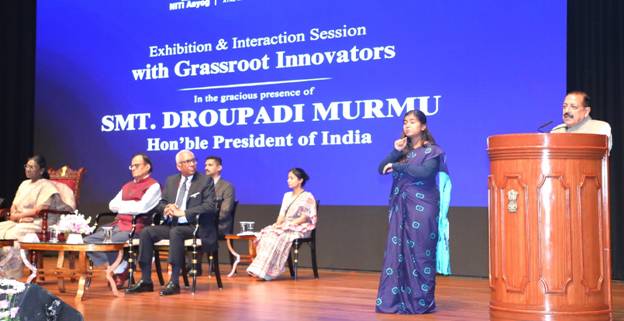
- Jitendra Singh calls for linking grassroots innovators with India’s formal innovation ecosystem.
- Twenty-six innovators from 16 states and 23 districts were honoured in New Delhi.
- Minister seeks stronger integration between Atal Innovation Mission and DST’s NIDHI initiative.
- Singh says local innovations must be transformed into scalable national enterprises.
GG News Bureau
New Delhi, 1st Aug: Union Minister Dr Jitendra Singh has called for connecting grassroots innovators with the country’s formal innovation ecosystem, saying India’s next wave of growth would emerge not only from laboratories and major cities but also from villages, small towns and local communities.
Addressing the Grassroots Innovator Recognition Ceremony 2026 at the Rashtrapati Bhavan Cultural Centre in New Delhi, Singh said grassroots innovations could play a crucial role in building an Atmanirbhar Bharat and achieving the vision of Viksit Bharat@2047.
He called for a seamless national pathway through which promising local innovations could move from recognition to scientific validation, technology development, incubation and eventually market adoption.
“Recognition should mark the beginning, not the destination” of an innovator’s journey, Singh said, stressing the need to turn locally developed solutions into scalable enterprises.
26 Grassroots Innovators Honoured
The ceremony was held in the presence of President Droupadi Murmu and was attended by Principal Scientific Adviser Ajay Sood, NITI Aayog CEO Nidhi Chhibber, scientists, government officials and incubation partners.
A total of 26 grassroots innovators from 16 states and 23 districts were recognised for developing affordable and community-oriented solutions.
The innovators ranged in age from 24 to 66 years and included 11 women.
Their innovations covered areas including agriculture, healthcare, clean energy, assistive technology, water management, circular economy and sustainable livelihoods.
Among the innovations recognised were compact mini rice mills for small farmers, tractor-operated machines for reclaiming uncultivable land, technologies converting agricultural residue into bio-products, AI-enabled soil diagnostic services and biodegradable alternatives to single-use plastics.
Affordable assistive technologies for persons with disabilities and decentralised clean-energy solutions were also among the innovations highlighted at the ceremony.
‘India Has Crossed 2.4 Lakh Startups’
Singh said India has crossed 2.4 lakh startups, making it the world’s third-largest startup ecosystem.
However, he said the success of the country’s innovation movement should ultimately be measured by its ability to solve everyday problems and improve the lives of farmers, women, artisans, entrepreneurs and other citizens.
The minister said innovations that reduce physical drudgery, improve productivity, generate livelihoods and help create sustainable local enterprises represent the spirit of inclusive development.
He credited the Atal Innovation Mission (AIM) with expanding access to the innovation ecosystem beyond premier institutions and metropolitan centres to rural, tribal, hilly, coastal, aspirational and remote regions.
25 Atal Community Innovation Centres Operational
Singh said 25 Atal Community Innovation Centres (ACICs) are operational across the country, while another 25 are under development.
Existing centres have supported more than 2,500 grassroots innovators by providing mentoring, incubation, technical guidance, capacity building and market linkages, he said.
The minister called for stronger integration between the grassroots innovation network developed under AIM and the Department of Science and Technology’s National Initiative for Developing and Harnessing Innovations (NIDHI).
Such integration, he said, could give innovators access to Technology Business Incubators, Centres of Excellence, prototype development facilities, intellectual property support, testing, certification, financing and manufacturing partnerships.
Singh cited the Mitticool refrigerator as an example of how a traditional grassroots idea could evolve into a nationally recognised product with scientific validation and institutional support.
He urged scientists, universities, incubators, industry and government departments to work together to help grassroots innovations progress from ideas to commercially viable products.
Singh said sustained institutional support could enable innovators from villages and districts to become key contributors to India’s development and help transform local solutions into nationally relevant enterprises.
