
THE LION ROARS BUT ITS TEETH HAVE BEEN BLUNTED
Charting America’s strategic decay.

By Alok Lahad
The United States remains the world’s only true economic superpower. Its nominal GDP in 2026 stands between roughly $29 trillion and $32 trillion, far ahead of China’s $18–21 trillion. The American economy is approximately 1.5 times the size of China’s in market-exchange terms and several times larger on a per-capita basis. India, the next major rising power, registers around $4 trillion. This economic primacy was built on institutions that rewarded innovation, secure property rights, open markets, and the rule of law. Military power has long rested on that foundation. The question now is whether the instruments of that power are still sharp enough to deliver decisive results at acceptable cost.
The Scale of American Military Spending
According to SIPRI data for 2025, global military expenditure reached nearly $2.9 trillion. The United States accounted for $954 billion — about 33 percent of the world total, not half. China followed at an estimated $336 billion, Russia at $190 billion, Germany at $114 billion, India at $92 billion, the United Kingdom at $89 billion, France at $68 billion, and Japan at $62 billion. Iran’s official figure was around $7–8 billion, though independent estimates that include off-budget Revolutionary Guard and missile programmes place the real total higher, perhaps in the mid-teens of billions.
No other country comes close to American absolute spending. The gap, however, is less decisive than the raw numbers suggest once production rates, stockpile depth, and the economics of modern conflict are examined.
Industrial Base and the Cost of Precision
The American defence industry is dispersed rather than concentrated in a single corridor: ground vehicles in Michigan, aerospace and electronics across California and the Midwest, munitions production in places such as Arkansas and Texas. The major primes — Lockheed Martin, RTX, General Dynamics, Boeing, and Northrop Grumman — produce systems of extraordinary technical sophistication.
Those systems are expensive. A Tomahawk cruise missile costs roughly $2 million. A THAAD interceptor runs $10–15 million. A Patriot PAC-3 MSE interceptor is in the $3–4 million range. An SM-6 is several million dollars. Even cheaper precision munitions such as JASSM, AMRAAM, or Hellfire still cost tens or hundreds of thousands of dollars each. Full batteries and supporting radars push system costs into the hundreds of millions or billions.
Iran fields far cheaper alternatives: ballistic missiles in the low hundreds of thousands of dollars, one-way attack drones often under $50,000, and simple cruise missiles produced in volume. Its preferred method is saturation — large salvos of mixed missiles and drones designed to exhaust interceptors. Each Iranian projectile may be imperfect, but the arithmetic favours the side that can generate many low-cost threats against a defender that must answer with high-cost interceptors produced on long lead times. In the 2026 conflict this asymmetry became visible: American and Israeli defences intercepted most incoming weapons, yet the expenditure of premium munitions was heavy and the industrial pipeline could not rapidly replace them.
The 2026 Iran Campaign
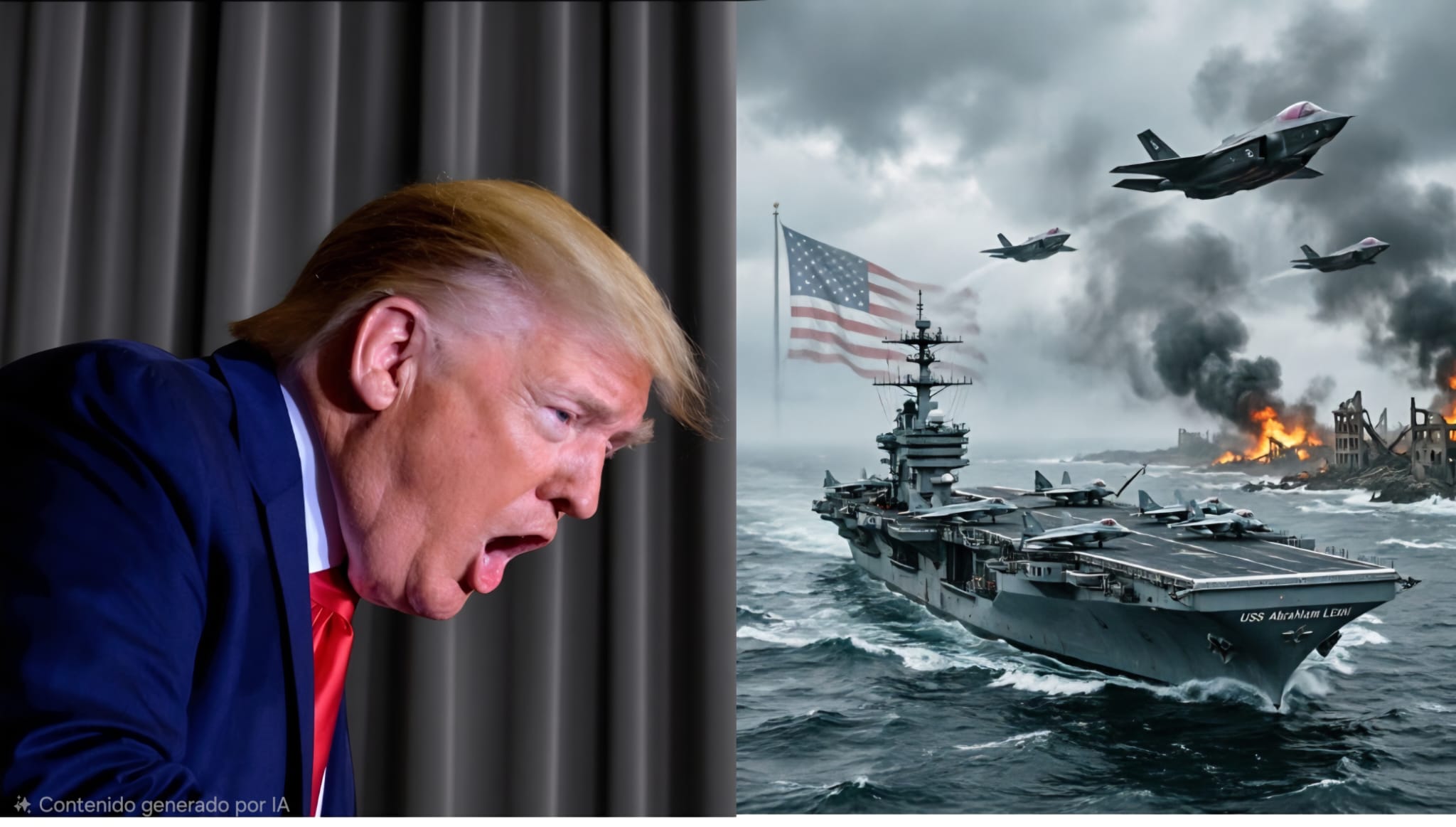
Operation Epic Fury and the parallel Israeli Operation Roaring Lion began with coordinated strikes that included the targeting of Iranian senior leadership. Iranian forces responded with repeated missile and drone barrages against Israel and against American and partner facilities across the Gulf and Jordan. Bases in Qatar, the UAE, Saudi Arabia, Kuwait, Bahrain, and Jordan sustained confirmed damage to hangars, radars, communications nodes, and other infrastructure. Some American personnel were killed or wounded. Interception rates were high, but magazines ran down. The question remains: is this America’s war?
Naval forces operated primarily from the Mediterranean, the Arabian Sea, and the Gulf of Oman rather than lingering inside the Strait of Hormuz itself. Carriers and long-range bombers supplemented regional air bases. The campaign degraded Iranian surface forces, some production capacity, and command structures. It did not produce regime collapse, permanent elimination of the missile force, or a stable new political order. After weeks of intense activity the United States paused, negotiated, resumed limited strikes, and paused again. Core political objectives remained incomplete.
The leadership strikes themselves illustrate a broader shift. Precision targeting of named individuals is presented by those who conduct it as a lawful attack on military command. The same method, if executed by Iranian proxies against Israeli or American leaders, would almost certainly be labelled terrorism or assassination. Consistency in the standard is difficult to maintain once the practice becomes normalised by any side.
Stockpiles, Timelines, and Economic Reality
Analyses after the main phase of fighting showed substantial drawdowns of Tomahawks, JASSM-family missiles, Patriot interceptors, and THAAD rounds — in some categories approaching or exceeding half of pre-war inventories. Replenishment of the most complex systems is measured in years, not months. Production lines for solid rocket motors, seekers, and specialised components cannot be surged overnight. Framework agreements signed in 2026 aim to raise annual output over the coming half-decade, yet the near-term constraint remains real. High-cost, slow-to-replace munitions against low-cost, high-volume threats make sustained high-intensity operations economically unattractive.
Structural Questions
The deeper pattern is older. NATO expansion into the former Soviet space can be camouflaged by stating that it is a sovereign choices of Eastern European states and by genuine fear of Russian power, but fact remains, it is needless eastward adventurism. As it is perceived in Moscow as progressive strategic encroachment challenging its military and security concerns. Europe’s long under-investment in conventional defence left it dependent on the American security guarantee — a transactional relationship that benefited European budgets and American industry until the costs of extended deterrence rose. Europeans people had started seeing Russians as future partners rather than invaders till the red line was crossed in Ukraine. Unless keeping Russians coming closer to Europe was the objective and Ukraine and it’s people as collateral damage the objective has not been met. Europeans are now thinking of having their own army and arms producing facilities where it would not need the USA. In the Gulf the post-1970s security-for-oil arrangement delivered decades of stability; Iranian strikes on bases hosted under that arrangement eroded confidence that the presence alone guaranteed safety. The August 2026 Mecca Joint Defense Agreement between Saudi Arabia, Turkey, and Pakistan — with its collective-defence language — is a rational hedge. Is the mind set of the traditional allies changing?
Nuclear policy reveals similar selectivity. Pakistan, despite its record on proliferation and terrorism, possesses nuclear weapons. Iran, a civilisation state with its own grievances and ambitions, is told it may not. The non-proliferation regime has always been unevenly enforced; that unevenness is noticed. Any unprincipled stance loses its moral strength..
The Post-Vietnam Record
Since Vietnam the United States has demonstrated unmatched conventional military skill and still failed to convert many interventions into durable political success. Iraq removed a dictator and produced prolonged instability and weapons is mass distraction never found and American lies exposed. Afghanistan toppled the Taliban US itself created to fight against the Sovieta and, after twenty years, watched them return. Libya and the Syrian conflict left fragmented landscapes. The 2026 Iran campaign fits the pattern: significant military damage, incomplete strategic results, high material cost, and visible strain on partners and political and military objectives unmet.
Being the global policeman carries a price. Resources spent on open-ended or poorly bounded conflicts are resources not available for deterrence against peer competitors, for industrial resilience, or for domestic renewal. Allies notice when protection proves costly to the protector and imperfect for the protected. The roar is still heard. The teeth, however, are being ground down by the economics of precision warfare against adaptive, lower-cost adversaries and by the political difficulty of turning battlefield superiority into lasting outcomes and the world has noticed it.
America retains unique strengths. It would be better served by clearer prioritisation — defending core interests, maintaining credible deterrence, and declining to fight every conflict that others prefer to see fought with American treasure and munitions. The alternative is continued erosion of the very superiority that once made the lion’s roar decisive.
