

By Jyotika Kalra
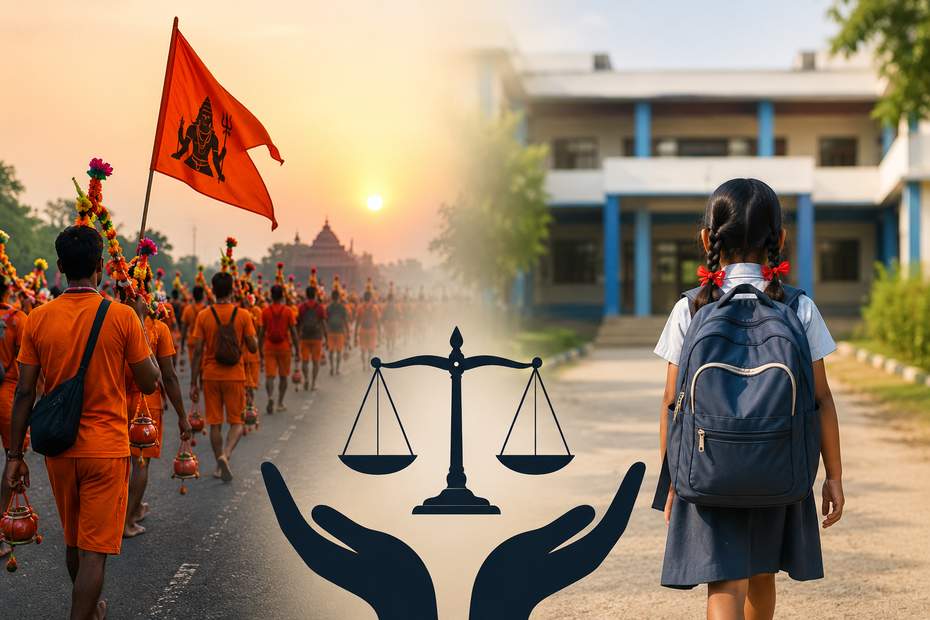
A Government Administration may sometimes have good reasons to close the schools. A religious procession can clog roads, strain policing, and make the movement of children genuinely unsafe. But when the same administration that asks schools to close also takes to the skies to shower flower petals on the same procession, the issue is no longer merely one of management of the clogging of roads. It becomes a question about what the State thinks its priorities are.
That question acquired an almost literal form in district Baghpat of Uttar Pradesh. During the Kanwar Yatra last year, District Magistrate Asmita Lal and Superintendent of Police Suraj Kumar Rai were reported flying over the Pura Mahadev temple and showering petals on Kanwariyas and other Shiva devotees. This year, the district administration again included helicopter flower showers among the arrangements announced for the Kanwar Yatra. Meanwhile, the same DM ordered the closure of all schools in Baghpat District from 03.08.2026 to 12.08.2026. Seems, the District Magistrate forgot the oath of office which she took before joining the Indian Administrative Services.
The Kanwar Yatra is a vast public event. Dihs of pilgrims on the roads require traffic regulation, police protection, medical facilities, sanitation, drinking water and emergency planning. Our constitutional scheme accommodates faith; Articles 25 to 28 protect religious freedom. The Constitution protects the believer without requiring the State to become a participant in belief. However, the Constitution equally imposes upon the State a positive obligation to secure to every child the right to free and compulsory education under Article 21A of the Constitution of India. The Constitution does not envisage a conflict between these constitutional guarantees; rather, it requires the State to harmonise competing constitutional values through fair, reasonable and proportionate executive action.
That is why the orders shutting schools deserve attention. School closures across several western Uttar Pradesh districts affected lakhs of students. In District Baghpat, Muzaffarnagar, Meerut, Noida and Ghaziabad, educational institutions were ordered shut for varying periods during the Kanwar Yatra, in some cases for more than a week.
Safety cannot become a complete answer to every administrative choice. The Kanwar Yatra is not an unexpected cloudburst. It is an annual event, known months in advance, planned for extensively and managed through elaborate traffic and security arrangements. If its arrival repeatedly requires schools to suspend normal functioning, the question must be whether sufficient thought has gone into protecting education alongside the Yatra.
It has to be seen in the context that no similar order has been passed by the State of NCT of Delhi and the State of Uttarakhand directing closure of schools even though a similar number of Kanwar devotees, or even higher in the case of Uttarakhand, also pass through these states.
It is the duty of the DM to ensure a smooth Kanwar Yatra, but the DM also has a constitutional obligation towards education. Article 21A guarantees free and compulsory education to children between six and fourteen. The Right of Children to Free and Compulsory Education Act places a corresponding obligation on the government to secure admission, attendance and completion of elementary education.
Education cannot be treated as the easiest public activity to sacrifice whenever administration becomes difficult. The inequality produced by such closures or online classes cannot be overlooked. A well-resourced private school may shift classes online overnight. A child without an independent laptop, broadband connection, and a quiet room suffers immense inconvenience. For many children in government schools or lower-income households, a closed school simply means a lost school day. What appears administratively neutral can therefore fall very differently on different sections of society, especially those who need it the most.
A capable administration should not have to choose between the Kanwariya and the Schoolchild. It should protect both. Traffic restrictions can be calibrated, school timings staggered, affected zones narrowed, alternative routes planned and lost instructional time compensated.
The Kanwariya does not need the State to validate his faith. He needs the State to protect his journey. The schoolchild does not need constitutional rhetoric. She needs the State to make every reasonable effort to keep her education going. Protect the pilgrimage. Police it well. Provide water, sanitation, medical care and safe passage. But let devotion remain the citizen’s, and let the administration remain the Constitution’s.
Jyotika Kalra
Advocate-On-Record
Supreme Court of India
Former Member NHRC
