

By Anjali Sharma
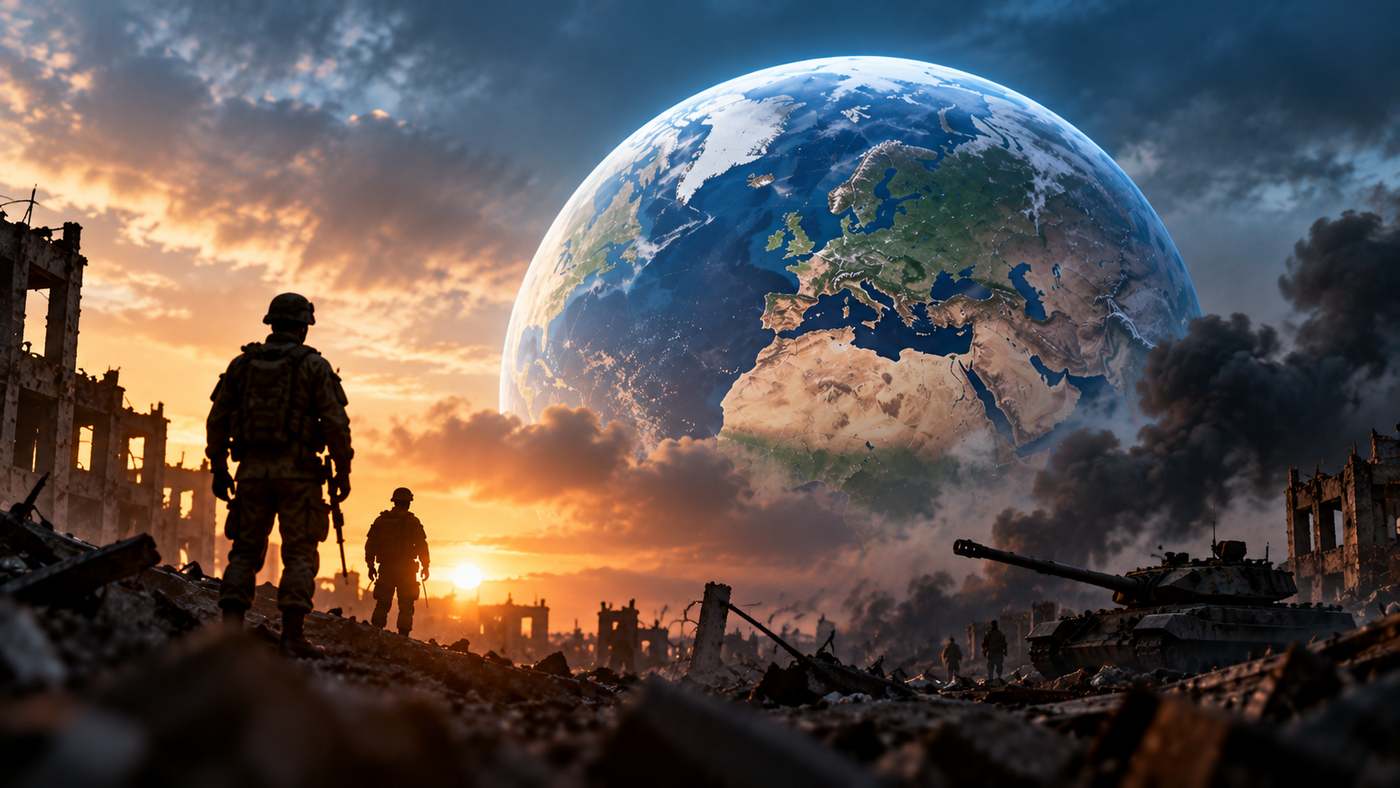
UNITED NATIONS – According to a new UN Global Risk Report issued on Tuesday stated that 2 years ago, the idea of a large-scale war breaking out felt like a distant hypothetical to the experts who help chart the world’s dangers. Today it tops their list of fears.
The study draws on the views of 1,300 people from government, international organizations, civil society, the private sector and academia, spanned every region of the world.
They rated 28 political, economic, environmental, societal and technological threats on how likely they were, how damaging, and how ready the world was to cope.
The report said that large-scale war climbed 16 places up the rankings compared with 2024 the steepest rise of any risk on the list.
It noted that a third of those surveyed, 36% think its effects could touch a significant share of humanity within a year; 76% expect that within seven years.
It is also a threat the world seems ill-equipped to face: large-scale war was the only risk to land in the top six across all four measures the survey tracked importance, imminence, how interconnected it is with other dangers, and how unprepared institutions are to respond.
The environmental threats, misinformation and pandemics dominated the picture about 2 yrs ago.
Now geopolitical tension, war and a weakening rule of law sit at its centre.
UNSG Antonio Guterres wrote in the report’s foreword. “At the same time, the institutions expected to respond are seen as less able to act.”
“The findings are sobering. Political risks have moved centre stage. The prospect of large-scale war is seen as far more important and far more immediate than it was two years ago,” he added.
Large-scale war and geopolitical tension now rank among the top 10 threats in every one of the seven regions the survey covers, and in the top five in six of them.
Two years ago, these same risks made the top five in just one region.
Weapons of mass destruction also broke into the top 10 in Central and Southern Asia, Sub-Saharan Africa and Oceania.
In Eastern and South-Eastern Asia, worries grew over a possible global financial crisis, the downsides of artificial intelligence, and the growing power of technology companies.
AI-related risks also entered the top 10 in Europe and North America.
Pandemics and biological threats, by contrast, fell out of the top 10 everywhere – a sharp reversal from two years ago, when they still ranked among the most pressing risks in Eastern and Southeast Asia, Latin America and the Caribbean, and Sub-Saharan Africa.
No risk exists on its own, the report argues. Shortages of natural resources, economic fragmentation, misinformation and weakening multilateral institutions all raise the temperature on geopolitical tension – which in turn makes large-scale war more likely.
Of the 705 connections between risks that the survey identified, the link between geopolitical tension and war was the strongest.
Artificial intelligence draws particular attention in the report. Concerns about AI, other frontier technologies and the concentration of power they enable have grown sharply in two years even as respondents say the multilateral system is the least prepared to handle technological threats.
Climate change has not gone away: inaction on it remains the single risk rated most important overall, and it ranks high in every region, alongside worries about resource shortages.
The report’s authors cautioned that other environmental risks slipping down the list does not mean they have become less dangerous only less visible. And visibility matters: issues that draw less attention often lose funding too.
The respondents pointed to weak governance and coordination, a lack of political consensus, and eroding trust and accountability as the biggest obstacles to managing risk alongside poor prioritization, resistance from the public, politicians or business, and gaps in data.
Over 86% said funding for risk reduction simply was not enough, with the report singling out natural hazards and the risk of multilateral institutions collapsing as particularly underfunded.
UN is careful to frame the report as a snapshot of perceptions rather than a prediction.
Respondents still see joint action between governments as by far the most effective means of prevention. No country, no company, no institution can face these risks alone.
“The 2026 Global Risk Report sets out the evidence that must inform our choices. We owe it to present and future generations to use this knowledge wisely, and to act while cooperation can still shape a safer course.
“The choice is ours,” Mr. Guterres said.
