
China Steps Up Gold Exploration
New discoveries and mining plans across Tibet and the western Pacific come as Chinese jewellery demand faces a sharp decline

By Pushp Ranjan
China’s jewellery market is showing signs of weakness, with several major retail chains closing outlets, even as the country intensifies its search for new sources of gold and other strategic minerals.
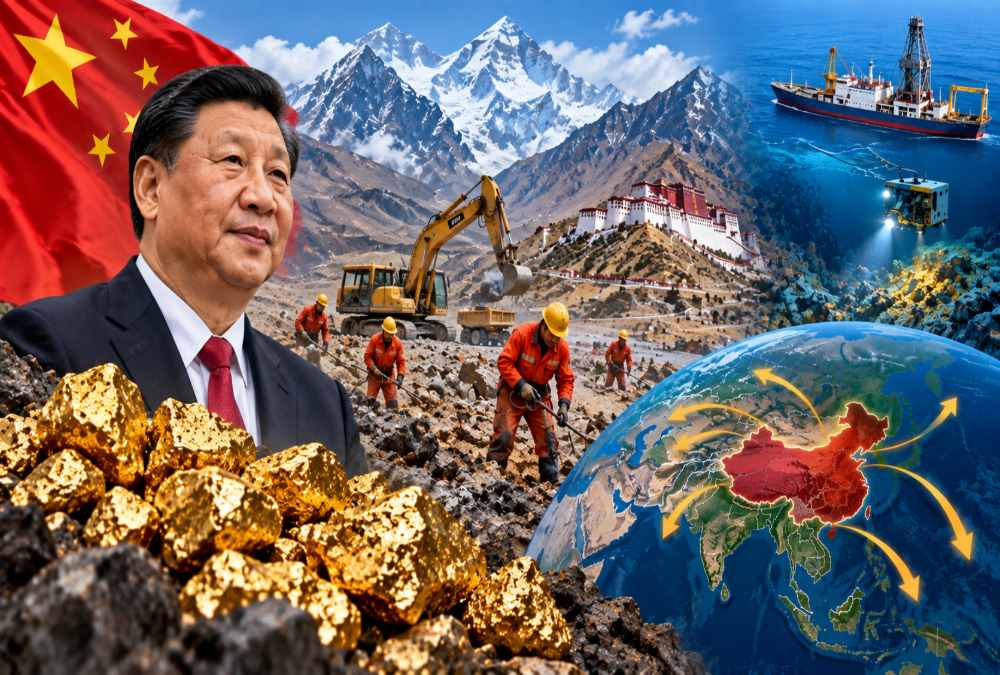
China is expanding exploration across Tibet, areas close to the Nepal and Arunachal Pradesh frontiers, and even parts of the western Pacific. The developments come as China continues to consolidate its position as the world’s largest gold producer.
According to the World Gold Council, China was the world’s largest gold producer in 2025, accounting for around 10% of global mine production.
At the same time, Chinese consumers are buying less jewellery by weight amid record-high gold prices. The World Gold Council reported that mainland China’s jewellery demand fell 28% year-on-year in the second quarter of 2026 to 50 tonnes, while first-half demand declined 30% to 136 tonnes. Consumers have increasingly shifted towards lighter jewellery, old-for-new exchanges and lower-premium investment products.
Jewellery Retailers Close Outlets
The weakness in jewellery consumption has affected major Chinese retailers. Several large chains have reduced their store networks as the market adjusts to high gold prices and changing consumer preferences.
The trend reflects a broader shift in China’s gold market: jewellery demand is weakening in volume terms, while investment demand remains significant. In the first quarter of 2026, China’s bar and coin investment demand reached a record 207 tonnes, according to the World Gold Council.
China Pushes Mining in Tibet
Alongside developments in the domestic gold market, Chinese mining companies are increasing their focus on Tibet and other mineral-rich regions.
Two Chinese mining companies have reportedly planned joint investment in gold, copper and other strategic-mineral projects in the Tibet Autonomous Region. The wider strategy is aimed at strengthening domestic supplies of minerals considered important for advanced manufacturing, technology and other strategic sectors.
The mineral potential of the Tibetan Plateau extends beyond gold. Copper, chromium, lithium, lead, zinc and other resources are also considered important to China’s long-term resource strategy.
The region’s high-altitude terrain, however, makes exploration and extraction technically challenging. China’s continued investment indicates the strategic importance Beijing attaches to securing domestic mineral resources.
Gold Exploration Beyond the Mainland
China’s search for resources also extends beyond land-based deposits.
Chinese scientists have reported identifying a large hydrothermal mineralisation zone in the western Pacific during a scientific expedition. Chinese state broadcaster CCTV reported that samples contained economically important minerals and relatively high concentrations of gold and silver.
The reported findings point to the growing importance of seabed mineral exploration, although the commercial viability of extracting such resources remains a separate question from geological discovery.
Earlier Exploration in Nepal
China has also previously undertaken mineral exploration activities in Nepal.
In 2018, a Chinese exploration team began work in the Holu Khola area of Bheri Municipality-1 in Jajarkot after obtaining permits from Nepal’s Department of Mines and Geology. The team examined an area of nearly five square kilometres for possible gold deposits.
The subsequent extent of China’s mineral exploration activities in Nepal remains less publicly documented.
What Does It Mean for India?
The contrast with India is significant. India has substantial geological gold resources, but domestic mine production remains relatively small compared with the country’s consumption.
India relies heavily on imports to meet its annual gold requirements, while domestic exploration and extraction face challenges including regulatory processes, high capital requirements and the technical difficulty of developing deeper deposits.
China’s continuing investment in geological exploration, mining technology and strategic mineral projects therefore raises a broader question for India: can the country significantly expand domestic gold exploration and production?
India’s geological potential is considerable, but converting resources into economically viable mines requires sustained exploration, investment, technology and policy support.
The comparison is not simply about gold. It is increasingly about control over strategic mineral resources that underpin financial security, manufacturing, technology and national economic resilience.
For India, the question is whether its mineral wealth can be converted into productive assets through faster exploration and modern mining capabilities—or whether the country will continue to depend heavily on imports while its geological potential remains largely untapped.
