UNGA Debates China-Russia Veto on Iran Nuclear Panel
UN member states debate the Security Council veto of a US-backed proposal to revive an Iran sanctions expert panel.

By Anjali Sharma
UNITED NATIONS – The World body on Thursday held a meeting to examine the UN Security Council vetoed by China and Russia over a US backed sanctions panel of experts on Iran nuclear facilities.
UNGA debated the use of the veto by two permanent Security Council members at the Council’s 17 September 2026 meeting in connection with the item entitled “Non-proliferation”, for which the Council submitted a special report.
The meeting was held pursuant to resolution which requires an Assembly debate within 10 working days of a veto, unless an emergency special session addresses the same situation.
The procedure gave the wider UN membership an opportunity to discuss the issue and promotes transparency and accountability in the use of the veto.
Several Member States have called to remove or limit veto power in the Council, but reform of the 15-member organ remains a work in progress.
The 2025 annual veto debate, then-General Assembly president Annalena Baerbock called repeated veto use a “poster child’ for global gridlock.
The debate was triggered by the assembly’s landmark veto initiative, established in 2022.
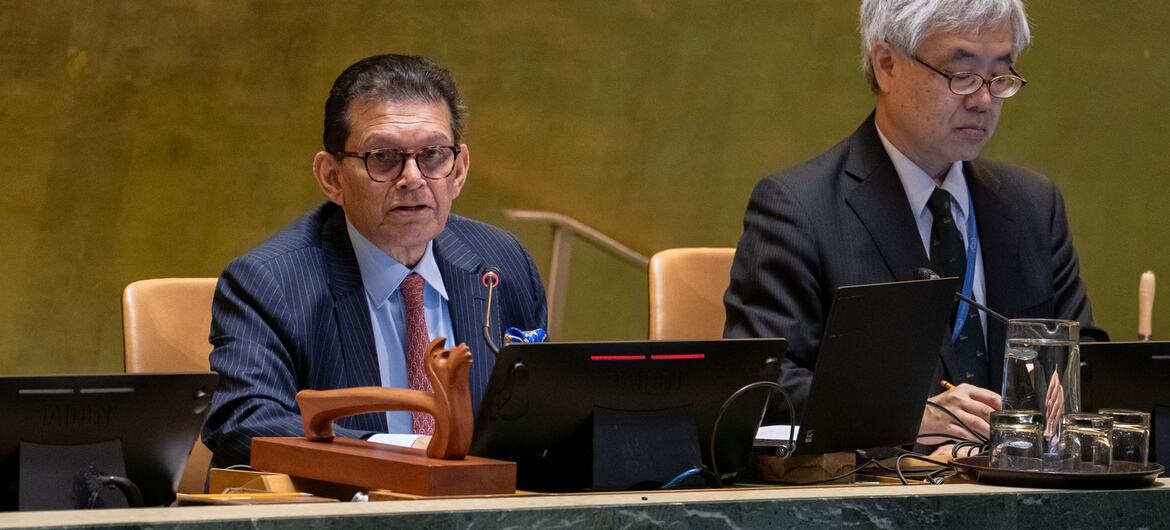
The president of the assembly’s 81st session Khalilur Rahman said the veto initiative “cannot substitute for effective council action”.
He said that each invocation of the initiative “highlights both the value of this mechanism and the circumstances that make it necessary” and affirms the assembly’s complementary role, ensuring that veto use is accompanied by transparency, explanation and consideration by the wider membership.
The initiative does not override the veto, it guarantees a public and accountable debate on each use and its implications in the General Assembly, where there is no veto power.
Deputy Permanent Representative Sun Lei of China said that his delegation voted against the draft resolution to “uphold a correct sense of right and wrong”.
The current impasse on the sanctions panel arises from the United States’ unilateral withdrawal from the Joint Comprehensive Plan of Action on Iran’s nuclear facilities – the Iran nuclear deal of 2015 its campaign of “maximum pressure” and its “two rounds of strikes against Iran in the midst of negotiations”.
He said other delegates argued for extending the panel’s mandate.
Hedda Samson, Deputy Head of the European Union delegation said “No UN Member State should prevent the UN Security Council from functioning properly and being fully operational.”
He noted that the need for a panel of experts is “even great today”. allowing Thursday’s debate, the assembly president will send a summary of discussions back to the Security Council.
Mr. Rahman said the assembly and the council “serve humanity best when they operate in balance”, each fulfilling its distinct but complementary responsibilities under the UN Charter.
“Let us, therefore, use this debate not to exacerbate tensions or assign blame, but to clarify positions, identify common ground for constructive solutions and chart a credible path forward to support dialogue and diplomacy and ultimately restore trust in the organization and its ability to deliver,” he said.
Khalilur Rahman of Bangladesh said that each invocation of the Assembly’s veto initiative “highlights both the value of this mechanism and the circumstances that make it necessary”.
It affirms the Assembly’s complementary role and ensures that veto use is accompanied by transparency, explanation and consideration by the wider membership.
But, “this mechanism cannot substitute for effective Security Council action”.
He said that its purpose should to “promote transparency and accountability, clarify positions, and above all, help identify a constructive path forward”.
Khullar noted that the Council’s deliberations revealed “significant” differences concerning the draft resolution.
He stressed that “it is precisely when positions diverge most sharply that dialogue and diplomacy become most indispensable”.
He therefore urged those present to use this debate “not to exacerbate tensions or assign blame”, but to “restore trust in the Organization and its ability to deliver”.
Deputy Permanent Representative of Russian Federation Anna M. Evstigneeva said there was no legal basis for the “snapback” mechanism by the United Kingdom, France and Germany.
She stressed that Council resolution 2231 (2015) has not been in effect since 18 October 2025, when the Council concluded its consideration of Iran’s nuclear programme, and the item regarding “non-proliferation” was removed from its agenda.
Anna M. Evstigneeva denounced the proposal to extend the mandate of the Council’s 1737 Iran Sanction’s Committee and Panel of Experts, given that both had ceased to exist in 2015 and the Council had taken no decision to resume their activities.
“The US draft resolution that was considered by the Security Council on the 17th of September simply lacks the legal basis and even lacks a subject,” she said.
“Therefore, we were faced with no option apart from challenging that document.”
Deputy Permanent Representative Sun Lei of China said that his delegation voted against the draft resolution to “uphold a correct sense of right and wrong”.
He said that the current impasse arises from the United States’ unilateral withdrawal from the Joint Comprehensive Plan of Action, its campaign of “maximum pressure” against Iran and its “two rounds of strikes against Iran in the midst of negotiations”.
The invocation of the “snapback” mechanism is “legally and procedurally flawed”, he said, stating that resolution 2231 (2015) has expired and that the Council has “ended its consideration of the Iranian nuclear issue”.
“No UN Member State should prevent the UN Security Council from functioning properly and being fully operational,” said Hedda Samson, Deputy Head of the European Union Delegation, noting that the need for a Panel of Experts is “even great today”.
She expressed grave concerned by Iran’s “continued refusal” to engage with the International Atomic Energy Agency in remedying its non-compliance and facilitation of an effective implementation of safeguards.
“As clearly indicated by the IAEA Director General, Iran’s implementation of its Safeguards Agreement cannot be suspended under any circumstances,” she said.
The EU, including through the efforts of the High Representative for Foreign Affairs and Security Policy and in line with Council resolutions 2231 (2015), 1929 (2010) and 1803 (2008), is ready to support the negotiations on Iran’s nuclear programme
“In this context, the reinstatement of a fully functional and independent Panel of Experts to assist the 1737 Iran Sanctions Committee is long overdue,” she stressed.
Deputy Permanent Representative Gholamhossein Darzi of Iran stressed that the draft resolution submitted by the United States was a “politically motivated, legally unfounded and cynical attempt” to revive the Panel of Experts of the “illegitimate 1737 Committee”.
The vetoes cast by China and the Russian Federation were “principled and necessary acts defending the UN Charter, international law and the integrity and authority of the Security Council against its abuse”.
He stated that the Council has concluded its consideration of the Iranian nuclear issue.
Gholamhossein Darzi added that, “while Iran pursued diplomacy in good faith, the United States chose aggression”.
He underscored “The repeated claim that Iran’s nuclear programme is being diverted to military objectives is a false narrative, first concocted by the Israeli regime in 2003 and repeatedly parroted by the United States and certain European countries.”
Deputy Permanent Representative Noa Furman of Israel asked: “Who benefits when the oversight disappears?”
She said that, for decades, Iran has advanced its military nuclear programme while deceiving the international community and exploiting diplomacy to buy time.
Noa Furman said the latest IAEA findings describe an “unprecedented” situation.
She pointed out that over 9 tons of nuclear material including 440 kilograms of highly enriched uranium have remained outside the Agency’s safeguards for more than a year.
The IAEA Board of Governors decided to report Iran’s noncompliance to both the Council and the Assembly on 9 September 2026.
She urged the Council to restore effective oversight via the 1737 Committee and its Panel of Experts,.
The Israeli envoy stressed “Without enforcement, sanctions are merely words on paper.”
