
Non-Violence in Economics: Gandhi’s Legacy in the Needonomics Framework
How Needonomics applies Gandhi’s principles of restraint, responsibility and human welfare to economic life.

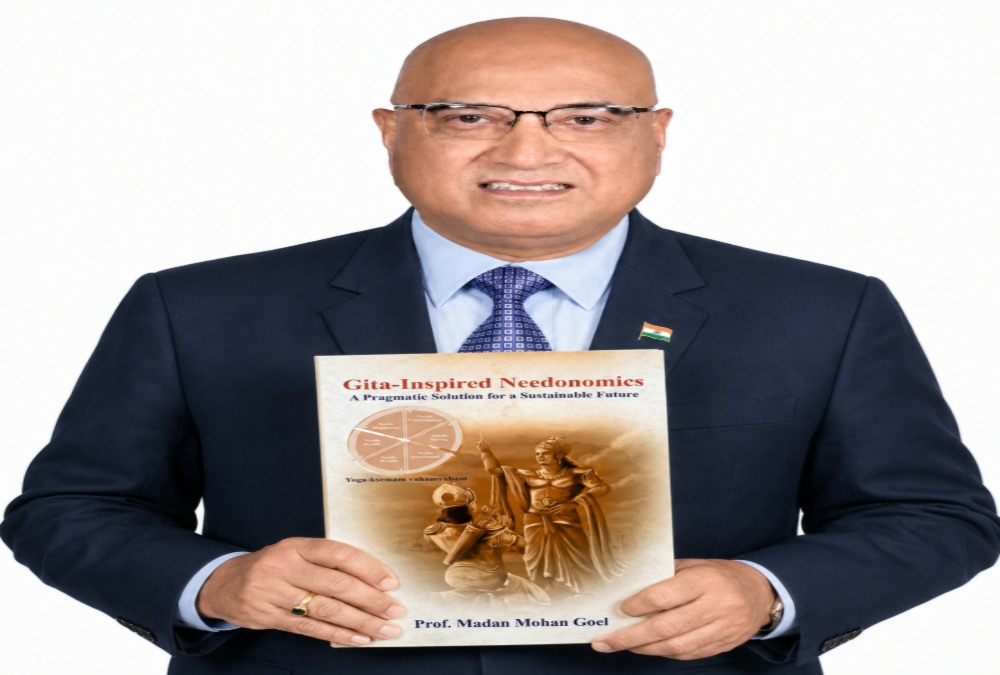
Prof. M.M. Goel Propounder, Needonomics School of Thought
October 2, 2026 marks the 157th birth anniversary of Mahatma Gandhi, whose leadership, Satyagraha and commitment to non-violence played a defining role in India’s freedom struggle and inspired movements for justice across the world. The day is observed in India as Gandhi Jayanti and internationally as the United Nations’ International Day of Non-Violence.
The UN General Assembly adopted Resolution 61/271 on June 15, 2007, designating October 2 as the International Day of Non-Violence and calling for the dissemination of the message of non-violence through education and public awareness.
For the Needonomics School of Thought (NST), a Kurukshetra-based think tank, Gandhi Jayanti provides an opportunity to extend the principle of non-violence beyond politics and social relations into the economic sphere.
1. Non-Violence in Economics
The idea of “Non-Violence in Economics” calls for an economic order in which human needs, dignity, fairness and sustainability take precedence over unrestrained greed and accumulation.
Gandhi demonstrated that resistance need not become violent to be effective. Through mass participation, non-cooperation and civil disobedience, he challenged colonial authority through moral courage and collective action. Satyagraha was not passive submission; it was a disciplined pursuit of truth without hatred or violence.
This distinction remains relevant today. Economic competition, excessive consumerism, resource pressures and unequal access to opportunities can generate tensions within societies and across nations. Economics, therefore, cannot be concerned merely with production, income and consumption; it must also consider the human consequences of economic choices.
2. From Greedonomics to Needonomics
Needonomics begins with a fundamental question: Are we consuming because we genuinely need something, or because we have been encouraged to desire more?
The distinction between need and greed is central to the Needonomics School of Thought. Greedonomics—the economics of excessive wants and accumulation—can encourage overconsumption, waste, exploitation and an endless race for more.
Such tendencies can contribute to inequality, environmental pressure and social discontent. Needonomics offers a corrective by placing Need over Greed and human welfare above the compulsive pursuit of material accumulation.
3. Needo-Consumption: Consume with Consciousness
The alternative is Needo-consumption—mindful consumption based on genuine needs rather than artificial wants or compulsive accumulation.
Needo-consumption does not reject markets, enterprise, technology or prosperity. Instead, it calls for responsibility in using them. Before making a purchase, a Needo-consumer can ask three simple questions: Is it needed? Is it affordable? Is it responsible?
These questions have both economic and ethical significance. When consumers avoid needless expenditure, producers receive clearer signals about genuine demand. When businesses respect workers, consumers and the environment, economic value can be created without imposing avoidable social costs.
Responsible consumption is not anti-growth. It is a call for better-quality growth with goodness.
4. Non-Violence Across the Economic Chain
Non-violence in economics should not be limited to consumer behaviour. It must extend across the entire economic chain—production, consumption, distribution and governance.
A business that exploits workers may be profitable, but such profit carries a social cost. A production system that damages nature may create output today while transferring costs to future generations. A government that uses public resources without prudence compromises the trust of taxpayers.
Economic non-violence therefore means reducing avoidable harm while creating value. It requires businesses to balance profit with responsibility, governments to protect public interest, consumers to exercise restraint and institutions to remain accountable.
5. Gandhi, Simplicity and Responsible Prosperity
Gandhi’s emphasis on simplicity, self-restraint and ethical living has renewed relevance in the contemporary consumer economy. Advertising, digital platforms and easy access to credit can continuously expand perceived wants.
The challenge is not consumption itself but consumption without reflection.
Needonomics consequently advocates “Need over Greed” and “Value over Volume.” Prosperity should improve the quality of life rather than merely increase the quantity of possessions. The objective is not to reject material progress but to place it within a framework of human values and social responsibility.
6. Peace, Progress and Prosperity
The global economy also requires a broader understanding of peace. Conflicts may arise from political, territorial and historical disputes, while competition over resources, markets and economic advantage can add to tensions.
No economic philosophy can eliminate war, terrorism or conflict, whose causes are complex and multidimensional. Yet moderation, fairness, cooperation and responsible resource use can help reduce some of the pressures associated with exploitation, exclusion and discontent.
The Needonomics vision is captured in PPP: Peace, Progress and Prosperity. Peace provides the foundation for development, progress expands opportunities, and prosperity should ultimately serve human welfare.
These three objectives become meaningful and sustainable when economic activity is guided by responsibility, morality and concern for the common good.
7. Responsibility of Every Stakeholder
Needonomics places responsibility on every participant in the economy.
Consumers must distinguish genuine needs from unnecessary wants.
Businesses must balance profit with social and environmental responsibility.
Governments must protect public interest and use public resources transparently and prudently.
Workers deserve dignity, fair opportunities and humane working conditions.
Citizens must recognize that economic rights are accompanied by economic responsibilities.
An economy becomes humane when responsibility is shared rather than transferred from one stakeholder to another.
8. Gandhi Jayanti as a Day of Economic Introspection
The most meaningful tribute to Gandhi cannot be confined to ceremonies, speeches or symbolic remembrance. His principles acquire contemporary relevance when translated into everyday conduct.
Truth in transactions, restraint in consumption, fairness in business, compassion in relationships and accountability in public life can collectively contribute to a culture of non-violence.
October 2 can become a day of economic introspection. Can we move from Greedonomics to Needonomics? Can excessive consumption give way to Needo-consumption? Can we pursue prosperity without compromising human dignity and nature? These are not merely economic questions. They are civilizational questions.
9. Conclusion:
Gandhi gave the world the moral force of Satyagraha—the pursuit of truth through non-violent means. Needonomics seeks to carry that spirit of restraint, responsibility and human welfare into economic behaviour. The objective is not less prosperity, but better prosperity—prosperity that is inclusive, ethical, sustainable and rooted in human dignity. On Gandhi Jayanti 2026, let us renew our commitment to Need over Greed, Values over Volumes, and responsible consumption over reckless accumulation. Let us work towards an economic order in which Peace, Progress and Prosperity reinforce one another. That would be a fitting tribute to Gandhi: not merely remembering non-violence, but practicing it in the way we consume, produce, govern and live.
