
Two Great Indian Bustards Released in Jaisalmer
Bhupender Yadav calls release a milestone in India’s decade-long effort to restore the critically endangered species

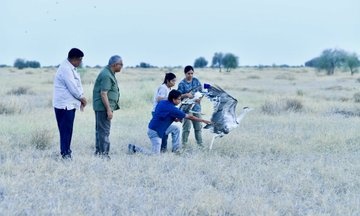
- Two male Great Indian Bustards released at Desert National Park.
- Conservation programme shifts towards rewilding and habitat recovery.
- Captive-breeding facilities currently house 97 GIBs.
- Rajasthan has developed nearly 200 sq km of protected grassland habitat.
GG News Bureau
Jaisalmer, 4th Oct: Union Environment, Forest and Climate Change Minister Bhupender Yadav on Sunday released two male Great Indian Bustards (GIBs) into the wild at Sam in Rajasthan’s Desert National Park, marking a major shift from conservation breeding towards rewilding.
The release is being seen as a significant milestone in India’s efforts to revive the critically endangered bird, with Yadav crediting nearly a decade of work by scientists, researchers and ground staff.
The release marks a transition in the national GIB conservation programme from building a viable conservation-breeding population to reintroducing birds into their natural habitat. Officials said learnings from the release will be used to improve protocols for subsequent releases.
Yadav also thanked Prime Minister Narendra Modi for his continued guidance and support for scientific efforts aimed at conserving the Great Indian Bustard and other endangered species.
The Bustard Recovery Programme is being implemented jointly by the Ministry of Environment, Forest and Climate Change, the Rajasthan Forest Department and the Wildlife Institute of India (WII), with technical collaboration from the International Fund for Houbara Conservation and financial support from National CAMPA.
The GIB conservation-breeding facilities at Sam and Ramdevra currently house 97 birds. Of these, 40 originated from wild-laid eggs and 57 were bred in captivity.
A total of 86 birds are being maintained for captive reproduction, while 11 have been earmarked for release into the wild. Two of those 11 birds were released on Sunday.
The breeding programme produced 24 live chicks in 2025 and 29 in 2026, strengthening hopes of building a sustainable population.
Scientists have also used innovative methods, including the ‘jumpstart’ approach, under which captive-laid eggs were placed in wild nests. Wild females accepted the eggs, resulting in six chicks hatching in Rajasthan and two in Gujarat.
Habitat restoration is another major component of the programme. The Rajasthan Forest Department has established around 200 sq km of fenced grassland enclosures within the Desert National Park. Long-term telemetry studies by WII have identified these areas as important breeding habitats for the species.
The conservation programme also includes habitat management, threat mitigation, habitat restoration and community engagement.
The latest release is expected to provide valuable scientific and field experience for future efforts to increase the Great Indian Bustard population in its natural habitat.
