
SC Declares Internet Access Fundamental Right, Orders Child Safety Database
Court directs Centre to establish a National Hash & URL List Database to detect and remove child sexual exploitation material, while recommending safer social media settings for children.

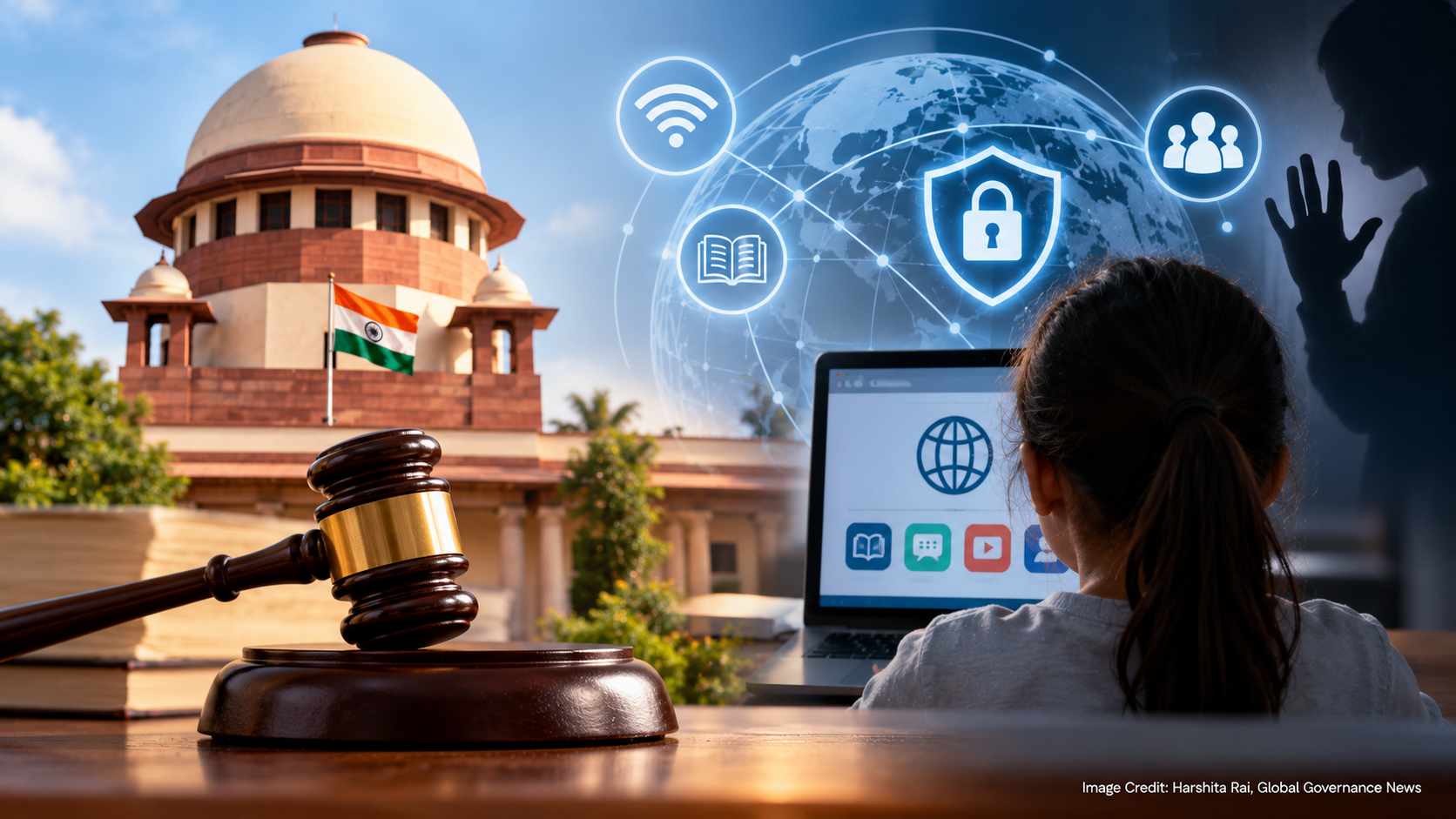
- Supreme Court recognises internet access rights
- Centre directed to establish national CSEAM database
- Child mode proposed for social media accounts
- Court calls for stronger online safety education
GG News Bureau
New Delhi, 26th Oct: The Supreme Court has declared access to and use of the internet a fundamental right for every individual, including children, and directed the Union government to establish a national database to detect and remove Child Sexual Exploitation and Abuse Material (CSEAM) from digital platforms.
A bench comprising Justice J.B. Pardiwala and Justice K. Vinod Chandran also suggested introducing a dedicated “child mode” for social media accounts, with stronger safeguards around parental consent, guidance and supervision.
The court observed that the right to access and use the internet is protected under Article 21, read with Article 19(1)(a) of the Constitution. It emphasised that children enjoy the same rights and that their safety and freedom are not mutually exclusive.
The observations came in the case of Just Rights for Children Alliance and Another v. S. Harish and Others. The court acknowledged that the internet presents serious risks to children but cautioned against restricting their access simply because digital platforms have failed to identify and remove harmful content.
National Database To Target Illegal Material
The court directed the creation of a National Hash & URL List Database to help identify and remove CSEAM. It said each entry must undergo multiple levels of verification, with the final screening conducted by at least three trained human analysts independently assessing whether the material qualifies as CSEAM.
Digital intermediaries will be required to check their platforms against verified database entries and promptly remove matching material. Law enforcement agencies will also use the database to help identify and address such content.
Where an intermediary identifies a match involving known CSEAM, it must immediately disable access to and remove the material without waiting for further verification at its end. The Ministry of Electronics and Information Technology (MeitY) will periodically revise the relevant guidelines and standard operating procedures.
The court directed the Union government to formulate the necessary guidelines, standard operating procedures and amendments to implement the framework.
Child Mode And Stronger Online Safeguards
On child mode, the court suggested measures such as private-by-default accounts, restrictions on contact and messages from unknown adults, and greater control over advertising and content accessible to children. Such safeguards may be introduced for pre-teens, with reasonable and proportionate methods of verifying parental consent.
The court also called on the Union and state governments, child rights commissions and other stakeholders to educate children about safe internet use, data protection and online privacy. Awareness programmes should help children recognise grooming, sexual extortion and other forms of online exploitation and abuse.
Senior advocate H.S. Phoolka, representing the petitioner, said the order provides a practical roadmap for strengthening online child protection, including immediate removal of illegal material, police reporting within two hours, dedicated grievance officers and a uniform reporting mechanism.
Rachna Tyagi, who represented Just Rights for Children Alliance, welcomed the ruling, stressing that platforms must comply with the law and report child sexual abuse material as required under the Protection of Children from Sexual Offences (POCSO) Act. She said removing such material without reporting it to the authorities would not be sufficient.
