
Kishtwar Gets New Seismological Observatory
Dr Jitendra Singh inaugurates earthquake monitoring facility as J&K Expands Disaster Monitoring Network; four new Doppler Weather Radars planned for 2027 to strengthen early warning systems

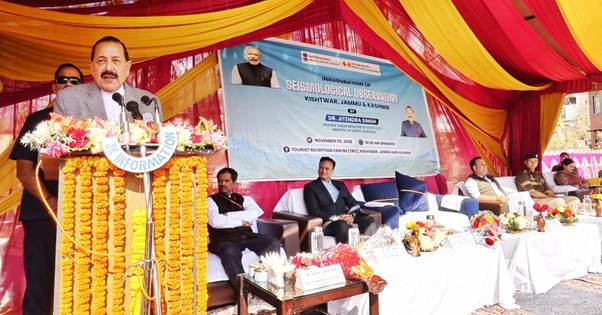
- New Seismological Observatory inaugurated in high-risk Kishtwar.
- Four Doppler Weather Radars planned for 2027, taking the regional total to eight.
- Automatic Weather Stations increased to 12 and Rain Gauge Stations to 15.
- Weather forecasts and agromet advisories now reach all Panchayats across five districts.
GG News Bureau
Kishtwar, 2nd Nov: Jammu and Kashmir has strengthened its disaster preparedness infrastructure with the inauguration of a new Seismological Observatory in Kishtwar, a high seismic risk region, by Union Minister Dr Jitendra Singh on Monday.
The facility, established under the Ministry of Earth Sciences, is equipped with advanced digital seismic instruments and will transmit earthquake-related data in real time to the National Centre for Seismology’s 24-hour monitoring centre in New Delhi.
With the addition of Kishtwar, Jammu and Kashmir now has four Seismological Observatories, located in Jammu, Srinagar, Udhampur and Kishtwar.
Addressing the inauguration, Singh highlighted the expansion of weather monitoring infrastructure across the region since 2014, particularly in the erstwhile Doda district. He said the improved network would help authorities monitor earthquakes, landslides, cloudbursts and other weather-related risks.
Doppler radar network to reach eight
Singh said Jammu and Kashmir had no Doppler Weather Radar in 2014. Four radars have since been installed at Banihal, Jot, Jammu and Srinagar.
Four additional Doppler Weather Radars are scheduled for commissioning in 2027 at Doda, Kishtwar, Anantnag and Baramulla, taking the regional network to eight.
The Minister also highlighted the expansion of Automatic Weather Stations from three to 12. The existing network now includes four stations in Kishtwar, two each in Doda and Ramban, and one in Kathua, alongside the earlier installations at Udhampur, Kathua and Ramban.
Rainfall monitoring has also been strengthened, with Rain Gauge Stations increasing from nine to 15 across the five districts of the parliamentary constituency.
Weather alerts reach Panchayats
The Minister said weather forecasts and agrometeorological advisories were now being disseminated across all Panchayats in the five districts. These services have reached 5,467 beneficiaries, providing local communities with access to weather-related information.
He also highlighted the High-Altitude Cloud Physics Laboratory at Patnitop and the Regional Meteorological Centre in Jammu as important additions to the region’s scientific infrastructure.
Referring to the Chasoti cloudburst tragedy last year, Singh said the expansion of monitoring facilities had been guided by the geographical vulnerabilities of the region and the need to improve disaster preparedness.
Minister urges people to follow scientific warnings
Singh stressed that scientific weather alerts could save lives only when people took them seriously and followed official advisories.
He recalled an instance when traffic restrictions were imposed following a weather warning, with subsequent damage to a highway demonstrating the importance of timely precautions.
“Information is important, but following the information is equally important,” he said, urging residents to cooperate with the administration during adverse weather conditions.
He also cautioned against unverified and alarmist information, calling for greater reliance on scientific assessments and credible sources.
The event was attended by Dr Srinivasa Kumar Tummala, Secretary, Ministry of Earth Sciences; Sunil Sharma, MLA from Padder-Nagseni and Leader of Opposition in the J&K Legislative Assembly; Kishtwar MLA Shagun Parihar; Deputy Commissioner Pankaj Sharma; SSP Sunny Gupta and other officials and public representatives.
