
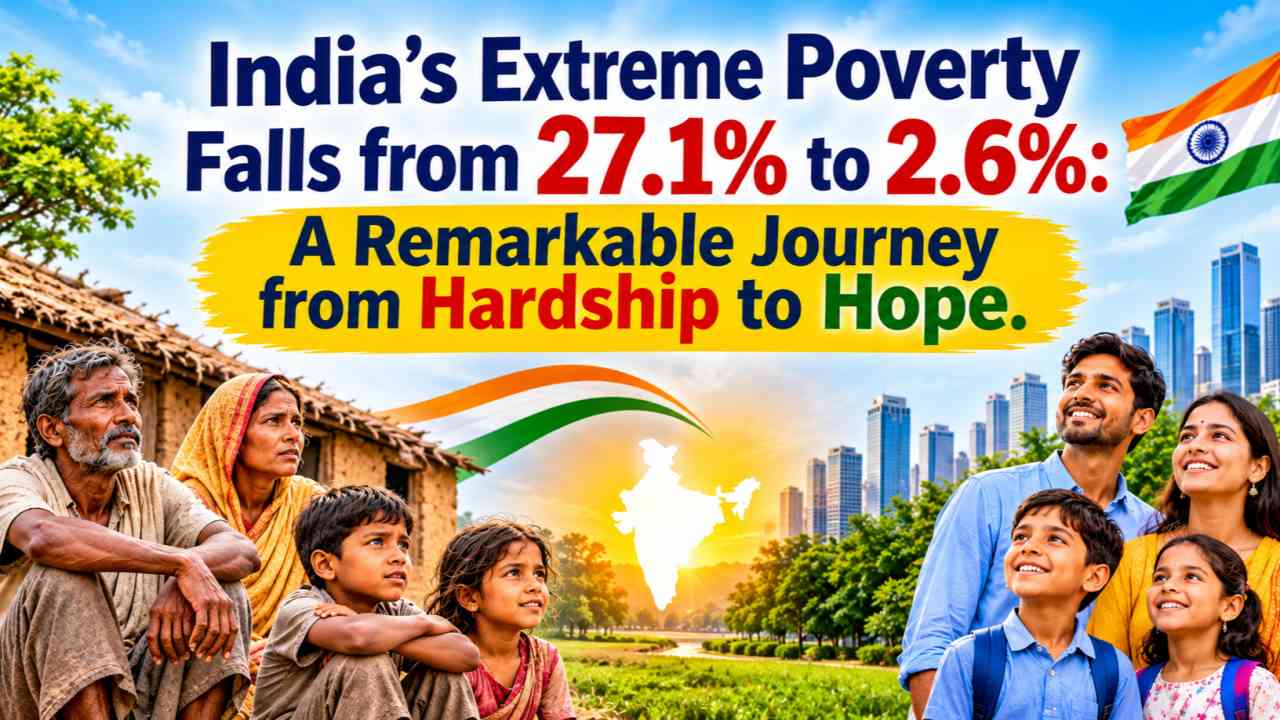
India’s Extreme Poverty Falls from 27.1% to 2.6%: A Remarkable Journey from Hardship to Hope
At the World Bank’s extreme-poverty threshold of $3 per person per day, India’s poverty rate declined sharply between 2011 and 2023.


A nation’s progress is not measured only by the height of its buildings, the size of its economy or the sophistication of its technology. It is also measured by how many people gain the freedom to look beyond their next meal and begin imagining a better tomorrow.
On that measure, India has a remarkable story to tell.
The World Bank’s October 2026 India Poverty and Equity Brief estimates that the proportion of Indians living in extreme poverty fell from 27.1% in 2011 to 2.6% in 2023.
At a separate, higher poverty threshold used for lower-middle-income countries, approximately 496 million Indians moved above the line during the same period.
That is 49.6 crore people.
These figures describe two different measures of poverty reduction. Together, they convey something extraordinary: deprivation need not be destiny.
Understanding the achievement
One distinction matters at the outset. India’s achievement is a reduction in the number and proportion of people living below poverty thresholds, not a reduction in the poverty line itself.
The World Bank’s assessment uses international benchmarks expressed in 2021 purchasing power parity terms. This adjustment accounts for differences in what money can buy across countries, rather than simply converting local spending into US dollars at market exchange rates.
At the extreme-poverty threshold of $3 per person per day, India’s poverty rate declined from 27.1% to 2.6%.
At the $4.20-per-person-per-day threshold used for lower-middle-income countries, the rate fell from 57.7% to 16.1%. The estimated reduction of 496 million people relates to this higher benchmark, not to the extreme-poverty measure.
The report was published in 2026, while these outcomes relate to the period ending in 2023. Keeping the measures and dates clear makes the achievement more credible, not less impressive.
Behind the numbers, a different horizon
Poverty narrows the horizon of human choice.
When almost every resource goes towards surviving today, tomorrow becomes difficult to plan. Education competes with immediate earnings. Healthcare competes with household expenses. Ambition competes with uncertainty.
Moving above a poverty threshold does not automatically remove these pressures. But it can mark the beginning of something profoundly important: greater room to choose.
The human meaning of progress lies in possibilities such as a child remaining in school, a household building a small financial cushion, or a worker gaining the confidence to pursue a better opportunity.
These are not individual case histories drawn from the report. They are the aspirations that make poverty reduction matter.
For a family accustomed to uncertainty, even a modest improvement can change the conversation at home. The question can gradually shift from “How will we manage today?” to “What can we build for tomorrow?”
That shift is the promise behind the statistics.
A national achievement with millions of contributors
The World Bank’s assessment links the decline principally to stronger consumption, rising employment, particularly among women, and expanded social transfers, including food subsidies.
That combination offers an important lesson. Economic opportunity and social protection need not be competing ideas. They can reinforce each other.
Employment can strengthen a household’s capacity to earn. Social support can help protect basic consumption. Together, they can create a firmer foundation for progress.
Yet no national statistic should eclipse the effort of citizens themselves.
India’s development story belongs also to workers who persevere, women who expand their economic participation, entrepreneurs who create livelihoods, and families who invest in the next generation.
It is a story of public action and private determination, of institutional effort and individual resilience.
For Indians, this is a legitimate source of pride. For the world, it is a reason to take seriously the possibility of large-scale change.
Pride must lead to a higher ambition
An inspirational account must also be an honest one.
Crossing a poverty line is not the same as entering the middle class. Nor does it guarantee a secure job, affordable healthcare, quality education or protection against a financial shock.
The World Bank flags continuing concerns around employment quality, weak real earnings and unequal access to opportunity. It also cautions that changes in survey measurement may account for part of the recorded improvement alongside genuine gains in welfare.
Acknowledging these limitations does not diminish India’s progress. It clarifies the next task.
The ambition must now extend beyond helping people cross a statistical threshold. It must include helping them remain above it and move steadily towards lasting economic security.
The next chapter should therefore be judged not only by how many people escape poverty, but also by how securely they can build their lives afterwards.
Better livelihoods, stronger human capabilities and wider access to opportunity must carry the achievement forward.
What India’s story offers the world
For a global audience, the significance of India’s experience lies in its scale.
Progress affecting hundreds of millions of people changes the conversation about what development can achieve. It challenges resignation. It gives substance to hope.
But this should not become a story of national self-congratulation alone. Its deeper value lies in the responsibility it creates.
For business leaders, that means treating productive employment and workforce development as part of value creation. For institutions, it means connecting economic growth more effectively with opportunity. For citizens, it means recognising that national progress becomes meaningful when more people can participate in it.
India has powerful reasons to celebrate how far it has travelled.
Its greater opportunity is to ensure that those who have escaped poverty never have to return, and that those still waiting are not forgotten.
The most inspiring message is not that India’s work is finished.
It is that progress on an extraordinary scale is possible, and that the next chapter can be more ambitious still.
Sources and reporting notes
- World Bank, India Poverty and Equity Brief: October 2026. Primary source for the poverty thresholds, reporting period and headline estimates. documents. world bank
- The Economic Times, reporting on the World Bank’s findings, including the drivers of poverty reduction, employment challenges and measurement caveats. economic times
- The Indian Express, explanation of the latest extreme-poverty estimates and the purchasing power parity benchmark.
About Author-
Shri Rajiv Tiwari is Senior Media Professional, Decision Partner to Leaders, Growth Consultant & Founder, Community Media Network based in New Delhi.
