
El Niño Likely Till February 2027: Govt
Government says AI-based forecasting indicates continued El Niño, while multiple climate factors will determine monsoon impact

- INCOIS forecasts El Niño to persist till February 2027 with 70–90% probability.
- Centre says Indian monsoon depends on multiple climate drivers, not El Niño alone.
- Indigenous AI/ML system developed for ENSO forecasting with uncertainty estimates.
- Government strengthens ocean forecasting and coastal early warning systems.
GG News Bureau
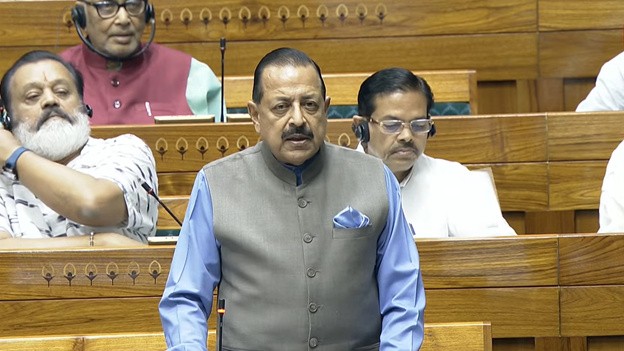
New Delhi, 5th Aug: Union Minister of State (Independent Charge) for Science and Technology and Earth Sciences Dr. Jitendra Singh informed the Lok Sabha that El Niño conditions, which developed in May 2026, are likely to persist until February 2027, according to the latest assessment by the Indian National Centre for Ocean Information Services (INCOIS).
The Minister said the forecast, based on INCOIS’ indigenous Artificial Intelligence and Machine Learning (AI/ML)-based El Niño Southern Oscillation (ENSO) prediction system and the Global Ocean Data Assimilation System, indicates a 70 to 90 per cent probability of El Niño continuing through the period.
Dr. Singh clarified that while El Niño has historically been associated with weaker Indian summer monsoon rainfall in some regions, it is not the sole factor determining monsoon performance. He said the Indian Ocean Dipole (IOD), Madden-Julian Oscillation (MJO) and regional ocean-atmosphere interactions also play a significant role.
He said the evolving El Niño could influence atmospheric circulation over the Arabian Sea and Bay of Bengal, increase the likelihood of marine heatwaves and affect marine ecosystems, fisheries and coastal activities.
The Minister said the government has strengthened Ocean State Forecasting and marine multi-hazard early warning services through high-resolution forecasting models, expanded ocean observation networks and advanced data assimilation systems. He added that advisories, stakeholder training and awareness programmes are being conducted to improve preparedness among coastal communities.
Dr. Singh also informed the House that ₹145.06 crore has been allocated under the Deep Ocean Mission during the current financial year for marine resource mapping and exploration using advanced underwater technologies.
