
IMD Launches AI-Based Hyper-Local Weather Forecast Systems
Jitendra Singh launches advanced AI-based monsoon and rainfall forecasting platforms

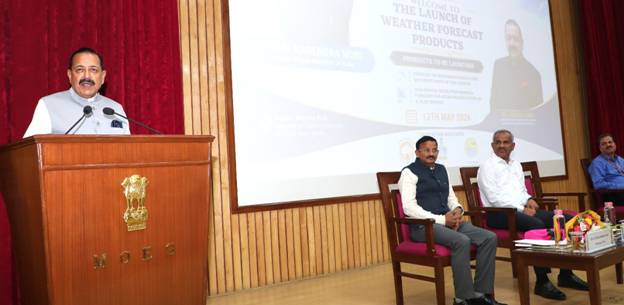
- IMD launches AI-enabled monsoon forecasting system
- New platform to provide forecasts up to 10 days in advance
- Hyper-local weather services introduced for 16 states and 3,000 sub-districts
- Uttar Pradesh gets pilot 1-km resolution rainfall forecast system
GG News Bureau
New Delhi, 12th May: Union Minister Jitendra Singh on Tuesday launched two advanced AI-enabled weather forecasting systems aimed at providing hyper-local and impact-based weather information across the country.
The systems were launched under the Ministry of Earth Sciences and developed jointly by the India Meteorological Department, Indian Institute of Tropical Meteorology and National Centre for Medium Range Weather Forecasting.
The newly launched products include India’s first AI-driven “Forecast of Monsoon Advance over Different Parts of the Country” and a “High Spatial Resolution Rainfall Forecast for Uttar Pradesh” pilot service.
Forecasts Up to 10 Days in Advance
Jitendra Singh said the new systems marked a major shift from conventional forecasting towards decision-support and impact-based weather forecasting.
According to the Minister, the AI-enabled monsoon forecasting platform will provide probabilistic forecasts of monsoon progression every Wednesday up to four weeks in advance.
The service is designed to support farmers across 16 states and more than 3,000 sub-districts through the dissemination network of the Agriculture Ministry.
The Uttar Pradesh pilot project will generate rainfall forecasts at 1-km spatial resolution up to 10 days ahead using AI-driven downscaling techniques.
The system integrates data from Automatic Rain Gauges, Automatic Weather Stations, Doppler Weather Radars and satellite-based rainfall datasets.
IMD’s Expanding Weather Infrastructure
The Minister said India’s weather forecasting capabilities had improved significantly over the past decade due to technological advancements and infrastructure expansion.
He noted that the number of Doppler Weather Radars in the country had increased from around 16-17 nearly a decade ago to about 50 currently, with another 50 planned under Mission Mausam.
Dr Singh said IMD had become an essential component of governance, agriculture planning, disaster preparedness and public decision-making.
He added that weather advisories and warnings are now being disseminated through mobile applications, SMS alerts, WhatsApp, television and Kisan portals to improve last-mile connectivity.
Better Accuracy for Extreme Weather Events
The Minister said India had witnessed nearly 40 per cent improvement in severe weather forecast accuracy during the past decade.
He added that cyclone track, intensity and landfall forecasts for 72 hours had improved by nearly 30-35 per cent in the last five years.
Jitendra Singh said changing climate patterns and increasing extreme weather events made accurate forecasting more critical than ever before.
He said the government under Prime Minister Narendra Modi was modernising weather forecasting systems through initiatives such as Mission Mausam, radar expansion and enhanced computing infrastructure.
The Minister described the new AI-driven forecasting products as another step towards building a climate-resilient and citizen-centric weather service system in India.
