
India Targets No. 1 Position in Global Silk Production: Giriraj Singh
Government aims to raise silk output to 60,000 tonnes by 2030-31 as Central Silk Board marks 77th Foundation Day

- India’s silk production has risen from 26,000 tonnes in 2014 to 42,000 tonnes currently.
- The government targets 60,000 tonnes of silk production by 2030-31.
- India aims to attain the No. 1 position globally in silk production by 2028-29.
- Karnataka remains the leading silk-producing state, according to Union Minister Shobha Karandlaje.
GG News Bureau
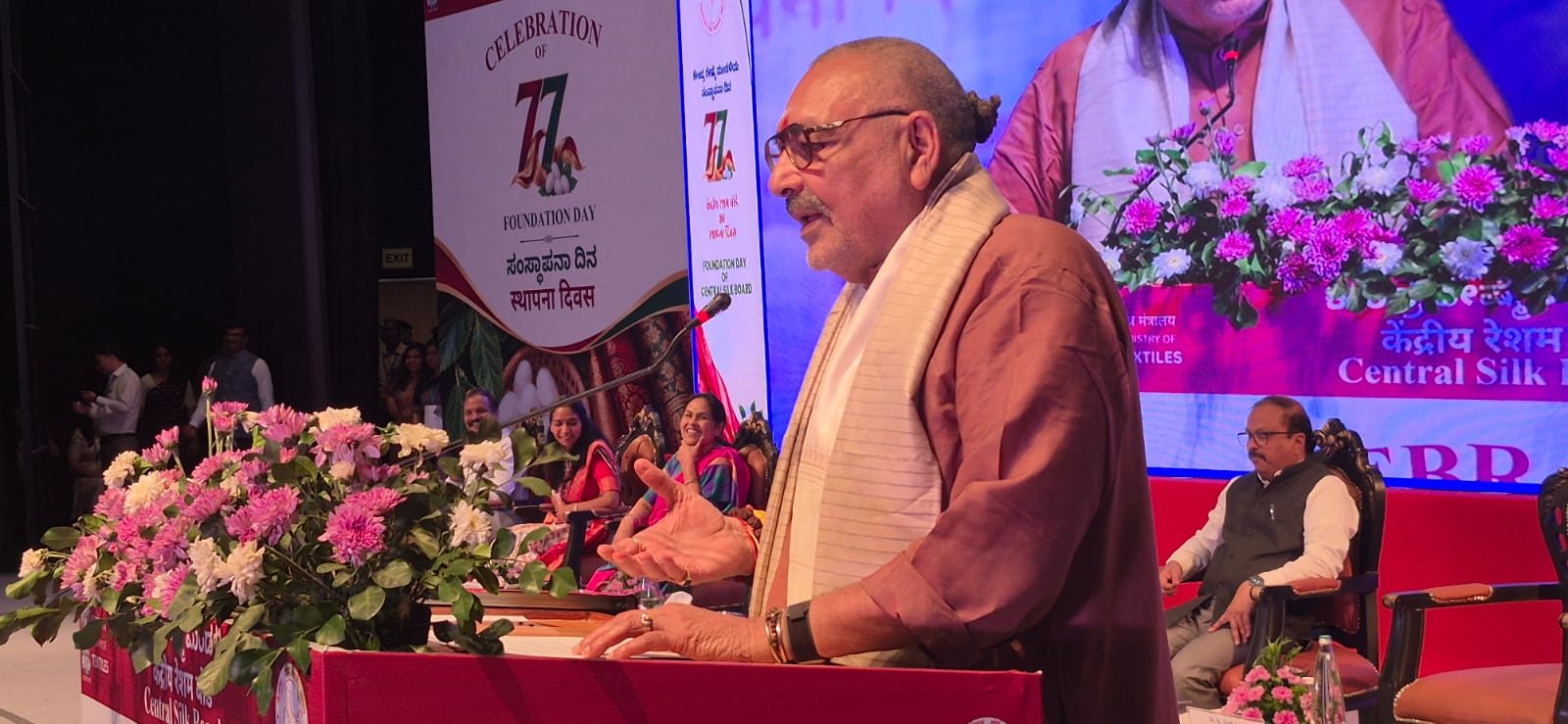
Bengaluru, 21st Sept: Union Textiles Minister Giriraj Singh said on Sunday that the government is working to make India the world’s leading silk producer by 2028-29, while aiming to increase national silk production to 60,000 metric tonnes by 2030-31.
Singh made the remarks while inaugurating the 77th Foundation Day programme of the Central Silk Board (CSB) and an exhibition of silk products and technologies at the University of Agricultural Sciences-GKVK auditorium in Bengaluru.
The minister said India’s silk production has increased from 26,000 metric tonnes in 2014 to 42,000 metric tonnes currently. He said efforts are being made to improve mulberry leaf yields and increase cocoon-rearing cycles, with the objective of raising annual incomes of sericulture farmers to between ₹10 lakh and ₹12 lakh.
‘Best Silk Farmer’ awards proposed
Singh called for ‘Best Silk Farmer’ competitions at district, state and national levels to encourage competition and innovation among sericulture farmers.
He also stressed the need to ensure that scientific innovations, improved hybrid varieties and modern machinery reach farmers directly.
The minister said international demand for Indian silk is increasing while China’s silk production is declining. He emphasised strengthening the complete value chain, from sericulture and reeling to weaving, while improving economic security for weavers and workers.
Karnataka leads silk production
Union Minister of State Shobha Karandlaje said Karnataka holds the leading position in India’s total silk production and highlighted the government’s focus on infrastructure and industrial development in the sector.
She said modern technologies and high-density production methods are being promoted to improve quality and help Indian silk meet international export standards. Government subsidy and quality-improvement schemes are also being implemented to support entrepreneurs registered under the MSME framework.
AI and advanced technology to boost production
Padmini Singla, Joint Secretary (Silk), Ministry of Textiles, said the government is introducing high-yielding silkworm hybrids and modern machinery to achieve the 60,000-tonne production target.
She also highlighted the planned use of Artificial Intelligence, GIS and Machine Learning for quality inspection and improving production capacity.
The event also witnessed the exchange of MoUs between the Central Silk Board and various organisations, distribution of appointment letters to 28 scientists, presentation of awards to outstanding employees and stakeholders, and release of CSB publications and periodicals.
