

By Anjali Sharma
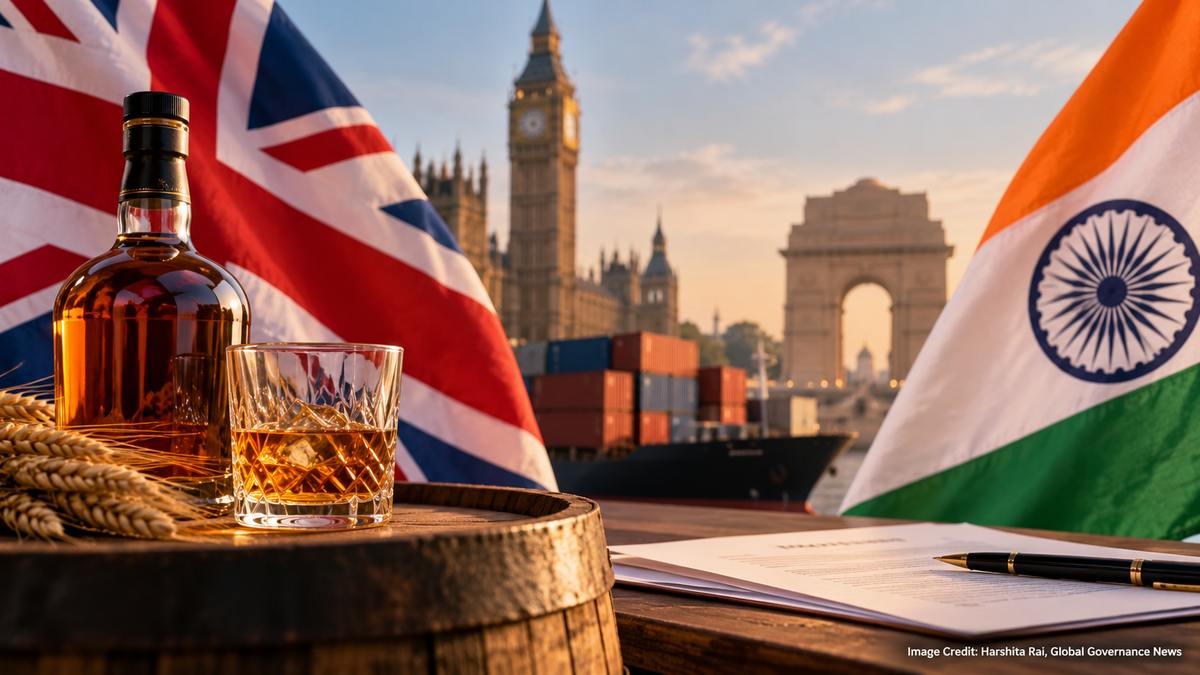
WASHINGTON – Britain on Saturday has intervened in a dispute over India’s investigation into Scotch whisky imports, as global liquor giants Diageo and Pernod Ricard face demands to pay double the import duty they believe applies under the India-UK trade agreement.
Indian revenue investigators searched liquor company offices this month over customs classifications used for imported whisky concentrates.
An industry association has sought urgent government clarification, media reported
The British government said it was in talks with New Delhi to resolve the controversy, which centres on whether bulk Scotch concentrates used in popular Indian whisky brands qualify for a reduced 75 per cent tariff or remain subject to the earlier 150 per cent duty.
The intervention follows a warning from the International Spirits and Wines Association of India which represents major liquor companies that the tax investigation threatens a significant commercial benefit negotiated under the bilateral trade agreement.
UK government spokesperson told media in its first public response to the controversy that “We are working with the government of India to resolve this issue to ensure UK businesses can export under the tariffs agreed in the trade deal.”
The dispute concerns bulk Scotch concentrates imported from Britain and blended with other ingredients in India to produce whisky brands such as Royal Stag, Blenders Pride and McDowell’s.
Indian authorities are investigating whether the companies incorrectly classified these imports to claim preferential duties under the trade agreement.
The Directorate of Revenue Intelligence searched offices linked to Diageo and Pernod Ricard this month and questioned executives as part of the investigation media reported.
According to people familiar with the investigation cited by media that tax officials maintain that bulk Scotch concentrates fall under a customs classification that attracts a 150 per cent duty rather than the preferential 75%.
The companies dispute that interpretation and believe the imports qualify for the lower tariff.
ISWAI in a letter to Commerce and Industry Minister Piyush Goyal warned that the classification dispute “risks undermining, in practice, an important market-access benefit negotiated and agreed between India and the United Kingdom”.
The association said the preferential tariff “could effectively become unavailable” for the affected imports.
It sought urgent clarification from the government to prevent disruption to businesses that expected to benefit from the agreement.
The Scotch Whisky Association also expressed concern over the dispute, it stressed that bulk Scotch imports play an important role in the industry’s business in India.
The association said it was “committed to working in partnership with the UK and Indian governments on the smooth implementation of the deal”.
The India-UK Comprehensive Economic and Trade Agreement which came into force on July 15, 2026, reduced Indian import duties on qualifying Scotch whisky from 150 per cent to 75 per cent.
The agreement provides reductions to 40% over 10 years, a key market-access concession secured by Britain after years of negotiations.
The investigation has exposed a disagreement over which whisky imports qualify for those concessions.
The dispute carrie with implications beyond the two companies.
According to Crisil Ratings the Scotch whisky responsible for much of that trade.
Britain accounts for three-quarters of India’s imported spirits market,
Diageo and Pernod Ricard are major players in India’s alcohol industry, where imported Scotch concentrates form part of the production process for widely sold domestic whisky brands.
The investigation has emerged as an early significant disagreement over implementation of the trade agreement, over 3 months after it took effect.
