
Jadhav Calls for Prevention-Focused Healthcare
Ayush Minister stresses scientific validation, quality standards and wider access to Yoga and Naturopathy

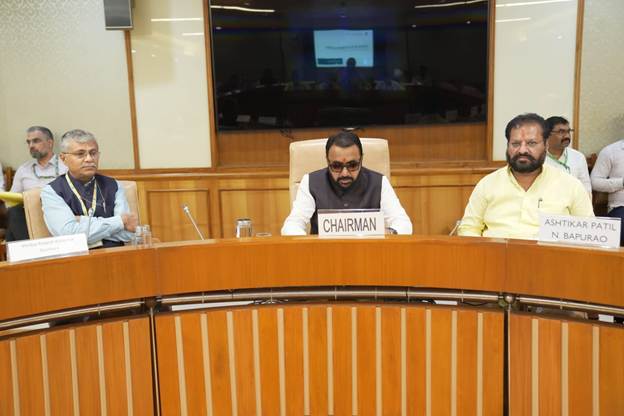
- Prataprao Jadhav chaired the fifth Ayush Parliamentary Consultative Committee meeting.
- He stressed prevention and healthy lifestyles alongside disease treatment.
- Committee backed stronger education, research and regulatory standards.
- Seven priorities were outlined to expand Yoga and Naturopathy nationwide.
GG News Bureau
New Delhi, 10th Aug: Union Minister of State for Ayush Prataprao Jadhav on Monday stressed the need to place disease prevention and healthy lifestyles alongside disease treatment, highlighting the role of Yoga and Naturopathy in preventive healthcare and holistic well-being.
Jadhav chaired the fifth meeting of the Parliamentary Consultative Committee of the Ministry of Ayush in New Delhi, which focused on strengthening Yoga and Naturopathy through education, research, quality standards and wider community access.
The Minister said Yoga and Naturopathy represent important components of India’s traditional knowledge systems, with Yoga supporting physical, mental and emotional well-being and Naturopathy focusing on nutrition, lifestyle modification, natural therapies and the body’s healing capacity.
Highlighting the growing burden of non-communicable diseases, stress and mental health challenges, Jadhav said greater emphasis is needed on prevention, healthy ageing, rehabilitation and wellness. He noted that Yoga and Naturopathy can support areas including stress and pain management, mental health, rehabilitation and active ageing.
Focus on Scientific Evidence and Quality
Jadhav called for India’s traditional knowledge systems to be integrated with modern scientific research and evidence. He said, “Tradition is our strength, science is its evidence, and quality is our priority.”
The Minister highlighted institutions including the Morarji Desai National Institute of Yoga, Yoga Certification Board, National Institute of Naturopathy, Central Council for Research in Yoga and Naturopathy and Naturopathy Registration Board as key components of the institutional framework.
A presentation to the committee highlighted 22 CCRYN units, more than 100 universities offering Yoga courses, over 5,000 Yoga centres, 113 accredited institutions and 29 accredited Personnel Certification Bodies. The Ministry also cited a research base of more than 10,500 peer-reviewed, PubMed-indexed publications.
Members of Parliament and experts supported the need for a unified regulatory mechanism for education in Yoga and Naturopathy.
The Ministry identified seven priority areas, including strengthening education and infrastructure, promoting scientific research, improving certification and accreditation, strengthening registration and quality assurance, expanding community-level access, promoting wellness tourism and taking India’s Yoga and Naturopathy traditions to the global stage with scientific evidence and quality standards.
The meeting reaffirmed the importance of coordination among the Ministry, Parliament and stakeholders to develop Yoga and Naturopathy as evidence-based and accessible systems of preventive healthcare.
