

By Anjali Sharma
UNITED NATIONS – UN Security Council on Tuesday has failed to adopt a resolution aimed to boost security in the Strait of Hormuz as the critical shipping corridor remains largely closed to global trade and the transport of humanitarian aid, with war continuing to rage across the region.
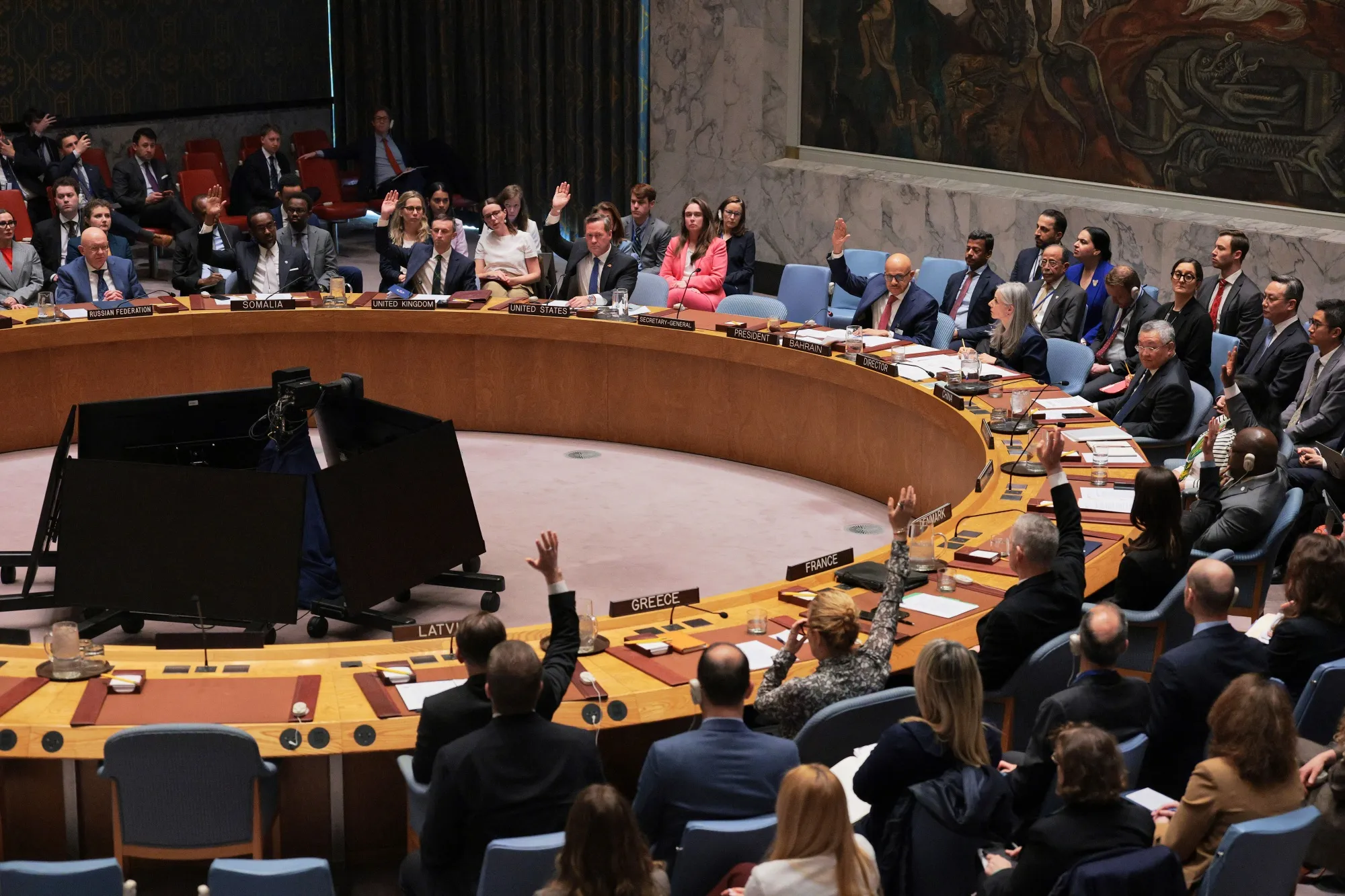
The draft resolution tabled by Bahrain received 11 votes in favor, 2 abstentions and 2 voted against were China and Russia vetoed, Colombia and Pakistan abstained.
The draft resolution sought to strongly encourage States interested in the use of commercial maritime routes in the Strait of Hormuz which lies between Iran, Oman and the United Arab Emirates and to “coordinate efforts” defensively, to contribute to ensuring the safety and security of navigation there, including the use of escorts for merchant and commercial vessels.
The draft also demanded that Iran immediately cease all attacks on shipping and any attempt to impede transit or freedom of navigation in the strait.
The text was submitted by Bahrain which was cosponsored by Jordan, Kuwait, Qatar, Saudi Arabia and the United Arab Emirates.
Bahrain’s Foreign Minister Abdullatif bin Rashid Al Zayani expressed regret on the failing of the resolution.
He said “The Council failed to shoulder its responsibility in relation to an illegal conduct that requires decisive action with no delay.”
“Failing to adopt this resolution sends the wrong signal to the world, to the peoples of the world, the signal that the threat to international waterways can pass without any decisive action by the international organization responsible for the maintenance of international peace and security.”
US Ambassador to the UN Mike Waltz said that his country stands with Bahrain and the people of the Gulf “at this moment of reckoning.”
He told the Council that 47 years ago, the Iranian regime’s first act was to take dozens of Americans hostage.
“Now it’s taking the Strait of Hormuz hostage, and with it, attempting to take the world’s economy hostage. Well, colleagues, that may be its last act. We’ll see,” he said.
He stressed that “the Strait of Hormuz is too vital to the world to be used as hostage, to be choked, to be weaponized by any one State.”
Russian Ambassador Vassily Nebenzia said that the resolution presented Iranian actions as the sole source of regional tensions while illegal attacks by the United States and Israel were “not mentioned at all”.
Chinese Ambassador Fu Cong said the draft “failed to capture the root causes and the full picture of the conflict in a comprehensive and balanced manner.”
He expressed hope that peace and stability would be restored and affirmed China’s commitment to addressing the situation properly by tackling the root causes.
Iran envoy Ambassador Amir Saeid Iravani said the draft sought “to punish the victim for defending its sovereignty and vital national interests in the Persian Gulf and the Strait of Hormuz, while providing political and legal cover for further unlawful acts by the aggressors.”
The humanitarian and economic pressures grow in the region as Russia and China veto resolution on Strait of Hormuz
Security Council resolution put forward by Gulf States to ensure safety and security of ships in the Strait of Hormuz
Abdullatif bin Rashid al Zayani, Minister for Foreign Affairs of Bahrain and Council President for April has chaired the session.
Bahrain, DR Congo, Denmark, France, Greece, Latvia, Liberia, Panama, Somalia, United Kingdom, United States voted in favor
Against (2): China, Russia
Abstentions (2): Colombia, Pakistan
Abdullatif bin Rashid Al Zayani said “Failing to adopt this resolution sends the wrong signal to the world, the people of the world – a signal that threats to international waterways can pass without any decisive action by the international community,” he said, speaking in national capacity.
He added that the Council should shoulder its responsibility, emphasizing that the draft had been intended as a step towards ensuring freedom of navigation in the Strait, while also calling on Iran to fully comply with its obligations and cease attacking its neighbours.
United States stands firmly with Middle East partners at ‘moment of reckoning’. “The strait of Hormuz is too vital to the world to be used as hostage, to be chocked, to be weaponized by any one State,” said US Ambassador Michael Waltz.
US stands with the people of the Gulf, by contrast, China and Russia “sided with a regime that seeks to intimidate the Gulf into submission”.
He recalled that “the Iranian regime’s first act was to take dozens of Americans hostage” 47 years ago.
Walz said that it now takes the Strait of Hormuz hostage and, with it, the world’s economy. “Well, colleagues, that may be its last act. We’ll see,” he added.
The request from Bahrain was not unreasonable, he continued. It was a simple resolution; Iran must stop attacking the Gulf,” he said, adding that “when critical shipments are delayed – the world will know who exactly chose obstruction over responsibility.”
UN High Commissioner for Human Rights has urged the international community to take urgent steps to de-escalate the conflict in the Middle East and help protect civilian lives.
“This is sickening. Carrying through on such threats amounts to the most serious international crimes.”
His statement follows US President Donald Trump stated that “a whole civilization will die tonight, never to be brought back again” if Iran does not agree to open the Strait of Hormuz maritime corridor.
Pakistan Ambassador to the UN said at this critical juncture, restraint, diplomacy and dialogue must prevail.
Asim Iftikhar Ahmad, the Ambassador of Pakistan said “Our objective is clear – a permanent end to hostilities, containing the expansion of this conflict and preventing any further loss of civilian life or destruction of critical infrastructure,”.
Pakistan has been actively engaged in diplomatic efforts towards that end in concert with its partners in the region and beyond, he said, adding that last week, China and Pakistan announced a five-point initiative.
It includes: a sequenced road map encapsulating an immediate halt to hostilities; launch of inclusive peace talks; protection of civilians and critical infrastructure; restoration of maritime security in the Strait of Hormuz; and a firm reaffirmation of the UN Charter and international law as the indispensable framework for a lasting political settlement.
Russian Ambassador Vassily Nebenzia said that his delegation voted against the text, which constituted a “fundamentally erroneous and dangerous approach to the situation in the region.
The resolution presented Iranian actions as the sole source of regional tensions. Illegal attacks by the United States and Israel were “not mentioned at all”, he said.
He stressed that the resolution’s implications are “clear to us”, he reminded Council members what the “loose and expansive interpretation” of resolution 1973 (2011) caused in Libya.
Russia and China, he said, will soon propose an alternative resolution, adding: “Our draft will be concise, equitable and balanced.”
“The Security Council should not rush to vote on a draft resolution when serious concerns have been raised by members,” he said.
He expressed hope that peace and stability would be restored and affirmed China’s commitment to addressing the situation properly by tackling its root causes.
“This war should never have happened,” he added, blaming the United States and Israel as instigators and urging them to halt what he described as illegal military actions.
He also emphasized that China’s position is objective and balanced, and called on Iran to stop its attacks.
Iranian Ambassador Amir Saeid Iravani of Iran said that the objective of this draft is obvious.”
He said it seeks “to punish the victim for defending its sovereignty and vital national interests in the Persian Gulf and the Strait of Hormuz, while providing political and legal cover for further unlawful acts by the aggressors.”
“In substance, this was a United States draft,” he said.
He expressed appreciation to China and Russia for their “responsible” action in exercising the veto, as well as to Pakistan and Colombia for abstaining and recognizing the serious implications of the text, which would have normalized the use of force based on vague and unfounded allegations.
Tehran has responded to the brutal war against it through proportionate measures to prevent the passage of vessels associated with the aggressors. Non-hostile vessels will be free to exercise their right of passage, he assured.
He rejected any proposal for a temporary ceasefire, “particularly in light of our experience last June”, emphasizing that any viable solution must guarantee a definitive end to the aggression.
The United States and Israel must assume full responsibility for the suffering they have inflicted, he stressed.
UN Spokesman Stéphane Dujarric in New York underscored the need for diplomatic efforts to end the current crisis in the Middle East and to protect civilians as well as critical infrastructure.
“The Secretary General is very troubled by the statements that we’ve heard yesterday and again this morning: the statement suggesting that an entire people or an entire civilization may be made to bear the consequences of political and military decisions,” he said.
“There is no military objective that justifies the wholesale destruction of a society’s infrastructure or the deliberate infliction of suffering on civilian populations.”
He said the UN chief “reiterates that conflicts end when leaders choose dialogue over destruction, that choices still exist and that those choices must be made now.”
Dujarric called for stepped up diplomatic efforts to find a peaceful way forward.
He recalled that the Secretary-General’s Personal Envoy for the Middle East conflict, Jean Arnault, is travelling to the region to support diplomatic efforts to end the crisis.
