
India’s Silent Global Power Play : Modi’s Six-Day Diplomacy Redefined India’s Position

Poonam Sharma
A Quiet Shift in Global Politics
In an age where shouting matches and viral tantrums seem to dominate the news cycle, some of the biggest moves on the global chess board happen in relative silence. While cable news shows wrangled over free speech, and social media trends captured the public’s imagination, India seemed to be taking a different, more deliberate, and remarkably precise path.
Prime Minister Narendra Modi’s whirlwind six-day visit to five countries wasn’t just a series of high-profile meetings; it was a calculated geopolitical move that showcased a decade-long strategy in action. The message was subtle, yet powerful: India is no longer playing catch-up for relevance; it’s aiming to become an essential player in the global order.
Abu Dhabi: Securing Energy and Economic Stability
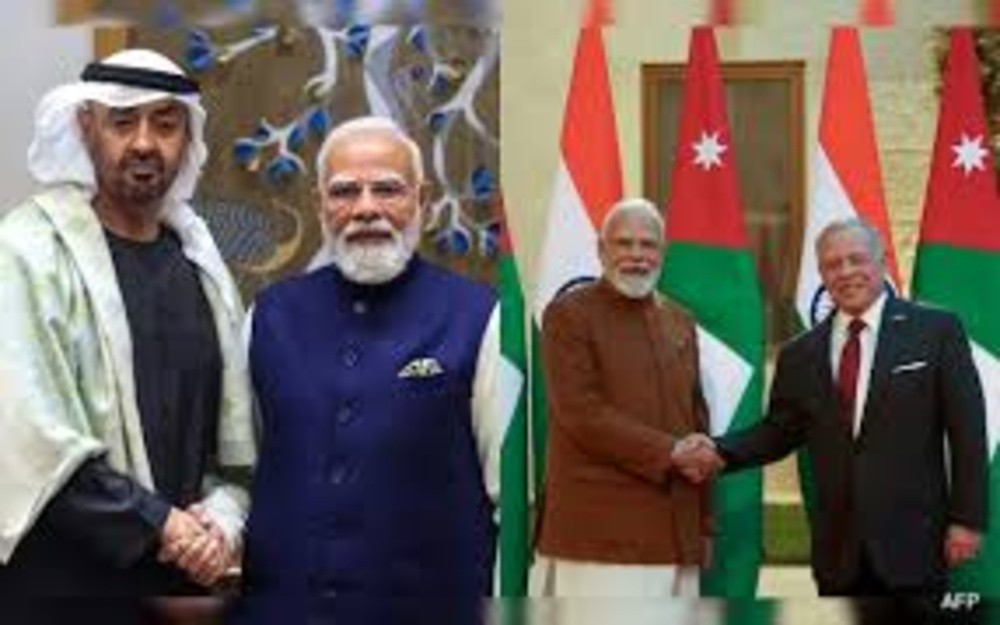
The journey began on May 15th in Abu Dhabi. Though the stop lasted barely two and a half hours, its strategic importance was immense. India’s relationship with the Gulf has undergone a dramatic transformation in the last ten years. Energy security, once India’s biggest weakness, is now a source of strength. By building strong partnerships with Gulf nations, India is insuring itself against the potential economic fallout of future oil crises.
Even more crucially, Gulf investment is now pouring into Indian infrastructure, rather than just flowing to China. This is a significant shift in a region traditionally aligned with Western and Chinese interests, positioning India as a stable and reliable economic partner. If the Gulf region ever faces instability, India stands ready to be the economic and logistical alternative.
The Hague: Entering the Semiconductor Race
The second leg of the trip, from May 15-17, took Modi to The Hague. It was here, perhaps, that the most critical deal of the visit was struck. India met with ASML, the Dutch company that holds a virtual monopoly over the advanced chip-making machinery needed to produce cutting-edge semiconductors. Without ASML’s technology, no country can truly compete in fields like advanced chip manufacturing, artificial intelligence, defense electronics, or future computing technologies.
China has been unable to acquire this technology due to Western restrictions, but India has quietly secured greater cooperation. This was more than just a business deal; it was India’s entry ticket into the global technology race of the future.
Semiconductors are no longer just industrial goods; they are strategic assets that dictate military power, AI capabilities, cyber warfare potential, and economic dominance. By moving closer to the semiconductor ecosystem, India has clearly indicated it doesn’t want to be just a consumer market. It’s setting its sights on becoming a technological and manufacturing powerhouse.
Sweden: Building an AI and Innovation Partnership
Modi then visited Gothenburg, Sweden, from May 17-18. Here, the India-Sweden Technology and AI Corridor agreement was signed with European Commission President Ursula von der Leyen in attendance. This deal signaled another significant shift in India’s foreign policy: a move from transactional diplomacy towards innovation-driven partnerships.
The agreement directly benefits Indian startups and tech firms by providing them access to European markets. Meanwhile, Sweden, a leader in defense and industry, benefits from India’s vast manufacturing capacity, engineering talent, and scalability. The trip underscored a growing realization among European nations that India is more than just a market; it’s a strategic technology partner for the long haul.
Norway: Green Investments and Arctic Opportunities
The visit to Oslo, on May 18-19, was equally significant, marking the first trip by an Indian Prime Minister to Norway in 43 years. A key focus of the discussions was Norway’s massive sovereign wealth fund, the largest in the world, estimated to be worth nearly $1.7 trillion.
The signing of the Green Strategic Partnership between India and Norway highlighted how climate diplomacy can now serve as a tool for geopolitical influence. Norway’s willingness to invest in India indicates a growing confidence in the country’s long-term economic outlook. Additionally, cooperation in areas like green shipping, hydro technology, and Arctic sea routes places India within developing global trade and energy networks that will shape the future.
Rome and IMEC: Rewriting Global Trade Routes
Rome was the final destination on May 20. While the cameras and social media were focused on photo ops with Italian Prime Minister Giorgia Meloni, the real agenda centered on the India-Middle East-Europe Economic Corridor (IMEC).
Often seen as India’s strategic answer to China’s Belt and Road Initiative, IMEC has the potential to dramatically reshape global trade routes. Through stronger ties with the UAE and Italy, India aims to become a central trade conduit connecting Asia, the Middle East, and Europe.
If fully implemented, IMEC could significantly boost India’s logistical importance while lessening global reliance on Chinese supply chains. Italy’s ports could see a resurgence, fueled by increased trade between India and Europe, with India positioned at the heart of one of the century’s most ambitious economic projects.
India’s Emerging Global Role
What makes this diplomatic strategy so effective is its ability to maintain balance. Today, India has relationships with key players in rival power centers. The United States sees India as a vital partner in the Indo-Pacific, while Russia continues to rely on India as a stable strategic ally. Europe views India as a democratic and economic alternative. Even China, despite ongoing border disputes, recognizes India’s growing importance in global markets and supply chains.
In a world increasingly fractured along ideological lines and divided into competing blocs, India is attempting something few nations have achieved: to become indispensable without becoming antagonistic to anyone.
The Bigger Picture
The future may not be determined by the loudest voice or the most powerful military. It may well belong to the nation that becomes too important to ignore and too deeply integrated to isolate.
Through its quiet diplomacy, economic foresight, technological collaborations, and strategic pragmatism, India is clearly laying claim to that role.
