
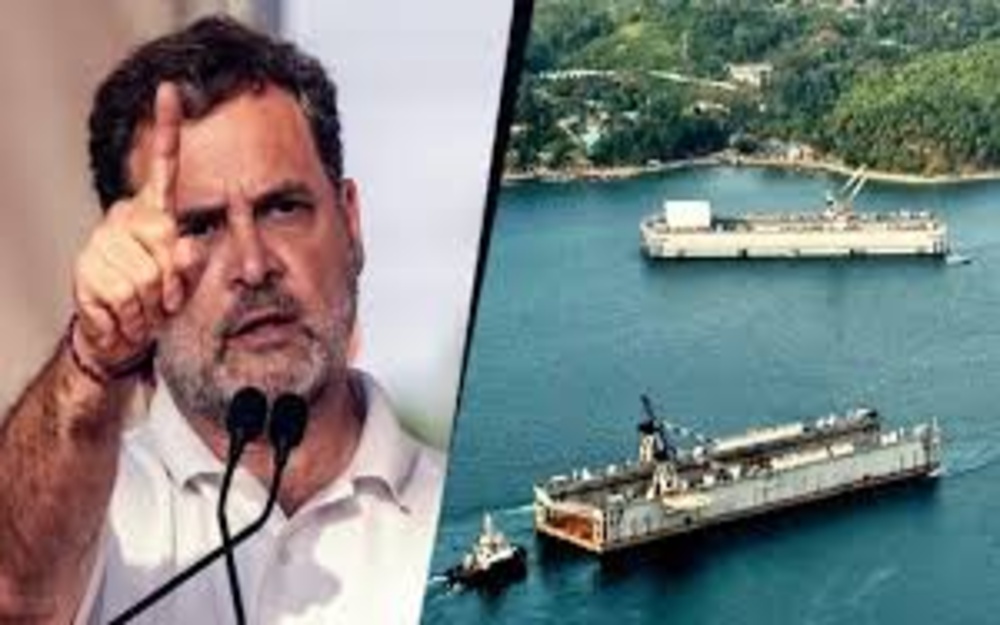
Rahul Gandhi : Objections ,The Great Nicobar Project ?
Raise Serious Questions about India’s Strategic Future

Poonam Sharma
Great Nicobar Project: Politics of Opposition, Security and Infrastructure
India’s proposed Great Nicobar Project is no ordinary infrastructure announcement. It is one of the biggest strategic projects undertaken by the country since independence – a huge thrust to change India’s maritime, commercial and military position in the Indo-Pacific region.
The project, valued at more than ₹81,000 crore, includes the development of a transshipment port at Galathea Bay, an international airport, township development, energy infrastructure and military-linked upgrades in one of the world’s most strategically sensitive regions.
But although the project is seen as a long-term political investment by strategic experts, Congress leader Rahul Gandhi’s attack on the initiative has sparked strong political reactions. The opposition to such a nationally important project sends the wrong message at a time when China is aggressively expanding its footprint across the Indian Ocean, critics say.
The debate is no longer environment versus development. It is now being seen as a larger question of India’s strategic preparedness.
Why Great Nicobar is so important
The Great Nicobar Islands are close to the Strait of Malacca, one of the most important maritime chokepoints in the world.
The narrow sea route connecting the Indian Ocean with the Pacific Ocean carries almost a third of the world’s trade and a huge proportion of China’s energy imports. For decades, strategic thinkers have argued that India’s geographic advantage in the Andaman and Nicobar region has been underutilized.
The Great Nicobar Project alters that equation.
The proposed transhipment port at Galathea Bay is expected to reduce India’s dependence on foreign ports such as Colombo, Singapore and Klang for handling cargo. Much of India’s transshipment cargo is currently transshipped outside the country, resulting in economic loss and strategic dependence.
A modern deepsea port at Great Nicobar would enable India to compete directly with the established maritime hubs of Southeast Asia.
More importantly, it enhances India’s ability to monitor maritime activity in a region that has emerged as a key theatre in global power politics.
China’s Rising Influence and India’s Response
Indian security planners have long been concerned about the growing Chinese presence in the Indian Ocean through ports and infrastructure projects in South Asia.
Beijing’s so-called “String of Pearls” strategy – from Gwadar in Pakistan to Hambantota in Sri Lanka – is often seen as an attempt to encircle India with Chinese-linked maritime infrastructure.
In this context, the Great Nicobar Project is not only a commercial one. It’s a strategy. Geography gives India natural leverage in the Indo-Pacific, with the Malacca Strait on its doorstep. India has not called for a disruption of global trade, but the ability to track and secure vital sea lanes takes on tremendous significance when geopolitical tensions or military conflicts arise.
That’s why many defence analysts see the project as a major strategic counter-balance to China’s growing influence.
The Opposition and the Political Story of Rahul Gandhi
Rahul Gandhi has basically questioned the project on the issues of environment and tribal rights. Environmental groups have also raised concerns about ecological impact, diversion of forests and protection of indigenous communities.
Those concerns deserve discussion and the right safeguards.
But critics say that the larger political framing of Rahul Gandhi undermines the seriousness of India’s strategic objectives. He has been criticized for repeatedly trying to bring industrialist Gautam Adani into the debate, even though the Adani Group has no direct role in the Great Nicobar Project at present.
To many observers, the connection of unrelated corporate allegations to a sensitive national infrastructure project seems more political than factual.
While India is in a competition with China for influence in the Indo-Pacific, critics of Rahul Gandhi say national security projects need responsible scrutiny, not political sensationalism.
The problem critics have isn’t that opposition voices should be silenced. “In a democracy it is legitimate and necessary to question government decisions. The problem, they argue, is when strategic projects are framed in a manner that misleads and creates confusion about India’s long-run interests.
Development vs. Delay
Political wrangling, activism and bureaucratic hurdles have often delayed big infrastructure and defence-linked projects in India.
But proponents of the Great Nicobar Project say India can no longer afford to delay strategically as China builds ports, logistics corridors and naval infrastructure across Asia.
They reflect the wider global reality: countries that control trade routes and maritime infrastructure have an enormous geopolitical influence.
The Strait of Hormuz is a good example . Any stress, no matter how slight, in that tight waterway can stir global oil markets and impact economies around the world.
The Strait of Malacca is also one of the most sensitive maritime corridors in the world.
India’s increasing footprint near this chokepoint is therefore not regarded as aggression but as strategic readiness. ## A Larger Question about India’s Strategic Mindset
The debate over the Great Nicobar Project is a microcosm of a deeper political divide over where India should stand in a rapidly changing global order.
One side says India should build strategic infrastructure and maritime dominance aggressively and reduce dependence on foreign systems.
The other side warns of environmental damage, displacement and unregulated development. Both are valid points.
But Rahul Gandhi’s critics say his approach often seems to ignore the larger geopolitical reality that India faces today. As China expands its military and economic footprint in the Indo-Pacific, they believe India needs clarity, confidence and national consensus on projects directly tied to long-term security.
They also contend that political opposition becomes an issue when it seems to be more of an attack on the government than a constructive contribution to the debate.
Conclusion
The Great Nicobar Project is much, much more than a port or an airport. It is India’s attempt to turn geography into strategic power.
In the coming decades, control of maritime routes, logistics hubs and naval access points will be as important to global influence as armies and economies.
India has a unique advantage in its location close to one of the most important trade arteries in the world. The question is whether the country is willing to make full use of that advantage.
So, Rahul Gandhi’s criticism of the project has been met with strong reactions as many believe this is not the time to create political confusion on matters that are linked to national security and strategic positioning.
Debate is a part of a democracy. But critics say the opposition needs to ensure that political attacks do not overshadow India’s larger national interests, especially on projects of huge geopolitical significance.
