
India, New Zealand Unveil Roadmap to 2030 for Strategic Ties
Six-pillar framework focuses on trade, defence, technology, education and Indo-Pacific cooperation

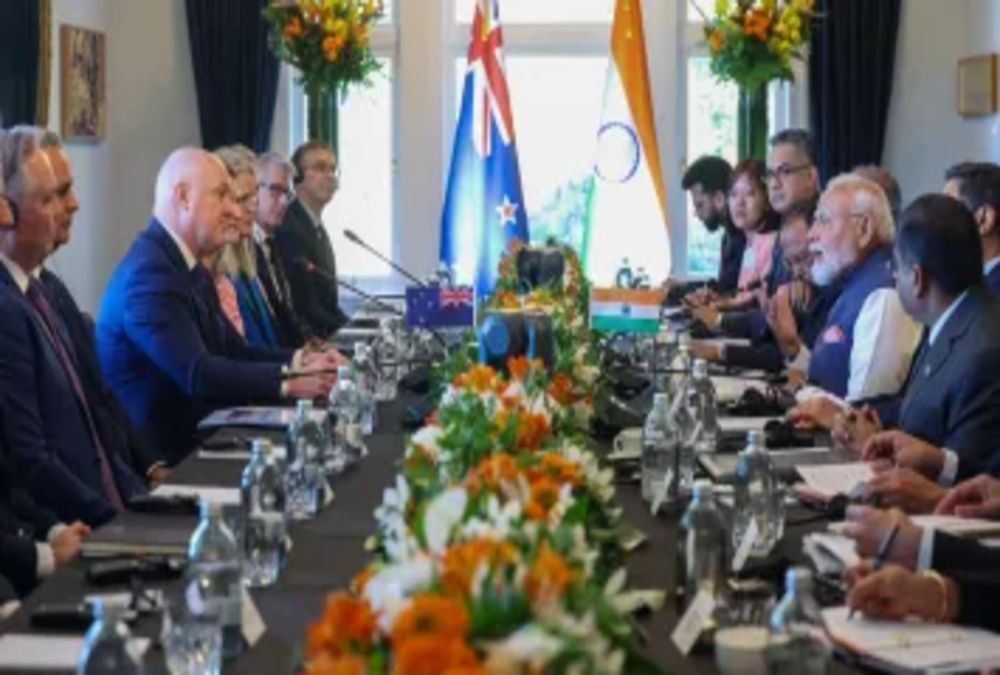
- India and New Zealand adopt Roadmap to 2030 after elevating ties to Strategic Partnership.
- Framework outlines cooperation across six key pillars, including defence and trade.
- Both countries target doubling bilateral trade to NZ$7 billion by 2030.
- Roadmap strengthens collaboration in education, climate, maritime security and multilateral forums.
GG News Bureau
Auckland, 11th July: India and New Zealand on Saturday adopted the India-New Zealand Strategic Partnership: Roadmap to 2030, a comprehensive six-pillar framework aimed at expanding cooperation in defence, trade, education, technology, maritime security and regional affairs after elevating bilateral ties to a Strategic Partnership.
The roadmap was endorsed by Prime Minister Narendra Modi and New Zealand Prime Minister Christopher Luxon during their bilateral meeting in Auckland. It will serve as the guiding framework for cooperation over the next four years while strengthening political engagement and economic collaboration between the two countries.
Under the first pillar, both countries agreed to hold regular meetings between Prime Ministers, Cabinet Ministers and Foreign Ministers, expand parliamentary exchanges, and institutionalise annual senior officials’ meetings to monitor implementation of the roadmap.
The defence and security pillar focuses on expanding military exercises, naval cooperation, maritime security, counter-terrorism, cyber security and law enforcement collaboration. India and New Zealand also agreed to operationalise the Maritime Cooperation Arrangement, establish an annual Maritime Security Dialogue and strengthen cooperation under the Indo-Pacific Oceans Initiative.
On the economic front, the two countries set an ambitious target of doubling bilateral trade in goods and services to NZ$7 billion (around ₹35,000 crore) by 2030. Both sides will work towards the early implementation of the India-New Zealand Free Trade Agreement while simplifying customs procedures through the Authorised Economic Operators Mutual Recognition Arrangement. Cooperation in horticulture, forestry, animal husbandry, dairying and tourism will also be expanded, alongside efforts to promote direct flights between the two countries.
The roadmap also places emphasis on strengthening people-to-people ties by engaging the Indian diaspora, enhancing sports cooperation, promoting cultural exchanges, traditional medicine, maritime heritage and collaboration between local governments.
In education, science and technology, both countries agreed to deepen institutional partnerships, promote research collaboration, support innovation in agriculture, climate and digital technologies, and implement agreements on disaster management, renewable energy and the Global Biofuels Alliance.
The regional and multilateral pillar reaffirms support for a rules-based Indo-Pacific, ASEAN-led regional architecture, cooperation under UNCLOS, United Nations reforms and India’s candidature for permanent membership of a reformed UN Security Council. Both countries also agreed to extend mutual support for each other’s candidature in international organisations wherever possible.
The roadmap clarifies that while it provides a structured framework for future cooperation, it does not create any legally binding obligations or financial commitments under domestic or international law.
