
Soundala: India’s First Caste-Free Village
Revives Ancient Hindu Ideals A Daring Move Rooted in Tradition

Poonam Sharma
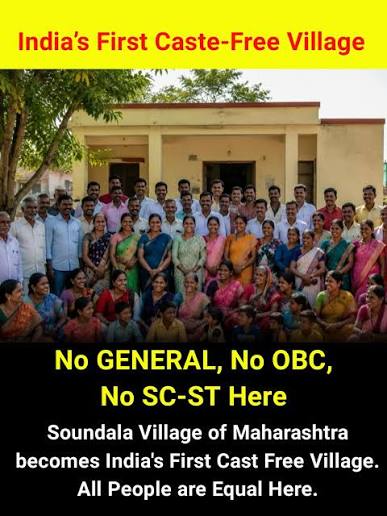
Soundala has seized the nation’s imagination in a tiny village in the heart of Maharashtra. Soundala, recently recognized as India’s first caste-free village, is not only making history, but revitalizing an ancient Hindu social tradition of equality and social unity, deep and often forgotten.
Breaking the shackles:
the way to caste free livingThe Soundala transformation didn’t happen overnight. It was the result of collective will — villagers, young and old, in one meeting after another, conversation after conversation, sharing experiences. What’s striking is that this movement wasn’t imposed from above. But it grew organically from the inside out, fueled by the simple but radical belief that every human being deserves equal respect.Residents talked, questioned long-held prejudices and started to break down the everyday barriers which had kept them apart for so long. Festivals, panchayat meetings and even daily meals began to mirror this new spirit, where everyone sits together, eats together and governs together.
The message is clear:
In Soundala, your worth is not determined by your birth.Echoes of an Old Social EthicWhat makes Soundala’s achievement remarkable is that it is less a departure from the past, and more a return to the original, inclusive spirit of the ancient Hindu society. Contrary to the modern misconception, the ancient Hindu way of life was based on the principle of sarva jan hitaya, the welfare of all. Village assemblies (sabhas) were open in nature and spiritual texts often spoke about the unity in diversity, interconnectedness of all beings and the importance of mutual respect.In the early Vedic period, varna was not a rigid birth-based identity but more about one’s qualities and action. At the heart of it was the thought of a society working in tune, everyone doing their bit, as they could and as they felt like it. Divisions and hierarchies did arise as history unfolded, but the core was always about inclusion and social harmony.
Soundala’s Modern Renaissance
Today, Soundala stands as a living testament to those original ideals. The village’s inclusive governance model ensures that every voice is heard, regardless of caste or background. Women and youth are encouraged to participate and decisions are made in a transparent manner. Social events and rituals have become an opportunity to bridge divides instead of reinforce them.The village’s journey is also a reminder that real social reform cannot be legislated alone, it requires the willing hearts and open minds of a community. The Panchayat leadership in Soundala, supported by grassroots activists, has been important, but it is the commitment of ordinary villagers that has made this initiative sustainable and embedded.
The Road Ahead
Keep the Spirit AliveSoundala’s progress is rightly applauded by the nation, but the village knows the journey is far from over. But the challenge is to nurture this spirit of equality – to make sure that our young people in particular imbibe these values, that economic opportunities are shared fairly, and that the temptations to revert to old patterns of behavior are overcome.In Soundala, educators are weaving tales of unity from the past and present into school curricula. Elders recount tales of the Upanishads and folk stories that celebrate inclusiveness. The character of local festivals has shifted, less about difference, more about common identity.An Inspiration to IndiaBut Soundala’s audacious experiment is not just a local story — it is a blueprint for villages across India. Soundala has tapped into the core values of ancient Hindu society and has reminded us that progress is not always about breaking with the past. Sometimes it means rediscovering the best of our heritage and letting it guide us toward a more just, harmonious future.Soundala proves that change from the ground up is possible when a community recalls its true roots and decides to go forward together, hand in hand.
