
India’s $17.2 Billion Semiconductor Leap
BRICS Nations Vie for AI and Chip Innovation Leadership

Poonam Sharma
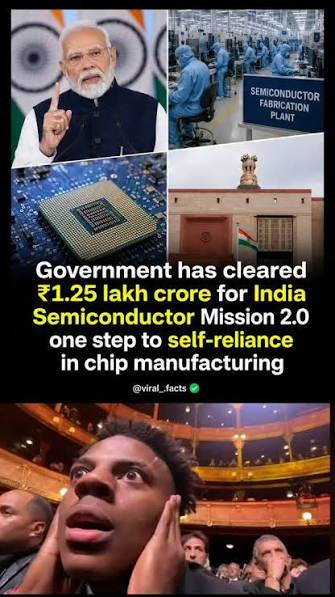
Microchips and artificial intelligence are among the components most crucial to the next wave of technological transformation. Now, India is making a bold $17.2 billion investment in semiconductor manufacturing, and sending a clear signal: the country will be at the heart of global electronics and innovation. But India is not alone. Countries across the BRICS block — Brazil, Russia, India, China and South Africa — are rolling out high-tech projects that are transforming industries and geopolitics.
India’s Silicon Dream: More Than Factories
In early July 2026, India said it had approved 12 big semiconductor projects. The move isn’t just about building a few new factories, it’s about creating an entire ecosystem. The details are impressive .
1 chip factory
2 semiconductor factory facilities
9 plants for chip packaging and test
But the real story is the broader vision of the government. India is not only strengthening manufacturing, but also developing indigenous equipment, materials and proprietary technologies. The country’s goal? To develop a resilient and self-sufficient supply chain that can withstand global shocks and cut dependence on foreign tech.India’s Startup Engine: From Designing to DeployingBeyond these headline mega projects, India is planting the seeds of innovation.
The government has: Through a microchip design program
Backed 24 projects
Give 105 companies access to cutting-edge design tools
23 projects completed development and factory testing using the latest manufacturing processes.
These are not mere numbers – they are signs of a rapidly maturing tech landscape. India is growing a new generation of chip designers and engineers as startups and researchers gain access to best-in-class tools.AI: India’s Billion-Dollar Bet Microchips are the hardware but AI is the software revolution. India has its India AI mission, backed by over $1 billion, to build a national AI infrastructure. The main thing? A massive computing hub with more than 45,000 graphics processing units (GPUs) purpose-built for training and running AI models. India is also working on 15 large and small language models that can handle speech, text and images, customized for its diverse population. The country’s digital data library already has 12,500+ datasets, 300+ AI models and 20 toolkit resources available to researchers, startups and organizations. Electronics: India’s Export Powerhouse This tech push is already paying off. Electronics in India is now a $136.4 billion industry, making it the country’s third largest export category. That figure is expected to skyrocket with new investments in semiconductor and AI.BRICS Tech Surge: How Other Countries Reacted India’s moves are part of a wider BRICS trend. Countries are struggling to cut dependence on foreign technology and make their own mark in the global innovation race, across the bloc. A sneak peek at what’s happening:
China: Supercomputers and Software Sovereignty
China has a particular problem much of the world’s most advanced scientific software was written with Western hardware in mind. Chinese scientists have recently released a new software platform for translating and adapting code for Chinese supercomputers and processors. The system even enables the formulation of tasks in natural language – think voice commands for supercomputers! China is making steady progress towards tech independence with a reported 71% success rate in automatic code conversion.
Russia: Illuminating The Chip World
The emphasis in Russia is on photonic integrated circuits, chips that use light (photons) instead of electrons. The technology has big benefits including faster data processing, less energy consumption and minimal heat generation. Skolkovo Institute of Science and Technology recently launched the first production line in the country for silicon-on-insulator-based photonic chips. These chips will transform AI, telecommunications, cryptography and sensor technology.
Vietnam: Creating a Local Chip Supply Chain
Vietnam, though not a core BRICS country, has the same ambitions in the tech world as its larger neighbors. The country launched its first national center for the development of semiconductor microchips, enabling local companies and universities to design, prototype and test chips in the country. Before that, prototypes had to be shipped overseas at a cost of up to $200,000 and a time of up to two years. The center in Vietnam will oversee the entire process, aiming to master cutting-edge semiconductor technologies by 2030 and become a leading chip prototyping hub in Southeast Asia.
Why it matters: Tech and geopolitics went hand in hand
BRICS countries are pouring money into microchips and AI, not just for economic growth, but for strategic autonomy. These countries want to reduce their dependence on the West, protect their economies and shape the future of global innovation by developing their own technologies.Conclusion: Emerging Tech PowerhousesIndia’s $17.2 billion semiconductor bet is only the beginning. Countries across the BRICS are building new factories, developing new technologies and investing in local talent. The race is on – not just for economic gain, but for a seat at the table in setting the rules of tomorrow’s digital world.Mumbai, Moscow, Beijing or Hanoi could be the next breakthrough in the world today. The future of tech is more global and exciting than ever, that’s for sure.
