
From Spectrum to Personal Guarantees: Understanding India’s High-Profile Financial Scandals and What Still Needs Fixing

By Alok Lahad
The recent National Company Law Tribunal decision in the Subhash Chandra personal-guarantor case produced dramatic headlines: roughly ₹6.5 crore against admitted claims of more than ₹22,000 crore. Many readers saw another instance of a powerful promoter walking away lightly. The reality, as earlier explained,https://globalgovernancenews.com/subhash-chandra-essel-group-personal-guarantee-nclt-haircut-explained/ is more limited. Chandra was a guarantor, not the borrower; the companies that took the loans remain liable; and creditors retain the right to pursue those companies. The episode nevertheless revived a larger public question: why do big financial controversies keep recurring in India, and why do ordinary salaried taxpayers often feel the system is uneven?
Today we examines the major categories of high-profile cases, concentrates on the United Progressive Alliance (UPA)-era scandals, traces the banking Non-Performing Asset (NPA) problem that spilled into the next government, clarifies who actually loses money in different situations, and assesses what the National Democratic Alliance (NDA) governments have already done and what still requires reform.
Three Broad Categories of Scandals
Not every large number is the same kind of wrongdoing.
Category 1: Government allocation and policy scandals
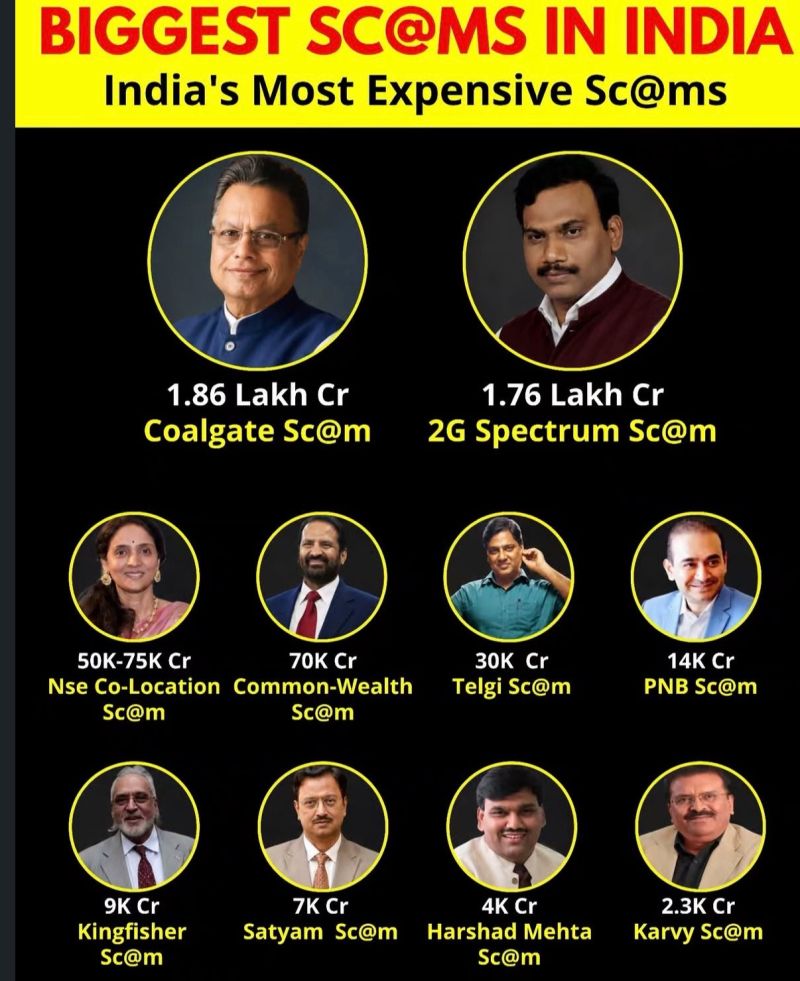
These involve discretionary decisions by the state over natural resources or public contracts. The primary loser is the government exchequer and therefore the taxpayer. The classic examples are the 2G spectrum allocation and the coal-block allocations during the UPA years.
Category 2: Classic bank frauds and promoter defaults
Here private promoters or companies borrow large sums, sometimes with alleged diversion of funds, fake instruments, or wilful default. Banks (especially public-sector banks) suffer the direct loss. Because the government owns most of these banks, large losses eventually require taxpayer-funded recapitalisation. Examples include the Nirav Modi–Mehul Choksi Punjab National Bank fraud, Vijay Mallya’s Kingfisher loans, ABG Shipyard, and Dewan Housing Finance Limited (DHFL).
Category 3: Personal-guarantor insolvency cases under the Insolvency and Bankruptcy Code (IBC)
A promoter gives a personal guarantee for company loans. When the companies default, creditors pursue the guarantor under the IBC. Recovery from the individual is often low because personal assets are limited, yet the companies themselves remain liable. The Subhash Chandra case belongs here. It is not a classic fraud of the Punjab National Bank type.
A fourth, overlapping problem is internal bank failure: weak due diligence, evergreening of loans, and, in some instances, alleged kickbacks to bank officials.
UPA-Era Scandals: What Happened, How, and Who Paid
2G Spectrum (licences 2008)
Spectrum and telecom licences were allotted at 2001 prices on a first-come-first-served basis. Cut-off dates were allegedly manipulated and some ineligible companies received licences. The Comptroller and Auditor General (CAG) estimated a presumptive loss of up to ₹1.76 lakh crore. The loss was not cash stolen from banks; it was potential revenue the government failed to collect through proper auctions. Taxpayers therefore lost the opportunity of higher public revenue. A. Raja, then Telecom Minister, and several associates faced trial. A Central Bureau of Investigation (CBI) special court acquitted all major accused in 2017. The CBI’s appeal has remained pending for years. Investigation and prosecution continued under the subsequent NDA government, but final convictions at the highest level did not materialise.
Coal Block Allocation (Coalgate)
Between 2004 and 2009 large numbers of coal blocks were allotted without competitive bidding. The CAG put the presumptive loss at ₹1.86 lakh crore. The Supreme Court later cancelled most allocations. Again the loser was the government exchequer. Some bureaucrats (including former Coal Secretary H.C. Gupta in multiple cases) and company directors received jail sentences of two to four years. Many other cases ended in acquittal. Trials continued and several convictions were secured after 2014.
Commonwealth Games 2010
Contracts for the Delhi Games were marked by allegations of inflated costs, poor quality and favouritism. Public money was spent inefficiently. Multiple First Information Reports were registered. Suresh Kalmadi was arrested. After fifteen years the results remain thin: a few peripheral convictions, several closures, and the Enforcement Directorate’s money-laundering case against Kalmadi closed in 2025 for lack of proceeds of crime. The direct loser was the taxpayer through misused public funds.
In all three cases the pattern is similar: high notional or actual losses to the public exchequer, lengthy investigations, and limited final accountability at the political level. These were not bank-loan frauds; they were failures of transparent allocation of public resources.
The Banking NPA Overhang: Origin and Clean-Up
A parallel problem built up inside the banking system. Aggressive lending, especially during the high-growth years before and after the global financial crisis, created a stock of stressed loans. Many of these loans were sanctioned in the UPA period. Banks practised evergreening—fresh facilities or repeated restructuring that kept accounts looking standard even when the underlying projects were in trouble. Forbearance policies under the then Reserve Bank of India (RBI) regime allowed delayed recognition of Non-Performing Assets.
Raghuram Rajan became RBI Governor in September 2013. He moved to end open-ended forbearance. The full Asset Quality Review (AQR) that forced consistent recognition of hidden bad loans was conducted in 2015. Under the leadership of Finance Minister Arun Jaitley the reforms were brought forward. Rajan himself later acknowledged that he had taken the plan to Jaitley and received his support to proceed with the clean-up, even though it would surface large NPAs and require capital infusion. The bulk of the later NPA stock originated from pre-April 2014 loans. Recognition was painful but necessary. Subsequent NDA measures—bank recapitalisation, the Insolvency and Bankruptcy Code, and the Fugitive Economic Offenders Act—gave banks better tools to resolve stress and pursue defaulters.
It is accurate to say that the loans and the culture of delayed recognition largely grew under the UPA years. The decisive push for transparent recognition and the political willingness to absorb the short-term cost of clean-up took place under Finance Minister Arun Jaitley’s leadership, with the then RBI Governor publicly acknowledging that support.
Who Actually Loses Money
Precision matters. When a private bank or insurance company suffers a loss, the institution and its shareholders bear it through lower profits or capital. Ordinary taxpayers do not write a cheque. When a public-sector bank suffers large losses, the government as owner often has to inject capital from the budget; that is an indirect burden on taxpayers. When the government itself is defrauded or forgoes legitimate revenue through opaque allocations, the loss is direct: money that should have entered the public exchequer never does. The 2G and coal cases belong to the last category. The Nirav Modi and Mallya cases belong primarily to the bank-loss category, with eventual fiscal consequences through recapitalisation.
Bank Due Diligence Failures and Kickbacks
Even after recognition improved, individual episodes revealed serious lapses. In the Yes Bank case, former Managing Director Rana Kapoor faces allegations of having sanctioned large loans to stressed borrowers, including DHFL and Cox & Kings, in return for kickbacks. Forensic audits of Cox & Kings uncovered extensive related-party transactions, bogus sales and diversion of funds. These examples show that weak appraisal, possible collusion, and inadequate monitoring of end-use of funds remain vulnerabilities. Personal guarantees, often taken as comfort, have frequently proved of limited value once the promoter’s personal estate is examined.
What the NDA Governments Have Already Done
Several structural changes deserve recognition. The Insolvency and Bankruptcy Code created a time-bound process for corporate resolution and, later, for personal guarantors. The Fugitive Economic Offenders Act enabled confiscation of assets of those who flee. Overseas investment rules were tightened for wilful defaulters and NPA accounts. Public-sector banks received large recapitalisation and were subjected to cleaner recognition of stress. The AQR itself, supported by the Finance Ministry under Arun Jaitley, ended the worst of the evergreening culture. Gross NPA ratios have since fallen to multi-decadal lows. These are real achievements.
Yet gaps remain visible. Recoveries from personal guarantors are often extremely low. Related-party voting in insolvency processes continues to generate controversy. Accountability for bank officials who ignore due diligence or accept inducements is still uneven. High-profile cases still produce headline numbers that feed public cynicism.
What Still Needs to Be Done
Further reform should focus on five practical areas.
First, personal-guarantor provisions under the IBC need tightening: clearer rules on related-party voting, mandatory deeper asset tracing, and greater transparency on actual recovery outcomes so that majority votes cannot produce results that appear commercially absurd.
Second, public-sector banks require stronger internal accountability. Proven failures of due diligence or acceptance of kickbacks should trigger swift departmental and criminal consequences, not prolonged internal inquiries.
Third, a public dashboard of high-value recoveries and pending personal-guarantor cases would reduce the information asymmetry that fuels suspicion.
Fourth, tax and recovery discipline must be visibly consistent. Large groups and high-net-worth individuals should face the same rigorous scrutiny that salaried taxpayers already experience. When the system appears to treat the powerful more gently, rhetoric about “Suit Boot ki Sarkar” or selective attacks on particular industrialists finds ready audience.
Fifth, communication must improve. Distinguishing a government-exchequer scam from a bank fraud from a personal-guarantor resolution is not pedantry; it is the only way to keep public debate honest.
Conclusion
India has moved from an era of opaque resource allocation and hidden banking stress to a regime with clearer recognition rules, a modern insolvency law, and better recovery tools. That progress is real. It is incomplete. The Subhash Chandra outcome, the lingering weakness in personal-guarantor recoveries, and occasional evidence of bank-level collusion show that further tightening is required. The goal is straightforward: rules that make both the rich and the ordinary citizen face consistent consequences, so that the salaried taxpayer no longer feels the system is designed to protect the powerful. Only then will political slogans about favoured industrialists lose their force. Fair process, visible enforcement, and honest classification of different kinds of failure remain the surest route to that outcome.
