
The ₹22,000 Crore “Haircut” That Isn’t: What the Subhash Chandra Case Really Means

By Alok Lahad
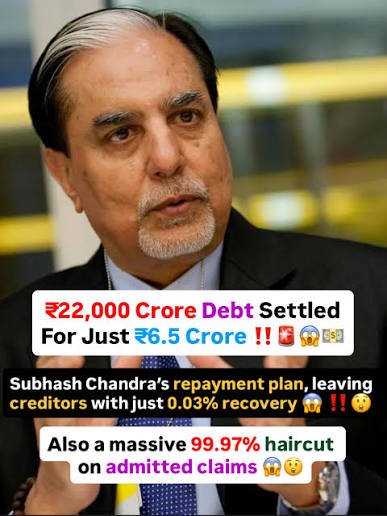
Over the past few days, headlines across Indian newspapers and television channels have screamed the same dramatic number: Essel Group founder and Zee promoter Subhash Chandra will pay just ₹6.5 crore against admitted claims of ₹22,006 crore. The arithmetic has been presented as a 99.97 per cent “haircut” for banks and financial institutions — one of the steepest in recent memory. The story has fuelled public outrage, political attacks, and comparisons with other high-profile debt cases.
The truth is more nuanced, and far less sensational.
The National Company Law Tribunal (NCLT) has not written off ₹22,000 crore of bank loans. It has approved a repayment plan that settles only Chandra’s liability as a personal guarantor. The companies that actually borrowed the money remain fully liable. Creditors retain every legal right to pursue those companies, enforce securities, and drag them to court if necessary. That distinction is the single most important fact that has been lost in much of the coverage.
What Exactly Happened
Subhash Chandra never borrowed ₹22,000 crore in his personal capacity. He stood as personal guarantor for loans taken by various companies associated with the broader Essel Group and Zee ecosystem. When some of those companies defaulted, creditors filed claims against him under the personal insolvency provisions of the Insolvency and Bankruptcy Code (IBC). The total of those claims came to approximately ₹22,006 crore.
The process began with a relatively modest facility. In 2016, Indiabulls Housing Finance (now Sammaan Capital) sanctioned loans to Vivek Infracon and related entities. Chandra provided a personal guarantee for the exposure on 5 December 2018. After the loan was recalled in February 2019, Indiabulls eventually initiated personal insolvency proceedings against him in 2022. Once the case was admitted, other creditors joined and the aggregate claims ballooned.
Many of the guarantees that make up the larger figure were given *after* the group’s difficulties became public in early 2019. Government sources and Chandra’s own statements indicate that only around ₹2,574 crore of the claims relate to guarantees given at the time the original loans were sanctioned. The rest were provided later as additional security.
In August 2026, after a split verdict between two NCLT members, a third member approved a repayment plan under which Chandra contributes roughly ₹6.25–6.5 crore from his personal estate. Creditors holding just over 80 per cent of the voting share had supported the plan. Dissenting creditors, including HDFC Bank, LIC Housing Finance, Axis Bank, Canara Bank, RBL Bank and Union Bank of India, opposed it. Several of them are now preparing appeals before the National Company Law Appellate Tribunal (NCLAT).
Why the “99.97 Per Cent Haircut” Narrative Is Misleading
The figure is mathematically correct only if one compares the ₹6.5 crore personal payout with the full ₹22,006 crore of *guarantee claims*. It is not correct if one presents it as a write-off of ₹22,000 crore of bank loans.
There are three critical points:
First, Chandra’s personal assets, as valued by the resolution professional, were limited. The plan reflects what is realistically recoverable from him as an individual. Pushing him into full bankruptcy was assessed as unlikely to yield more for creditors.
Second, the underlying corporate borrowers have not been discharged. Their liability continues. Government sources have clarified that the repayment plan itself contemplates further payments — reported in the region of ₹1,494 crore — from the principal borrowers. Creditors keep their rights against those companies, against any remaining securities, and against other available assets.
Third, Chandra has stated that the group companies for which he stood guarantee had outstanding borrowings of nearly ₹45,000 crore as of January 2019 and have since repaid about ₹43,000 crore. Whether those figures are fully accepted by every lender is a matter for verification, but they form part of the public record he has placed on the table.
In short, the NCLT order resolves Chandra’s personal-guarantor liability. It does not extinguish the debts of the companies that took the money.
Creditors Can Still Pursue the Companies
This is the central point that deserves repeated emphasis. Under Indian law, the liability of a personal guarantor and the liability of the principal borrower are distinct and co-extensive. Approval of a repayment plan for the guarantor does not automatically wipe out the borrower’s obligations.
Banks and financial institutions remain free to:
-Continue recovery proceedings against the principal borrowers.
– Enforce any surviving mortgages, pledges or other securities.
– Initiate or pursue insolvency or other legal action against the companies themselves if the facts justify it.
– Seek further settlements or recoveries outside the personal insolvency process of Chandra.
LIC Housing Finance has already stated publicly that the NCLT order does not affect the corporate liabilities of the principal borrowers or its security interests. Other lenders have taken similar positions. The door to recovery from the actual borrowing entities remains open.
The Government’s Limited Role
The Central Government has played almost no operational role in the outcome. The NCLT is an independent quasi-judicial body. The repayment plan was approved because a majority of creditors voted for it under the framework of the IBC. Government sources have limited themselves to clarifying the legal distinction between personal-guarantee claims and corporate debt. Public-sector lenders such as LIC Housing Finance, Canara Bank and Union Bank of India were among those who voted against the plan and are exploring appeals.
There is no evidence that the government directed the tribunal or engineered the result. The controversy is a product of the existing personal-guarantor provisions of the IBC and the commercial decision of the majority of creditors.
Appeals and What Comes Next
HDFC Bank and LIC Housing Finance have publicly indicated they are preparing to challenge the order before the NCLAT. Other dissenting creditors may join. The limitation period for appeal is 30 days from the formal order, with a possible further 15 days for sufficient cause. The appellate tribunal can examine issues such as related-party voting, valuation of assets, and whether the recovery is so low that the plan should not have been approved.
Even if the plan is ultimately upheld, the principal borrowers remain on the hook. The legal process against those companies is a separate track.
Broader Lessons
The case exposes a structural weakness in the way personal guarantees are treated under the current insolvency framework. When a promoter’s personal estate is modest, recoveries from the guarantor can be negligible even when the corporate debt is large. Related-party voting has also become a recurring point of contention. These are design issues in the law that successive governments have not fully addressed.
At the same time, the law correctly treats the guarantor’s liability as separate from the borrower’s. That separation is precisely why the companies can still be pursued.
Conclusion
The Subhash Chandra case is not a story of banks quietly writing off ₹22,000 crore. It is a story of a personal-guarantor resolution that yields very little from one individual while leaving the original corporate debtors fully exposed to further recovery action. The dramatic “99.97 per cent haircut” headline captures only half the picture — and the less important half.
Financial institutions retain the right, and in many cases the obligation to their own stakeholders, to continue pressing the companies that actually received the loans. Whether they succeed will depend on the assets and cash flows of those entities, not on the size of Chandra’s personal contribution. The courts remain open. The law remains available. The debt has not simply disappeared.
