
RSS Chief Mohan Bhagwat Calls for Grassroots Interfaith Engagement in NY

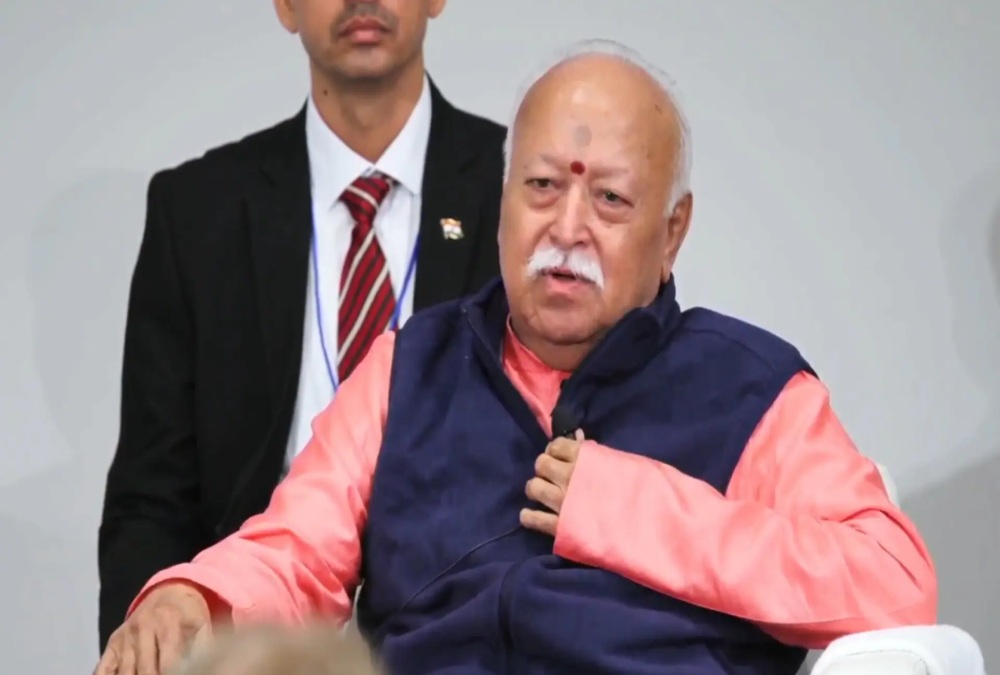
By Anjali Sharma
NEW YORK – RSS chief Mohan Bhagwat on Sunday called for interfaith engagement to move beyond international conferences and reach districts and local communities, while stated that dialogue should be accompanied by service.
Mohan Bhagwat New York engagements ranged far beyond a broad appeal for global harmony.
He addressed questions about Muslims in India, told members of the Indian diaspora that their first loyalty must be to the country where they live, criticised contemporary politics, and outlined how the RSS believes social change should be pursued.
Bhagwat repeatedly returned to one central argument diversity need not come at the cost of a shared identity in his remarks at a gathering in New York.
His comments went beyond philosophy.
He spoke about what being Hindu means, the responsibilities of Indian-Americans, the limits of politics, and the RSS’ engagement with Muslim and Christian communities.
Bhagwat had an unambiguous message for the Bharatiya diaspora living in the United States: their first duty is towards the country where they live and earn.
“We are in America, we live in America, we earn in America. So we are American. And we should behave true to America,” he said.
He explored Conservative Media Outlets
Bhagwat described the US as the diaspora’s “karma bhumi” and said members of the community must fulfil their responsibilities towards it.
“The diaspora, Bharatiya diaspora, they have a duty to their karma bhumi. They must fulfil that. They should be loyal to their karma bhumi,” he said.
Bhagwat drew a distinction between the diaspora’s responsibilities towards its country of residence and its connection with Bharat as its “janma bhumi”.
Those who want to contribute to the country of their birth can do so, he said, but only after discharging their responsibilities towards the country in which they live.
“Because Bharat is their janma bhumi, if they have an urge to do something and they can do that, after fulfilling their duties to their karma bhumi, it is not prohibited. But it is not obligatory,” Bhagwat said.
He said that his expectation from the diaspora was instead centred on carrying forward the values inherited from their motherland.
Bhagwat’s sharpest remarks came while recalled questions put to him by Muslim participants over the RSS’ conception of a Hindu nation.
He said he had been asked whether Muslims would be driven out of India under such an idea.
“I said no. That is not Hindu,” Bhagwat said.
“If any Hindu thinks that there should be no Muslim in Bharat. He will not remain Hindu.”
He went further while explaining his definition of Hindu identity.
“If you want to call yourself Hindu, you must believe that all paths are leading to the same. And every human has a dignity. There is no difference between humans,” he said.
Bhagwat also delivered an unusually direct assessment of politics.
“These things do not happen through politics. Sorry to say, but the fact is, politics has now become a game of self-interest,” he said.
His argument was that lasting changes in social attitudes cannot begin with political institutions.
Instead, he said, society must build consensus first.
“Where there is me, I am I. There is no solution. We and ours is the solution,” Bhagwat said.
“So our experience in Bharat is that we have to start with the society.”
Bhagwat did not argue that politics should be ignored altogether. He said social and religious leaders would eventually need to influence policies, including on matters such as war.
But in his formulation, political influence should be the outcome rather than the starting point.
Democratic politics ultimately responds to citizens, he said.
“If there is public opinion, then no politician will dare to go against it,” Bhagwat said.
His prescription was to first create social consensus through dialogue, service and examples of cooperation and then allow that consensus to influence political decision-making.
Bhagwat contrasted ideas commonly associated with the United States and Bharat at the Universal Oneness Celebration.
“When we say United States of America, one word is often discussed frequently. That is pluralism. And when we say Bharat, another phrase is discussed: unity in diversity,” he said.
“For Bharat, this unity and this diversity, both are in their DNA.”
He said diversity should not merely be tolerated.
“Diversity has to be celebrated, has to be respected, has to be accepted. And at the same time, we must keep in mind this feeling of oneness,” he said.
Bhagwat described making the world understand this coexistence of difference and unity as part of Bharat’s larger role.
He addressed the “One World, One Humanity” programme, Bhagwat said: “I am working in a society which traditionally says that religions might be different, but humanity is one”.
“Truth is one, and humanity is a product of that truth.”
He argued that different religions and practices could represent distinct routes towards the same ultimate truth.
Diversity is a decoration for our innate unity. It has to be accepted. It has to be respected. It has to be protected,” Bhagwat said.
“As I protect my own specific nature, I have to protect others also.”
Bhagwat said the RSS had continued engagement with Muslim and Christian communities after an interaction in Delhi in 2018.
“So we started that dialogue. Mainly with Muslims and Christians of Bharat,” he said.
“And step by step we are going ahead.”
He acknowledged that such dialogue could be slow and that participants themselves had at times questioned whether it was producing results.
Bhagwat said persistence was essential even when immediate outcomes were not visible.
Subscribing To Political News Outlets
“If we together start working, we can change the situation of the world,” he said.
“But it will take long time. It is not so easy to clean up public mind.”
Bhagwat argued that interfaith engagement could not remain confined to meetings and declarations.
“Dialogue is the first step. Service is another. Not one step after that. It had to start simultaneously,” he said.
He said RSS volunteers did not distinguish between people on the basis of religion while providing assistance.
“Whoever is in need we are serving,” Bhagwat said.
He cited the response of RSS workers to an air disaster involving aircraft carrying predominantly Muslim passengers as an example of the approach he was describing.
“We never thought at that time that these are Muslims,” he said.
Bhagwat also said the organisation did not expect anything in return for such work.
“We could do this because we are not in politics,” he said.
“We do it. We only give. We don’t want anything.”
Bhagwat’s prescription for interfaith cooperation was distinctly local.
Rather than confining dialogue to religious leaders at major international events, he called for engagement to reach communities at provincial, district and block levels.
“Whatever we decide to do today, we should start in our own country and create pockets of such selfless service, such atmosphere of unity,” he said.
“We should create at our own place the models of the world we want.”
Bhagwat said those local efforts should subsequently be connected through sustained dialogue.
“If we start at this level and start instructing our own people and then try to have this dialogue in all the countries, in the provinces of those countries, district level, block level, if you go like that, then the atmosphere will change,” he said.
The New York programmes form part of Bhagwat’s international outreach during a tour covering the United States, Canada and the United Kingdom.
The RSS chief Bhagwat arrived in New York past week on the first leg of the tour, undertaken at the invitation of overseas organisations as part of the Sangh’s centenary-related outreach.
