

~Alok Lahad
The New York Times, a newspaper long critical of Narendra Modi on questions of democracy, minorities and domestic politics, recently published a piece that many Indian readers found striking. Titled “Modi Is Hedging Against Trump, One Deal at a Time,” the article describes the Indian Prime Minister’s intensive foreign travel since August 2025 and the concrete agreements that have followed. It presents Modi as a leader moving at a “breathless pace,” securing technology, market access and partnerships while the United States under President Donald Trump has become less predictable. The tone is largely descriptive of Indian activism and more critical of the turbulence associated with Trump’s policies. For a publication whose editorial line has often been hostile to Modi, the relative absence of domestic criticism and the focus on diplomatic results invite careful reading.
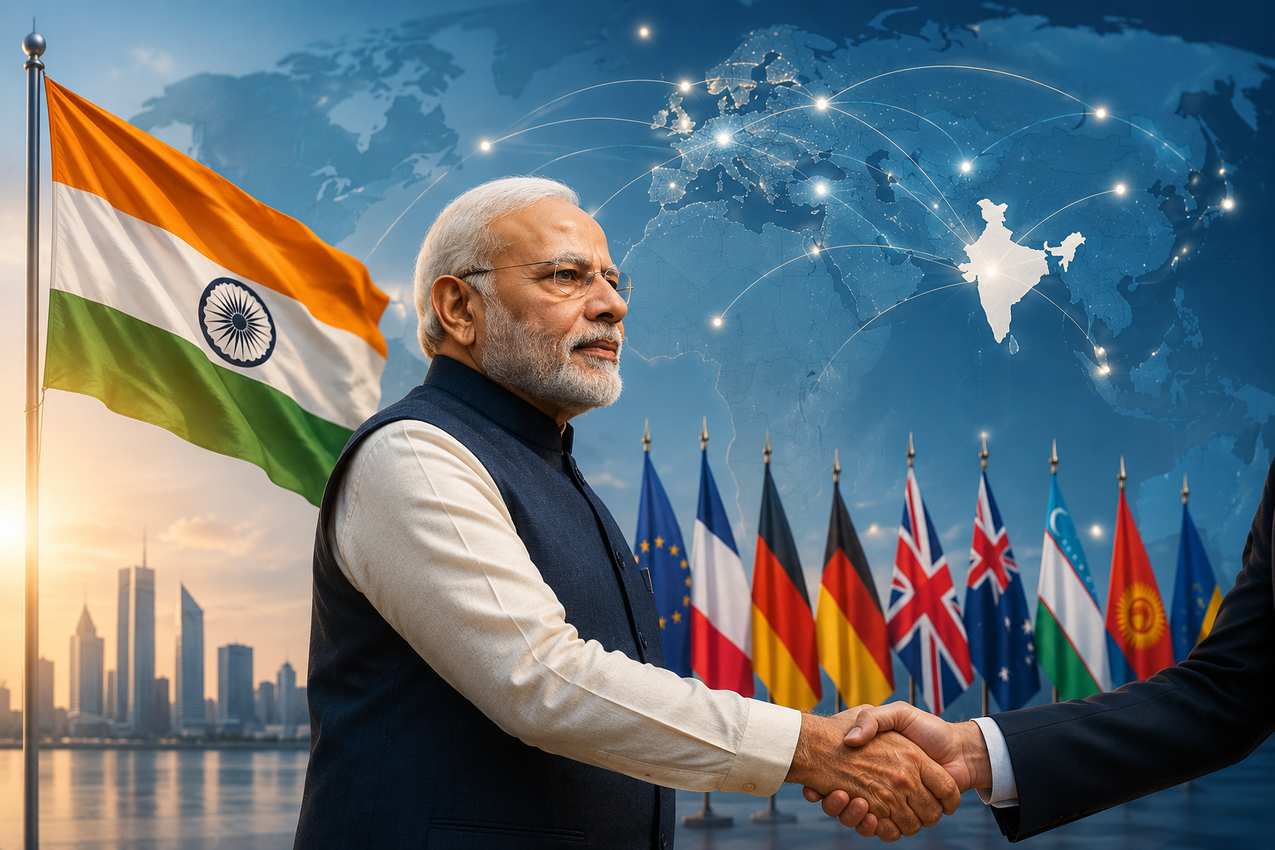
The facts the article records are not in dispute. Since August 2025 Modi has paid official visits to at least twenty countries. The list includes France, New Zealand, the Seychelles, Malaysia, Slovakia, Italy, the United Kingdom, Germany-related engagements, Indonesia, Australia, Norway, the Netherlands, Sweden and, most recently, Uzbekistan and Kyrgyzstan for the Shanghai Cooperation Organisation summit. These are not ceremonial tours. They have produced measurable outcomes.
With France the relationship has deepened into a Special Global Strategic Partnership. Agreements cover artificial intelligence, governance frameworks, the doubling of bilateral trade within five years, expanded use of India’s Unified Payments Interface, incubation of additional Indian startups, and a centre of digital sciences. Defence cooperation continues to advance, building on earlier Rafale and Scorpene arrangements. With Germany, discussions and roadmaps have advanced submarine technology cooperation and defence industrial collaboration. The United Kingdom reduced tariffs on Indian garments while India adjusted duties on alcohol, contributing to cheaper access to Scotch whisky, a product of wide consumer interest in India; the Comprehensive Economic and Trade Agreement has moved toward implementation. India concluded a major free trade agreement with the European Union, the world’s largest economic bloc, after years of negotiation. A free trade understanding with New Zealand has been advanced, alongside maritime security cooperation—the first visit by an Indian prime minister to that country in four decades. Norway reaffirmed commitments linked to job creation in India under the European Free Trade Association framework. In Central Asia, the Uzbekistan visit elevated ties to a Comprehensive Strategic Partnership, set a trade target of over five billion dollars by 2030, and produced multiple memorandums on infrastructure, digital public infrastructure, critical minerals, energy and payments connectivity, including UPI-related arrangements. These are tangible returns: technology, market access, investment signals, defence industrial pathways and people-to-people frameworks.
The Opposition in India has long criticised Modi’s foreign travel. Congress leaders and others have portrayed the trips as expensive, excessive and disconnected from domestic priorities. Priyanka Gandhi Vadra has claimed the Prime Minister spends almost half his working time abroad. Rahul Gandhi has attacked ongoing multi-nation tours during periods of domestic difficulty, warning of economic shocks that would spare the powerful while hurting ordinary citizens, and has questioned the gap between the Prime Minister’s global messaging and conditions at home. The broader charge is that foreign visits amount to photo opportunities and personal projection rather than national gain, and that resources and attention should remain focused on unemployment, prices and internal governance. Such criticism treats diplomacy as a zero-sum distraction from domestic politics.
That framing collides with the accumulating record of agreements. Free trade arrangements with the European Union and the United Kingdom, defence and technology pathways with France and Germany, maritime and trade understandings with New Zealand and Australia, job and investment commitments involving Nordic partners, and the elevation of partnerships in Central Asia do not disappear because the Opposition finds the travel schedule inconvenient. Diplomacy is measured by outcomes, not by the number of nights spent outside India. The New York Times article, whatever its larger agenda, at least registers those outcomes instead of dismissing the travel as empty.
Why would a newspaper with a consistent record of critical coverage of Modi produce a piece that appears to acknowledge his diplomatic effectiveness? The answer lies less in any conversion to admiration for the Indian Prime Minister and more in the paper’s long-standing hostility to Donald Trump. The article’s central organising idea is that Trump has unleashed global turbulence and rendered the United States less dependable. Modi’s response—spreading bets, cutting deals with middle powers and traditional partners alike—is presented as the rational adaptation to that reality. In this construction, Modi becomes useful evidence for a larger critique of Trump rather than an object of praise in his own right. The timing, with United States midterm elections approaching, reinforces the political utility of the frame. Stories that illustrate the costs of Trump’s unpredictability for allies and partners serve an editorial purpose that has little to do with reassessing Modi’s domestic record.
Indian readers should therefore avoid two opposite mistakes. One is to treat the article as a sudden change of heart by a traditionally critical Western paper and to claim validation from it. The New York Times has not altered its broader view of Modi’s governance; it has simply chosen a subject on which Modi’s actions can be described in functional terms while the primary critical energy is directed at Trump. The other mistake is to dismiss the entire report because of the paper’s past hostility or its present anti-Trump agenda. The visits happened. The agreements exist. The diversification of partnerships is observable. Even a critical newspaper has found it necessary to record that activity and its results.
The larger point is straightforward. Foreign policy is not performance art. It is the steady accumulation of access, technology, markets and strategic options. Modi’s intensive schedule over the past year has produced free trade advances with major economic blocs, defence and technology cooperation with key European partners, expanded mobility and payments linkages, and strengthened positions in the Indo-Pacific and Central Asia. The Opposition is entitled to demand domestic results and to scrutinise costs. It is on weaker ground when it pretends that the diplomatic ledger is empty. The New York Times article, for all its selective framing, inadvertently underlines that the ledger is not empty. Even critics, when they turn their attention to the external record, are finding it harder to ignore what the travel has delivered. That does not make the newspaper a convert. It does make the achievements harder to erase.
