
India, Nepal Deepen Multilingual AI Cooperation
BHASHINI SANGAM workshop in Kathmandu advances Language AI, language preservation and digital inclusion

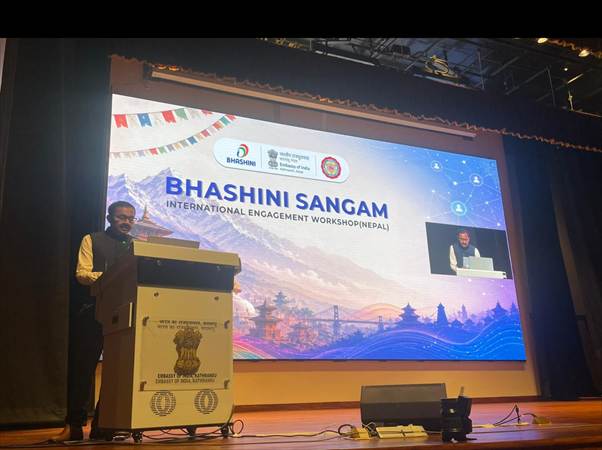
- BHASHINI SANGAM workshop brought together government, academia, technology and research stakeholders in Kathmandu.
- India and Nepal explored co-creation of language datasets and locally relevant AI applications.
- Live demonstrations showcased speech recognition, translation, voice interaction and document processing.
- BhashaDaan highlighted community participation in building representative multilingual AI.
GG News Bureau
KATHMANDU, Sept 1: The Digital India BHASHINI Division (DIBD), under Digital India Corporation (DIC), Ministry of Electronics and Information Technology (MeitY), in collaboration with the Embassy of India in Kathmandu and Kathmandu University, organised the BHASHINI SANGAM: International Engagement Workshop (Nepal) in Kathmandu.
The workshop focused on strengthening India–Nepal collaboration in multilingual and voice-first Artificial Intelligence (AI) and exploring ways to make digital services, information and opportunities more accessible in people’s preferred languages.
The engagement builds on the Memorandum of Understanding between DIBD and Kathmandu University on language technology and digital public infrastructure. Discussions focused on co-creating technology, datasets and locally relevant applications aligned with the linguistic needs of communities in both countries.
Focus on Language AI and preservation
BHASHINI SANGAM is an international engagement initiative aimed at bringing governments, academia, researchers, developers, startups, language experts and communities together to explore Language AI across linguistic and geographical boundaries.
The initiative seeks to combine technology with local knowledge while supporting the preservation of languages and cultures in the digital age.
During the Kathmandu workshop, the BHASHINI team conducted live demonstrations of its multilingual AI capabilities, including speech recognition, real-time translation, voice-enabled interaction and document processing.
A dedicated BhashaDaan session highlighted the importance of language data and community participation in developing representative AI. Participants explored contributions across speech, text and image.
Nepali, Maithili and other languages
The workshop also examined potential applications in Nepali and other languages, bringing together the BHASHINI technology ecosystem and Kathmandu University’s academic and research capabilities.
Shri Suman Shekhar, First Secretary at the Embassy of India in Kathmandu, said the MoU between DIBD and Kathmandu University provides a strong foundation for further collaboration, including development of local applications in Nepali, Maithili and other languages.
DIBD CEO Amitabh Nag said India and Nepal’s shared languages, communities and cultural connections provide an opportunity to build Language AI jointly, with communities and language users playing a central role in the process.
The workshop brought together researchers, students, language experts, developers, startups and ecosystem partners to explore collaboration in language datasets, research and real-world Language AI solutions.
BHASHINI’s multilingual ecosystem
According to DIBD, BHASHINI supports 36 Indian text languages, 23 Indian voice languages and 35 international languages. The platform powers more than 800 government websites, has enabled over 9 billion cumulative AI inferences and processes more than 24 million AI inferences daily.
The BHASHINI SANGAM workshop marks another step towards developing a shared India–Nepal Language AI ecosystem, with technology, academia, government and communities working together to strengthen digital inclusion.
