
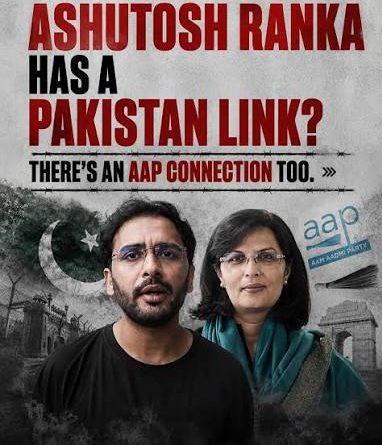
Ashutosh Ranka on Pakistan Payroll !
Salary from Pak Senator Dr.Sania Nishtar ?

Poonam Sharma
CJP leaders receiving payments from foreign individuals or organisations while participating in Indian political activities?
On October 10, party founder Abhijeet Dipke and leaders Saurav Das and Ashutosh Ranka were detained ahead of a planned protest demanding the resignation of Chief Election Commissioner Gyanesh Kumar. They were subsequently released under conditions requiring them to maintain public peace for one year. Now Again they have been detained and being sent to Tihar Jail. Abhijit Aiyer a noted Journalist has accused Ashutosh Ranka of taking Salary from Dr.Sania Nishtar during Operation Sindoor . What was the nature of Ashutosh Ranka’s alleged professional association with Dr Sania Nishtar?
The CJP , Foreign Funding Questions and the Dangerous Politics of Revolution
From allegations concerning overseas payments to references to Bangladesh-style revolution, India’s emerging protest movements face difficult questions about democratic responsibility, political transparency and national stability. The Right to Protest Is Not a Mandate to Speak for an Entire Nation.
India is a democracy of more than 1.4 billion people, with diverse political convictions, regional identities and social aspirations. No political organisation, however vocal or visible, can automatically claim to represent the entire population.
This question has acquired particular significance amid the growing controversy surrounding the Cockroach Janta Party (CJP), whose protests against Chief Election Commissioner Gyanesh Kumar have attracted national attention.
On October 10, Delhi Police detained CJP founder Abhijeet Dipke and leaders Saurav Das and Ashutosh Ranka ahead of a planned demonstration demanding the Chief Election Commissioner’s resignation. They were released the following day under conditions requiring them to maintain public peace for one
The question remains: does the visibility of a protest movement establish that it speaks for India’s youth, let alone the entire nation?
Certainly not. Democratic legitimacy cannot be measured solely by street mobilisation or social-media popularity.
Foreign Payments: What Exactly Was the Professional Relationship?
The controversy concerns allegations about Ashutosh Ranka’s professional associations. A circulated conversation further claims that information about this association appeared on Ranka’s LinkedIn profile. These assertions raise questions worth examining,
Was Ranka employed directly by Dr Nishtar, by an international organisation with which she was associated, or under some other professional arrangement? What was the nature of his responsibilities? Did any potential conflict exist between that work and his subsequent political activities ? These questions require very much for Ranka to responded.
Receiving lawful remuneration from an overseas employer when the employer is a Pakistani itself is doubtful. Equally, public political figures can strengthen confidence by clarifying relevant financial interests and professional associations.
Bangladesh, Nepal and the Language of Revolution
Another troubling dimension is the political rhetoric surrounding revolutionary change. Student activist Neha Bora’s reported remarks invoking Bangladesh as an example have drawn criticism that are readily connected and linked to as encouraging regime change. But what exactly does invoking Bangladesh mean?
Does it refer to mass mobilisation, political transformation through public pressure, or an endorsement of the violent upheaval that accompanied Bangladesh’s recent turmoil? The intention is enormously important. Bangladesh’s political unrest and Nepal’s experiences of instability offer reminders that political transitions can carry immense human and institutional costs. One must not romanticise violence as a shortcut to democratic reform.
At the same time, a reference to a foreign protest movement clearly establishes that CJP is planning violence in India. Such a conclusion is based on specific evidence of intent ,incitement all these days
Killing of Parminder singh Punjab’s Anti-Drug Struggle Deserves National Attention
The reported killing of Parminder Singh, described as a campaigner against Punjab’s drug menace, raises yet another urgent concern. The precise circumstances of his death and the unresponsive behaviour of Congress and CJP is critical . why is the organisation silent?
Nevertheless, the underlying question deserves attention. Punjab’s struggle against narcotics is not merely a regional problem. Drug trafficking threatens young lives, families, economic productivity and internal security. Why do some political controversies dominate national attention while sustained struggles against narcotics, organised crime and threats to ordinary citizens receive comparatively limited discussion?
Political movements seeking to represent India’s youth should be prepared to articulate meaningful positions on these challenges. The fight against drugs, protection of vulnerable communities and public safety are also matters of more national importance.
Institutional Respect and the Government’s Response .
The Election Commission is a constitutional institution whose independence is indispensable to Indian democracy.
Criticism of its decisions is legitimate. But allegations of wrongdoing must be supported by evidence rather than repeated until they acquire the appearance of truth. The government’s handling of demonstrations has remained proportionate, lawful and subject to judicial scrutiny.
