
HM Shah to Chair Western Zonal Council Meeting on Sep 7
28th meeting of the Western Zonal Council to be held in Panaji

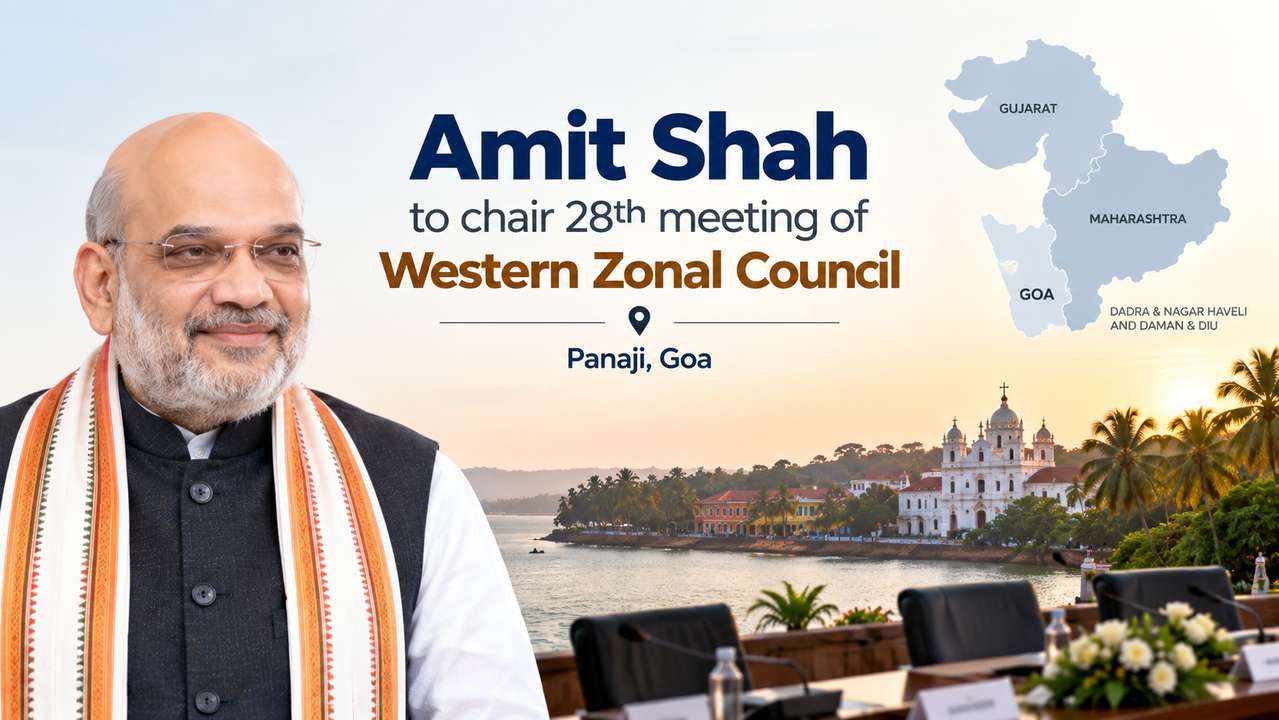
- Meeting to be chaired by Amit Shah in Panaji
- Council includes Goa, Gujarat, Maharashtra and Dadra and Nagar Haveli and Daman and Diu
- Discussions will focus on Centre-State and inter-State cooperation
- Zonal Councils have held 70 meetings since June 2014
GG News Bureau
Panaji, 5th Sept: Union Home Minister and Minister of Cooperation Amit Shah will chair the 28th meeting of the Western Zonal Council in Panaji, Goa, on September 7, 2026.
The Western Zonal Council comprises Goa, Gujarat and Maharashtra, along with the Union Territory of Dadra and Nagar Haveli and Daman and Diu. The Council has been established under Sections 15 to 22 of the States Reorganisation Act, 1956.
The meeting is being organised by the Inter-State Council Secretariat under the Ministry of Home Affairs and hosted by the Government of Goa. The Chief Ministers of the member States and two senior Ministers from each State are members of the Council, while senior officials from the Central and State Governments and the Union Territory will also participate.
A Standing Committee of the Council, comprising Chief Secretaries, examines issues raised by member States before they are placed before the Zonal Council. Matters that remain unresolved after deliberation by the Standing Committee are considered at the Council meeting.
The Zonal Councils provide a structured platform for dialogue on issues involving two or more States or the Centre and States. They also facilitate cooperation and help address inter-State and Centre-State issues and disputes.
The Centre said the Councils contribute to Prime Minister Narendra Modi’s vision of “Team Bharat” based on cooperative federalism and help harness the potential of cooperative and competitive federalism for development.
Since June 2014, a total of 70 meetings of various Zonal Councils and their Standing Committees have been held with the cooperation of State Governments, Central Ministries and Departments.
The Councils also deliberate on issues of national importance, including speedy investigation of crimes against women and children, implementation of Fast Track Special Courts, Emergency Response Support System (ERSS-112), food safety, banking facilities, nutrition, education, healthcare, power sector reforms, urban planning, cooperatives, cybercrime and digital infrastructure.
