
Western Region ‘WEST Engine’ of India’s Growth: HM Shah
Home Minister chairs 28th Western Zonal Council meeting in Goa; says region leads in wealth, exports, startups and tourism

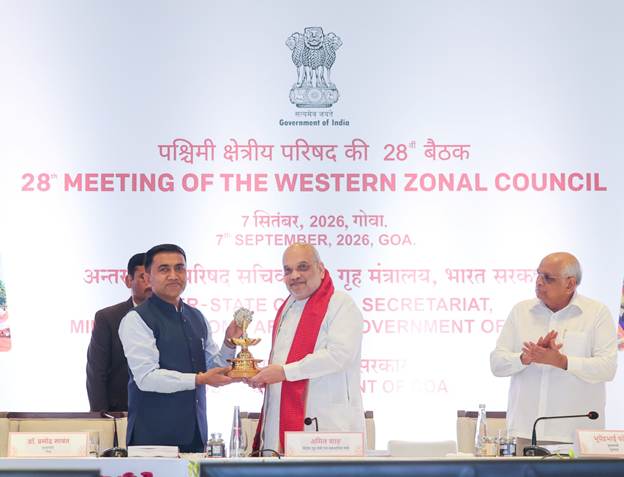
- Amit Shah chaired the 28th Western Zonal Council meeting in Panaji, Goa.
- Said the Western Region is the country’s largest economic, industrial and financial hub.
- Highlighted a nearly three-fold increase in Zonal Council meetings since 2014.
- Urged states to lead in implementing new criminal laws, cybercrime prevention and anti-drug initiatives.
GG News Bureau
Panaji, 7th Sept: Union Home Minister and Minister of Cooperation Amit Shah on Monday chaired the 28th meeting of the Western Zonal Council in Panaji, Goa, asserting that the Western Region remains the country’s largest economic, industrial and financial centre and serves as the “WEST Engine” of India’s growth.
The meeting was attended by Goa Chief Minister Pramod Sawant, Maharashtra Chief Minister Devendra Fadnavis, Gujarat Chief Minister Bhupendra Patel, Dadra and Nagar Haveli and Daman and Diu Administrator Praful K. Patel, along with senior officials from the Centre and participating states.
Addressing the gathering, Shah said the Western Region plays a critical role in India’s economic progress and has significantly contributed to the country’s 7.8 per cent GDP growth recorded in the first quarter of FY 2026-27 despite global economic uncertainties.
Explaining the acronym “WEST”, Shah said W stands for wealth and finance, E for exports and ports, S for startups and semiconductors, and T for tourism and the blue economy. He noted that the region leads the country in all these sectors.
Highlighting key achievements, Shah said Maharashtra ranks first in India with 33,872 startups, Gujarat’s Dholera has emerged as a semiconductor hub, Mundra Port handles the highest cargo volume in the country, while Mumbai continues to strengthen its position as India’s financial capital. He also noted that Goa attracts more than one crore tourists annually, including around five lakh foreign visitors, with tourism contributing 16 per cent to the state’s Gross State Domestic Product.
The Home Minister said Prime Minister Narendra Modi has strengthened the spirit of cooperative federalism over the past 12 years. He pointed out that while only 25 meetings of Zonal Councils and their Standing Committees were held between 2004 and 2014, the number has risen to 71 since 2014.
According to Shah, 1,893 issues have been discussed during these meetings, with 1,445 already resolved, demonstrating the effectiveness of the council mechanism in addressing governance and development challenges.
He said Zonal Councils have evolved from platforms for dispute resolution into instruments for monitoring the implementation of public welfare schemes. Shah noted that there are currently no major disputes among states in the Western Region, calling it a significant achievement.
The Home Minister urged the member states to take a leading role in implementing the New Nyaya Sanhitas and strengthening India’s fight against narcotics. He also highlighted progress in the computerisation of Primary Agricultural Credit Societies (PACS), with Maharashtra achieving 98 per cent coverage and Gujarat 92 per cent.
Shah stressed the need to strengthen cybercrime prevention mechanisms and called on all Urban Cooperative Banks to integrate with fraud detection and cyber security platforms. He also said the Ministry of Home Affairs would focus extensively on coastal security over the next two years.
Several key issues were discussed during the meeting, including fast-track courts for crimes against women and children, emergency response systems, food safety standards, Ayushman Bharat implementation, banking access in rural areas, railway projects, environmental clearances, malnutrition reduction, school dropout rates, cybercrime and digital infrastructure.
Shah said the Western Region, which is already leading the country in green energy and economic growth, should continue to play a major role in India’s journey towards becoming a developed nation.
