
Jitendra Singh Inaugurates Cancer Facility in Vidisha
Says cancer-care services must reach patients beyond major metropolitan centres

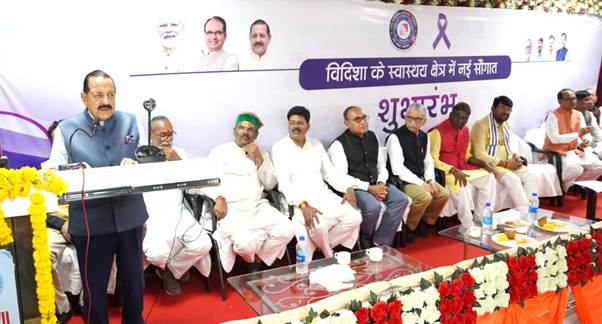
- Day-care cancer facility inaugurated at Government Medical College, Vidisha.
- TMC will support cancer treatment, diagnosis, prevention and early detection.
- India could see around 20 lakh new cancer cases annually by 2030.
- Facility will progressively expand to include radiotherapy, diagnostics and palliative care.
GG News Bureau
Vidisha, 8th Sept: Union Minister Dr. Jitendra Singh on Tuesday inaugurated a Day-Care Cancer Facility at Atal Bihari Vajpayee Government Medical College, Vidisha, Madhya Pradesh, and said the rising cancer burden requires sustained expansion of quality cancer-care services closer to patients’ homes.
The facility is being developed with technical support from Tata Memorial Centre (TMC), Department of Atomic Energy, as part of a phased programme to strengthen cancer-care services at the medical college. Union Agriculture and Farmers Welfare Minister Shivraj Singh Chouhan and Madhya Pradesh Deputy Chief Minister and Health Minister Rajendra Shukla were among those present.
Dr. Jitendra Singh said TMC is expanding cancer-care capabilities across the country, covering treatment and radiation as well as prevention, early detection, diagnosis and training of medical professionals. He also called for cooperation from citizens and society to address practices such as food adulteration that may contribute to the cancer burden.
The Vidisha programme began with a Cancer Gap Care Analysis conducted by a multidisciplinary TMC team from June 5 to 7, 2026. A cancer screening and awareness camp held during the period identified 586 cancer patients and 254 suspected cases for further treatment and referral.
The day-care facility is the first step in a phased expansion covering medical and surgical oncology, radiotherapy, pathology, community outreach, cancer registries and palliative care. Two doctors and seven nursing officers from Vidisha have already completed oncology training at ACTREC, Mumbai, while further training for surgical teams is scheduled.
The cancer-care plan also includes a radiotherapy facility with a Linear Accelerator (LINAC), advanced pathology and molecular diagnostics, and specialised training in oncopathology and immunohistochemistry. Population-Based and Hospital-Based Cancer Registries will help generate local data on cancer incidence, diagnosis stages and treatment outcomes.
Dr. Jitendra Singh said cancer care must extend beyond treatment and focus strongly on prevention and early detection. He said India could see around two million new cancer cases annually by 2030, underlining the need for wider access to comprehensive cancer services.
He said the Tata Memorial Centre’s national network, along with the National Cancer Grid, is helping strengthen cancer-care capacity through standardisation, training, research and knowledge-sharing. The broader objective is to enable medical institutions outside major metropolitan centres to progressively develop cancer-care capabilities suited to regional needs.
