
Can a Woman in India Simply Walk Home Without Fear?
From Jamui to Delhi, recent incidents raise a question larger than rape: why does safety still depend so much on where a woman is, who is around her and how quickly the system reacts?

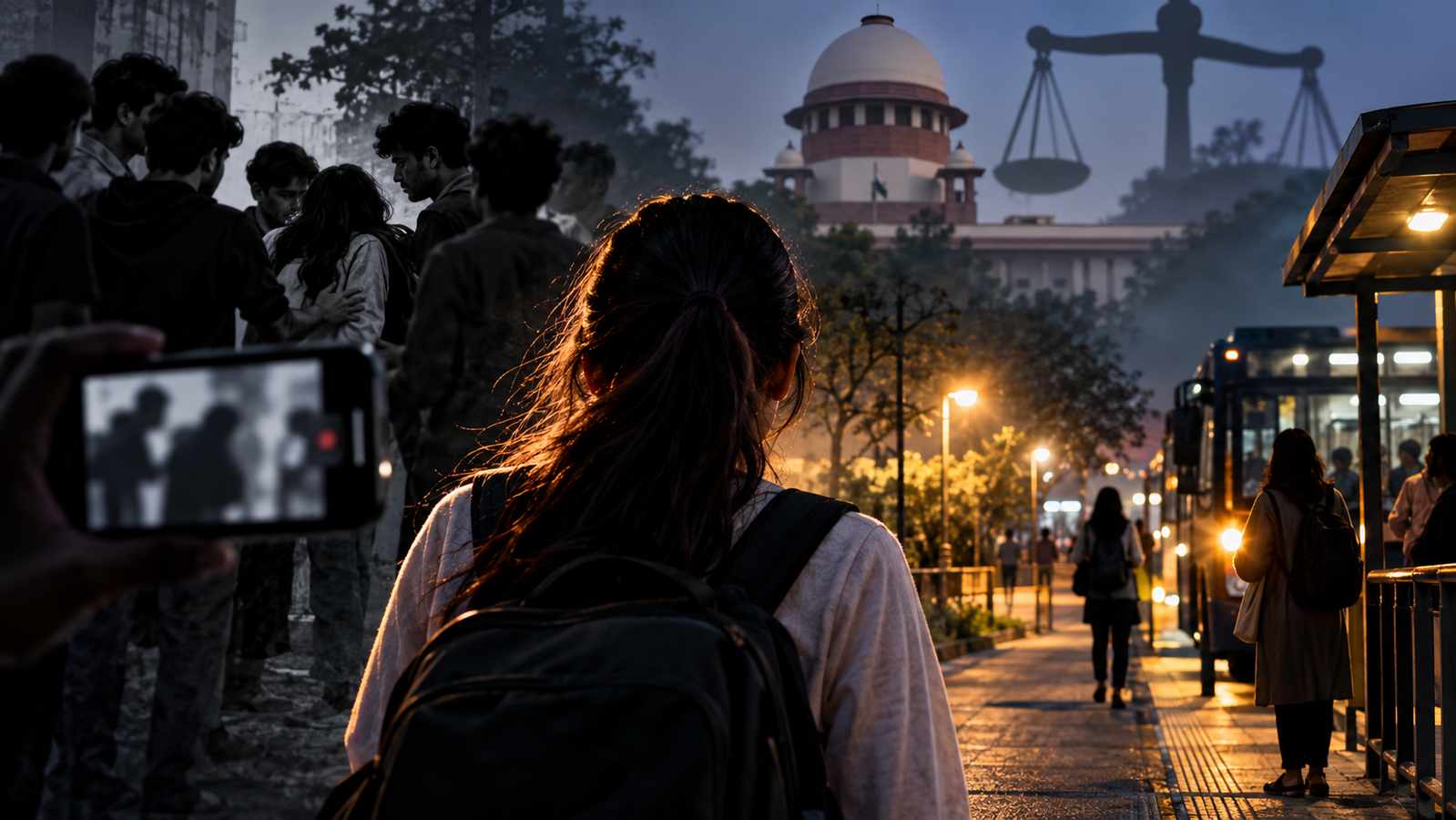
By Harshita Rai
The disturbing incident reported from Jamui in Bihar should not be reduced to another crime story that briefly dominates social media before public attention moves elsewhere. Two Class 10 students were reportedly returning from coaching when they were intercepted by a group of youths. Police said the girl was allegedly molested and the boy assaulted. Videos of the incident were recorded and circulated online, following which police registered a case and began making arrests. The National Commission for Women also sought an action-taken report from the authorities.
The allegations will have to be established through investigation and due process, but the incident raises a question that is much larger than the criminal case itself: how safe are India’s women and girls when they are simply going about their ordinary lives?
That question is becoming harder to ignore.
A girl travelling home from coaching should be an ordinary part of adolescence. A woman returning from work should not need to calculate which road is safer, whether there will be enough light, whether public transport will be crowded enough to deter harassment or whether she should remain on a phone call until she reaches home. Yet these calculations have become part of everyday life for many women.
This is why the national discussion about women’s safety must move beyond rape statistics.
Rape is among the most serious forms of violence against women, and every case deserves a strong criminal-justice response. But a woman does not suddenly become unsafe when sexual assault occurs. Fear often begins much earlier—with staring, stalking, unwanted comments, following, intimidation, threats, unwanted touching and the knowledge that a particular road, bus stop, park or neighbourhood may not be safe.
The Jamui incident shows that wider problem. If the police account is established, the teenagers were not attacked in some inaccessible location far removed from ordinary life. They were reportedly returning from coaching. The incident allegedly unfolded in a public setting and was recorded by people who were present.
That should force a serious examination of what we mean when we say a public space is “safe”.
A public space is not safe merely because it is open to everyone. It is safe when people can use it without reasonable fear of intimidation or violence and when authorities have systems capable of responding when something goes wrong.
Recent events in Delhi have raised similar concerns. A 17-year-old girl allegedly reported being gang-raped at Aastha Kunj Park near Kalkaji. The case led to arrests and student protests over women’s safety. The Supreme Court has subsequently taken suo motu cognisance of recent Delhi-NCR cases and raised concerns relating to safety in public spaces and institutional accountability.
The circumstances of the Jamui and Delhi cases are different and should not be artificially combined. The allegations in each matter require separate investigation, and guilt must be determined by courts. But both incidents raise the same broader policy question: can women and girls reasonably expect ordinary public spaces to be safe?
For years, India’s answer to women’s insecurity has often been to tell women how to protect themselves. Avoid isolated areas. Do not travel alone after dark. Share your location. Keep your phone charged. Inform your family when you reach home. Take a cab. Stay alert.
Some of these precautions are sensible. But there is a point at which precaution becomes a substitute for public safety.
A woman can take every precaution and still be attacked.
That is why the responsibility cannot rest primarily on the potential victim.
A safer city requires functioning street lights, visible policing, working CCTV systems, safe public transport, emergency response, responsive police stations and mechanisms through which complaints of harassment are taken seriously before they escalate into more serious offences.
These are not abstract administrative issues. They determine whether a woman feels able to move freely through her own city.
India has already invested heavily in creating an institutional architecture for women’s safety. The Nirbhaya Fund, established after the 2012 Delhi gang-rape, has been used to finance a range of projects, including emergency response systems, women help desks, One Stop Centres, Safe City initiatives, anti-human trafficking units, forensic facilities and fast-track courts. The government said in 2025 that ₹7,712.85 crore had been allocated under the fund since its creation, with ₹5,846.08 crore utilised.
Those figures demonstrate that the issue is no longer simply about whether resources exist.
The harder question is whether those resources are producing safety where people actually experience it.
A CCTV camera installed at a junction is useful only if it works, is monitored and leads to a response when necessary. A helpline is meaningful only if a person can reach it and receive assistance. A women help desk matters only if a complainant feels safe approaching it. A safety audit matters only if authorities act on what the audit identifies.
The difference between policy and reality is where the credibility of the entire safety system is tested.
The same distinction applies to the criminal-justice system.
India has established Fast Track Special Courts to deal with rape and POCSO cases more quickly. As of April 30, 2026, the government said 775 such courts, including 398 exclusive POCSO courts, were functioning across 29 States and Union Territories. At the end of 2025, however, 2,45,579 cases were pending before these courts, compared with 2,02,175 at the end of 2023. The figures include rape and POCSO matters and therefore should not be interpreted as the number of rape cases alone.
These figures do not mean that the fast-track system has failed. They do show the scale of the workload facing the justice system and the need to examine why the backlog remains so substantial.
For survivors and their families, a pending case is not simply a number in an annual report. It can mean years of uncertainty, repeated hearings and the continued psychological burden of a traumatic experience.
That is why justice must be understood in two stages. The first is preventing violence wherever possible. The second is ensuring a fair, timely and sensitive response when prevention fails.
India’s safety debate has often concentrated heavily on the second stage.
The first deserves much more attention.
Prevention requires knowing where risks exist. It means identifying poorly lit areas, examining patterns of harassment complaints, understanding vulnerable transport routes and ensuring adequate police deployment. It means looking at the journey a girl makes from school to home, not simply what happens if she becomes a victim.
The same principle should apply to children.
The Jamui victims were school students. That makes the incident especially troubling because children depend heavily on adults and institutions to create safe environments. Schools, coaching centres, families, police and local administrations all have a role in ensuring that children can travel between home and educational institutions safely.
The POCSO Act provides a specialised legal framework for sexual offences against children, but legislation cannot physically accompany a child on the road. Protection depends on whether adults recognise danger, whether children feel able to speak about it and whether authorities respond when concerns emerge.
There is also a cultural problem that cannot be solved through policing alone.
The Jamui incident reportedly involved people recording the alleged harassment on mobile phones. That raises an uncomfortable question about bystander behaviour. What makes people stand around and record a vulnerable person instead of intervening or seeking help?
The answer will not be found entirely in criminal law.
India needs a broader conversation about consent, boundaries, dignity and responsible behaviour. Boys and young men need to be taught that harassment is not a joke, intimidation is not masculinity and another person’s discomfort is not entertainment.
That education has to begin before a police complaint becomes necessary.
Technology has added another dimension to this problem. When incidents are recorded and circulated, victims can suffer a second violation of privacy and dignity. A video can travel far beyond the original location and remain online long after the criminal investigation has moved forward. Law enforcement therefore has to deal not only with the physical incident but also with the digital consequences.
There is an important distinction here between documenting evidence for law enforcement and circulating material that exposes or humiliates a victim. The latter can compound the harm.
The wider concern is that repeated incidents can gradually become normalised.
A woman changes her route because a road is unsafe. A student stops attending evening classes. Parents insist on accompanying their daughter. A woman remains on a phone call throughout her journey. People begin treating these behaviours as ordinary precautions rather than evidence of a safety deficit.
That is dangerous.
A society should not measure its success by how effectively women have learned to navigate unsafe environments. It should measure success by whether those environments have become safer.
This is where accountability becomes important.
After a crime, authorities often announce arrests and investigations. Those actions are necessary, but they should not be the end of the conversation. Authorities should also examine whether there were identifiable vulnerabilities before the incident and whether anything has been done to address them afterwards.
If a park is unsafe, what changed after the incident? If a road lacks adequate lighting, when was that corrected? If public transport has security gaps, what was done? If police response was inadequate, what changed within the system?
Citizens should not have to wait for another victim to discover whether those questions were answered.
The recent Supreme Court intervention in Delhi-NCR cases is significant precisely because it shifts some attention from individual criminal acts towards the broader responsibility of institutions to provide public safety. That should be used as an opportunity for evidence-based reforms rather than another temporary national controversy.
There is no single solution to women’s safety. More police may help in one situation. Better lighting may matter in another. Faster trials may improve confidence in the justice system. Better public transport security may reduce risk. Education and social change may address behaviour that policing alone cannot.
What matters is whether these interventions are connected and whether their results are measured.
The most important change, however, may be in the way society frames the problem.
The question should not always be, “Why was she there?”
It should be, “Why was the environment unsafe?”
The question should not be only, “Why did she travel alone?”
It should also be, “Why should travelling alone be dangerous?”
And when a child is harassed while returning from coaching, the response cannot simply be to tell the next child to stay home.
Children have a right to education, mobility and independence. Women have a right to work, travel and use public spaces. Those rights cannot be meaningful if exercising them requires constant calculations about personal safety.
This is ultimately what the Jamui incident should force us to confront.
The issue is not only rape. It is not only sexual harassment. It is not only policing. It is not only the justice system.
It is the basic question of whether women and girls can participate in ordinary public life without having to organise their lives around fear.
India has laws, courts, funds, schemes and institutions. The country has spent years building mechanisms intended to make women safer. The next question should therefore be much more demanding than whether another mechanism can be announced.
Are the mechanisms already in place actually making women safer?
The answer should be found not in another government statement or another day of outrage on social media, but on the road where a girl walks home from coaching, at the bus stop where a woman waits after work, in the park where a student meets her friends and in the police station where a survivor seeks help.
That is where India’s women’s safety record will ultimately be measured.
And until a woman can step outside without first calculating how she will protect herself, the country cannot honestly say that the problem of women’s safety has been solved.
