
India, Switzerland Deepen Research Partnership
New framework to strengthen research networks, mobility and academia-industry links after two decades of cooperation

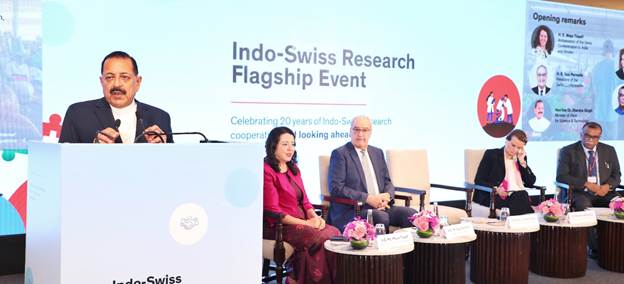
- India and Switzerland launch new research cooperation framework
- Focus on mobility, research networks and knowledge exchange
- Explore and AIT programmes to expand innovation opportunities
- New agreements target research, technology transfer and entrepreneurship
GG News Bureau
New Delhi, 7th Oct: India and Switzerland are set to deepen their scientific and innovation partnership with the launch of a new Indo-Swiss Research Framework (ISRF), aimed at expanding joint research, researcher mobility, knowledge exchange and academia-industry collaboration.
Union Minister of State for Science & Technology Dr. Jitendra Singh said the framework would give fresh impetus to more than two decades of India-Switzerland cooperation and provide a structured platform for taking the partnership into emerging areas of science, technology and innovation.
Addressing the Indo-Swiss Research Flagship Event 2026 in New Delhi, Singh said the occasion marked both a celebration of the partnership’s achievements and an opportunity to chart a more ambitious course for the future.
The event was attended by Swiss Confederation President Guy Parmelin, Switzerland’s Ambassador to India and Bhutan Maya Tissafi, State Secretary for Education, Research and Innovation Dr Martina Hirayama, Secretary of the Department of Science and Technology Prof Umesh V. Waghmare, along with representatives of research institutions, universities and funding agencies.
Two decades of scientific cooperation
India and Switzerland formally established their Science and Technology partnership through an Inter-Governmental Agreement in 2003, followed by the launch of the Indo-Swiss Joint Research Programme in 2005.
The partnership has since supported collaboration between faculty members and young researchers in areas of strategic importance. The Indo-Swiss Joint Committee on Science & Technology has also played a role in reviewing ongoing cooperation and identifying new areas, with seven rounds held so far, the latest in Bern in September 2025.
The partnership now involves institutions including the Department of Science and Technology, Department of Biotechnology, Ministry of Earth Sciences, ICMR and ICSSR, alongside Swiss institutions such as the Swiss National Science Foundation.
Research cooperation currently covers areas including mountain and glacier studies, geoscientific hazards, systems medicine, One Health and social sciences.
New avenues for research and innovation
Singh said the new framework represents a more strategic and structured phase of bilateral cooperation.
It will focus on strengthening research networks, mobility, knowledge exchange and sustained collaboration, while opening opportunities in areas aligned with national priorities and global scientific challenges.
The Minister also welcomed the upcoming ‘Explore’ programme, designed to build new research networks and encourage larger research consortia. The co-funded SNSF-DST initiative is scheduled to open in November 2026 and will support travel, networking and small equipment for a period of 9–12 months.
Another initiative, the Academia-Industry Training (AIT) programme, is aimed at creating opportunities for science-based innovators and strengthening links between research and industry.
New agreements strengthen partnership
The event also marked new institutional arrangements between India and Switzerland.
A Letter of Intent between the Department of Science and Technology and the Swiss National Science Foundation will support exploratory scientific collaboration, future joint research and long-term cooperation in mutually agreed priority areas.
An Implementation Arrangement between DST and Zurich University of Applied Sciences (ZHAW) will advance cooperation in innovation, technology transfer and entrepreneurship through the Indo-Swiss Academia-Industry Training programme.
Singh said the new mechanisms would complement the existing research and innovation ecosystems of both countries and create new opportunities for researchers and innovators.
Focus on climate, health and emerging technologies
The partnership is already supporting cooperation in several specialised areas.
The Ministry of Earth Sciences and SNSF have collaborated on mountain and glacier research and geoscientific hazards, including projects on glacier evolution, ice-nucleating particles, water vapour isotopes and debris-glacier interactions.
Cooperation in One Health is also expanding through SNSF, DBT and ICMR, while ICSSR and SNSF are working on subjects including digital governance, AI ethics, social impacts of artificial intelligence, inequality, justice and inclusion, mobility, social integration and economic transformation.
President Guy Parmelin said India and Switzerland share a strong commitment to excellence and a belief in the ability of science and innovation to address societal challenges.
He welcomed the new framework, noting the potential created by India’s expanding research ecosystem and Switzerland’s research excellence, funding mechanisms and innovation networks.
Swiss Ambassador Maya Tissafi also highlighted the complementary strengths of the two countries, with Switzerland bringing its research and innovation ecosystem and India contributing scientific talent, scale and a rapidly expanding technology base.
The Flagship Event brought together researchers, policymakers and other stakeholders to exchange knowledge, strengthen cross-project collaboration and explore ways of translating research into practical outcomes.
