
India, Switzerland Expand Strategic Science and Technology Ties
Jitendra Singh and Swiss President Guy Parmelin discuss long-term cooperation in AI, quantum technology, biotechnology and space

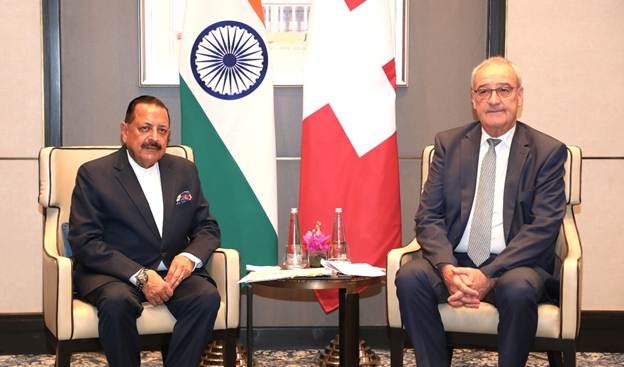
- India and Switzerland deepen long-term science cooperation
- Switzerland earmarks CHF 45 million for research partnership
- AI, quantum, biotech, space and deep-ocean research in focus
- New framework to strengthen mobility and institutional collaboration
GG News Bureau
New Delhi, 7th Oct: India and Switzerland are set to deepen their long-standing Science, Technology and Innovation partnership, with Union Minister Dr. Jitendra Singh holding a bilateral meeting with Swiss Confederation President Guy Parmelin in New Delhi on Tuesday.
The discussions focused on moving bilateral cooperation towards a more structured and long-term framework, with greater institutional engagement and collaboration in emerging areas of science, research and innovation.
Singh highlighted India’s growing mission-mode and interdisciplinary approach to science and technology, saying national programmes are increasingly bringing together expertise from different disciplines and ministries.
He said Artificial Intelligence is being approached as an enabling technology with applications across multiple areas rather than as a standalone discipline.
Focus on emerging technologies
Singh outlined India’s expanding priorities in biotechnology, vaccine development, genome sequencing, quantum technology, space and deep-ocean research, along with emerging opportunities in the blue economy and bio-economy.
He welcomed progress towards the Indo-Swiss Research Framework (ISRF) and the Indo-Swiss Joint Scientific Board, saying the initiatives would provide a stronger foundation for strategic and sustained cooperation.
He also welcomed the Letter of Intent between the Swiss National Science Foundation (SNSF) and the Department of Science & Technology (DST) and the Implementation Agreement between Zurich University of Applied Sciences (ZHAW) and DST.
Singh stressed the need for a regular working arrangement between the two countries to maintain sustained engagement and ensure effective follow-up on areas of mutual interest.
Switzerland earmarks CHF 45 million
President Guy Parmelin described India as a rapidly emerging global research and development power and said Switzerland seeks to position itself as a long-term partner for India in education, research and innovation.
Recalling the bilateral Science and Technology Agreement signed in 2003, Parmelin said cooperation has expanded steadily and that Switzerland is committed to building a more structured and long-term framework.
Switzerland has earmarked a further CHF 45 million for the partnership, Parmelin said, while expressing the expectation of a corresponding commitment from India to further strengthen the joint research framework.
He expressed confidence that the two countries could achieve greater results by building on their established scientific partnership.
AI and global cooperation
The two sides also discussed Artificial Intelligence and its wider applications.
Parmelin stressed the importance of ensuring that AI delivers benefits across the Global South and invited Indian participation in the forthcoming Geneva AI Summit, opening another avenue for cooperation in emerging technologies.
India and Switzerland have built more than two decades of scientific cooperation since signing their inter-governmental agreement in 2003. The partnership has expanded through the Indo-Swiss Joint Research Programme into areas including quantum technology, AI, clean technology, renewable energy, ocean research, blue economy, advanced materials, pharmaceuticals, biomedical research, pandemic preparedness and space technologies.
The new Indo-Swiss Research Framework seeks to take the partnership beyond individual projects towards a more strategic, system-level model with greater researcher mobility, knowledge exchange and long-term cooperation.
The meeting was attended by senior officials and representatives from Switzerland’s education and research institutions, including Dr Martina Hirayama, Maya Tissafi, Prof Torsten Schwede, Thomas Gfeller, Prof Regula Jöhl and Joël François Mesot.
From the Indian side, Singh was accompanied by Prof Umesh V. Waghmare, Dr Rajesh Sudhir Gokhale, Dr Praveenkumar Somasundaram and Dr Ramkrishna Sahoo.
