

By Anjali Sharma
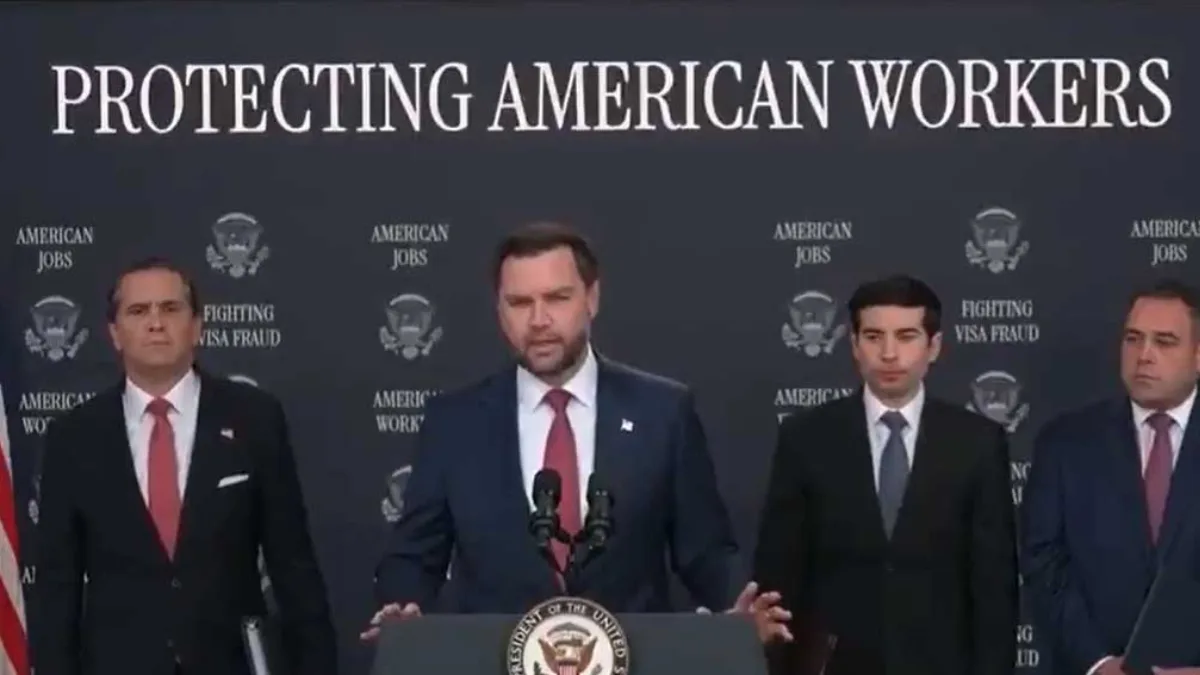
WASHINGTON – US Vice President JD Vance on Friday has sharpened his defence of the Trump administration’s immigration crackdown on major technology companies, accused critics of fighting to preserve a “never-ending flow of cheap labour” after Democratic lawmaker Pramila Jayapal warned that the measures would undermine legal immigration and American innovation.
Nasscom said Indian IT companies have reduced their reliance on H-1B visas and expanded local hiring in the US as Microsoft disputes allegations that foreign workers are being used to suppress American wages.
The exchange has opened a new political front around Washington’s decision to temporarily suspend Microsoft, Adobe and six major IT services companies from the Permanent Labor Certification, or PERM, process a crucial step used by employers seeking permanent residency for foreign workers.
Vance wrote: “‘Socialism’ apparently means fighting like hell to ensure mega-corporations have a never-ending flow of cheap labour,” responded to Jayapal’s criticism.
Jayapal, a Democratic US Representative from Washington and ranking member of the House Judiciary Subcommittee on Immigration Integrity, Security, and Enforcement had accused the administration of attacking legal routes for immigrants to work and remain in the United States.
She also pointed to her own experience as a former H-1B visa holder and her representation of a district that includes thousands of Microsoft employees.
“You don’t fix a broken immigration system by taking a hammer to legal immigration,” Jayapal said.
She argued that the PERM process includes safeguards intended to ensure employment-based immigration benefits the US economy without harming American workers.
“Targeting Microsoft or the PERM program in this way simply undermines legal immigration and weakens America’s ability to innovate,” she said.
The confrontation follows the US Department of Labor’s decision to suspend eight companies from the PERM process amid federal investigations.
The companies include Microsoft, Adobe, Cognizant, Infosys, Tata Consultancy Services, Wipro, HCLTech and Capgemini.
US Secretary of Labor Keith Sonderling said the department would neither accept new permanent labour certification applications involving the companies nor process pending applications while the action remained in force.
Trump administration has framed the crackdown as an effort to combat alleged abuse of employment-based immigration programmes and protect jobs and wages for American workers.
Vance singled out Microsoft while defending the policy, alleged that the technology company had laid off about 6,000 American workers while benefiting from thousands of H-1B visas and permanent labour certifications.
He also accused some companies of using foreign workers to undercut American wages, describing the system in stark terms.
“You bring in indentured servants from outside the country, you lay off American workers,” Vance said while outlining the administration’s case against alleged abuse of the H-1B system.
Microsoft has pushed back against the administration’s portrayal of its hiring practices.
The company said the “vast majority” of its US employees were Americans and that about 80% of the roughly 6,000 H-1B applications it filed in the previous fiscal year involved extensions or status changes for existing employees rather than new hires.
The remaining filings for new employees involved people already legally present in the United States, Microsoft said, adding that they represented about one per cent of its US workforce.
“They are not new arrivals to our country,” the company said.
Microsoft also disputed suggestions that H-1B workers were being used to suppress wages.
“We pay our H-1B employees the same as any other employees doing comparable work,” it said.
The company said it would provide the administration with additional information about its employment and immigration practices.
The National Association of Software and Service Companies sought to separate the debate over immigration from the movement of skilled workers.
“Immigration and skilled talent mobility are two distinct issues and should not be viewed through the same lens,” the industry body said.
NASSCOM said Indian technology companies had reduced their dependence on H-1B visas over the years while expanding local recruitment and building larger domestic workforces in the United States.
It also said few employees of Indian technology companies move from H-1B status to permanent residency through the PERM route.
Indian IT companies operate in more than 80 countries and have demonstrated a commitment to complying with local laws, Nasscom said.
The immigration battle produced a striking contrast in Washington on Thursday.
Microsoft faced suspension from the PERM process, US President Donald Trump presented its chairman and chief executive officer Satya Nadella with the National Medal of Technology and Innovation.
Trump praised Nadella for his role in Microsoft’s transformation and its rise in cloud computing, while the award citation credited him with helping build hyper scale infrastructure used for advanced artificial intelligence.
The honor came on the same day that senior members of Trump’s administration publicly targeted Microsoft over its use of foreign-worker programmes.
The PERM action is part of a broader tightening of US immigration and foreign-worker policies.
The Department of Homeland Security has separately proposed fees of $70,000 for an initial Optional Practical Training recommendation for an F-1 student and $30,000 for subsequent participation, including extensions.
Under the proposal, the fees would be imposed on participating educational institutions.
The administration said the changes are intended to combat fraud and protect American workers, while its critics argued that increasingly restrictive legal immigration policies could make it harder for the United States to attract global talent.
