
‘Mann Ki Baat’ a Pilgrimage to Celebrate People’s Contributions: PM Modi
Prime Minister celebrates 12 years of Mann Ki Baat, spotlighting local artisans, river restoration, millet farming, scientific research and India’s entrepreneurial spirit.

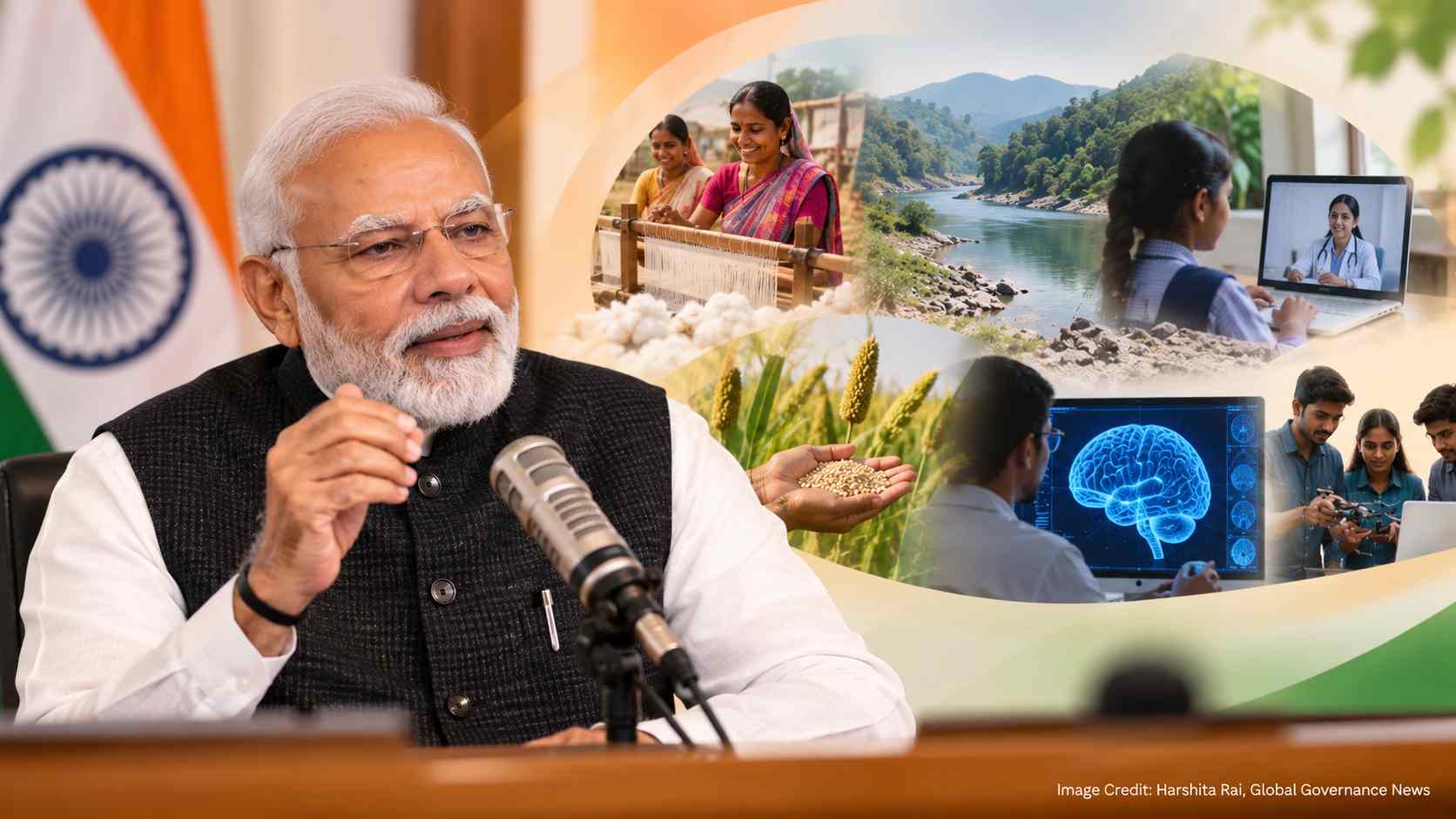
- Mann Ki Baat completes twelve years
- Organic cotton initiative empowers Punjab’s women
- e-Sanjeevani crosses 50 crore consultations
- Millet farming creates new rural opportunities
GG News Bureau
New Delhi, 25th Oct: Prime Minister Narendra Modi marked the 139th episode of Mann Ki Baat on Sunday, reflecting on the programme’s 12-year journey and highlighting inspiring initiatives in agriculture, environmental conservation, healthcare, scientific research and rural entrepreneurship.
Recalling the programme’s launch on Vijayadashami 12 years ago, Modi described Mann Ki Baat as a platform to celebrate the dedication, courage and service of ordinary citizens whose contributions often remain unnoticed. He said the programme had enabled him to connect with families across the country and recognise the collective strength of the people.
Organic Cotton and Women’s Empowerment
The Prime Minister highlighted the ‘Nav-Trinjan’ initiative of Punjab’s Kheti Virasat Mission, which promotes natural and organic cotton cultivation in the Malwa region. The initiative combines traditional agricultural practices with natural-coloured cotton to reduce the need for chemical dyes.
He also spoke about a weaving school established under the initiative that has helped women acquire skills and build livelihoods. Women who previously worked as agricultural labourers or domestic workers are now producing handloom textiles, including shawls and towels, using indigenous organic cotton.
Community Efforts Revive Heval River
Modi praised community-led conservation efforts in Uttarakhand’s Tehri Garhwal region, where villagers and the local administration joined hands to restore the Heval river. Rainwater harvesting, groundwater recharge and tree plantation helped revive the river and support the restoration of several natural water sources.
Ahead of Diwali and Chhath, he also urged citizens to maintain cleanliness in their surroundings, stressing that small individual efforts can bring positive changes to communities.
Vocal for Local and Indigenous Products
Emphasising the growing popularity of Swadeshi products, the Prime Minister cited examples of Bihar’s makhana reaching Greece and arhar dal from Karnataka’s Kalaburagi being exported to the Maldives.
He highlighted Maharashtra’s ‘Shabari Naturals’ initiative, which markets products such as honey, mahua, chironji and bamboo-based items in packaging inspired by tribal art. The packaging received Japan’s Good Design Award. He also referred to a Karnataka-based start-up developing packaging materials from bamboo and agricultural residue.
Modi said Khadi Gram Udyog product sales crossed ₹28 crore on Gandhi Jayanti, an increase of ₹1.5 crore from the previous year. He encouraged people to prioritise locally made products during the festive season to support artisans and advance the vision of Atmanirbhar Bharat.
e-Sanjeevani Expands Healthcare Access
The Prime Minister said e-Sanjeevani had facilitated approximately 50 crore teleconsultations, helping patients access medical expertise even in remote parts of the country.
He shared examples of patients from the Andaman and Nicobar Islands, Lakshadweep, Ladakh and Nagaland who received medical assistance through the platform. He also highlighted the role of nearly 1.9 lakh Ayushman Arogya Mandirs in improving access to healthcare and encouraging regular health check-ups in rural areas.
IIT Madras Brain Centre and Deep-Tech Innovation
During his recent visit to Chennai, Modi inaugurated the Sudha Gopalakrishnan Brain Centre at IIT Madras. The centre is developing high-resolution digital 3D images of human brains, with an initial goal of mapping 100 brains using the Param Shakti supercomputer. The resulting data is intended to be made available as an open-source resource for research.
He also highlighted emerging start-ups working on gold-quality verification, recovery of money lost to bank fraud, AI-assisted cervical cancer screening, flying electric vehicles, fast-charging batteries and AI applications in defence technology.
The Prime Minister urged young people to draw inspiration from Indian scientist Narinder Singh Kapany, widely known as the Father of Fibre Optics, whose work helped shape modern communications.
Millet Farming and India’s Cultural Heritage
Modi cited examples from Meghalaya and Nagaland where farmers and local entrepreneurs are reviving millet cultivation. In Meghalaya, women entrepreneurs have developed millet-based cookies, cakes, muffins and baby food, creating new demand for the traditional crop. In Nagaland’s Kezoma village, millet cultivation resumed in 2024, followed by the village’s first millet festival in 2025.
He said such initiatives demonstrate how traditional crops can create new economic opportunities while preserving local food cultures.
The Prime Minister also paid tribute to Maharishi Valmiki ahead of his birth anniversary on October 26, highlighting the values of compassion, service and social harmony in the Ramayan. He recalled freedom fighter Bhai Parmanand ahead of his 150th birth anniversary on November 4, urging young people to learn about his contribution to the independence movement and education.
Concluding the episode, Modi extended festive greetings for Diwali, Chhath and other celebrations, urging citizens to celebrate safely, remain healthy and share their happiness with others.
